Showing posts with label European Union. Show all posts

Wednesday, September 23, 2015

TTIP : The Fleecing of a Nation. US Citizens sold out yet again by their government.

Published on
Tuesday, September 22, 2015
by


Warning: TTIP Aims To Defang Local Rules Against Hazardous Chemicals

New report finds that the Trans-Atlantic Trade and Investment Partnership poses a threat to state regulations against hazardous pesticides, products, and fracking chemicals


by
Sarah Lazare, staff writer

Fracking wells in McKenzie County, North Dakota. (Photo: Tim Evanson/flickr/cc)

The mammoth Trans-Atlantic Trade and Investment Partnership (TTIP) under secret negotiation between the United States and European Union is poised to slash the power of local governments to regulate toxins—from pesticides to fracking chemicals—the Center for International Environmental Law (CIEL) warned in a report released Tuesday.

Preempting the Public Interest: How TTIP Will Limit US States’ Public Health and Environmental Protections (pdf) is based on an analysis of the European Commission's proposed chapter on regulatory cooperation from the April 20 round of negotiations. The report follows other analyses of the text which conclude that the TTIP poses a threat to human rights, environmental protections, and democracy on both sides of the Atlantic.

Beyond the regulatory cooperation chapter, little else is known about the content of the closed-door negotiations over what is set to be the largest bilateral "trade" deal in history.
The chapter's contents, warns CIEL, highlight the direct threat the TTIP poses to public health and environmental protections on the U.S. state level. This is especially troublesome, the report argues, because federal regulations under the Toxic Substance Control Act have proven "egregiously ineffective"—and could be even further eroded, thanks to the influence of the chemical industry in Congress.

"The bottom line is if you're trying to make the U.S. compatible with an international standard, and you have minimal federal regulations on the U.S. side, and you have states that go beyond that, the provisions will be used to attack state chemical and pesticide regulations."
—Sharon Treat, report co-author

In contrast, some state governments have taken the lead in responding to the dangers posed by fracking chemicals, pesticides, and hazardous products by adopting "more than 250 laws and regulations protecting humans and the environment from exposure to toxic chemicals," the report says.+

However, so-called "harmonization provisions" in the EU's proposal could force states to conform to the lowest common denominator—in this case weaker federal guidelines. As Sharon Treat, attorney, co-author of the report and former Maine state legislator, explained to Common Dreams, "The bottom line is if you're trying to make the U.S. compatible with an international standard, and you have minimal federal regulations on the U.S. side, and you have states that go beyond that, the provisions will be used to attack state chemical and pesticide regulations."

What's more, the report asserts, the proposed chapter calls for an imposition of "multiple procedural mandates—from an early warning system to regulatory exchanges to the trade and cost-benefit impact assessments—that will lead to a regulatory chill caused by delay, increased costs for government, fear of legal challenges, and heightened industry influence and conflicts of interest."
Beyond their demobilizing effect, such requirements could also expand the power of private interests in corporate tribunals, known as the investor-state dispute settlement (ISDS) systems.

"If you are requiring state and federal governments to do more studies to review whether a regulation could be done in a way that is less of an imposition on trade or big business, then you could bolster the case of the ISDS systems to block regulations," explained Treat. "That would be tipping the scales even further in favor of international corporations running roughshod over regulations and procedures to protect public health and the environment.

Given the continued secrecy of the talks, it is not known how the U.S. responded to the proposed chapter, but the researchers at CIEL say the EU's language alone is cause for alarm. CIEL warns that the "largest chemical and manufacturing corporations on both sides of the Atlantic" are playing a role in pressing the TTIP's regulatory agenda—and that the U.S. is likely pressing for a similar race to the bottom for EU member states.

Meanwhile, the Obama administration is negotiating the TTIP alongside two other secret trade deals: the Trans-Pacific Partnership and the Trade in Services Agreement. All three have come under stiff opposition from social movements and civil societies across the globe concerned that they will bolster corporate power at the expense of people and the planet. Some observers argue that these deals could collapse, in part due to their unpopularity and internal contradictions.

..................................................................................................................
This work is licensed under a Creative Commons Attribution-Share Alike 3.0 License

Monday, April 21, 2014

Ankara says Russia's South Stream Pipeline Could Run to Turkey

  Daily International News


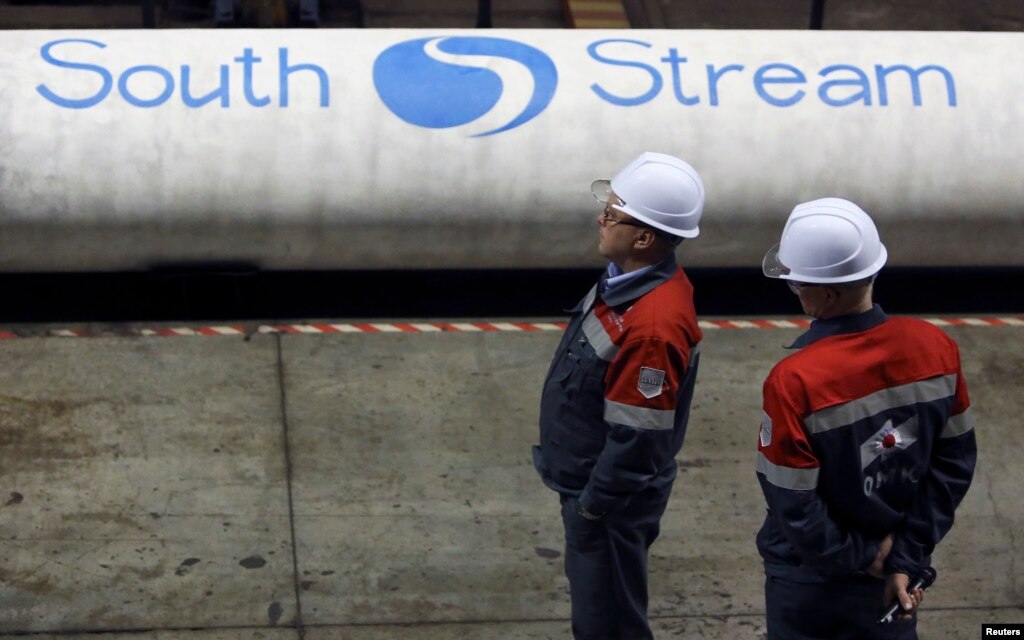
Employees stand near pipes made for the South Stream pipeline at the OMK metal works in Vyksa in the Nizhny Novgorod region, April 15, 2014.


Reuters
— Russia's controversial South Stream pipeline, which would transport gas via the Black Sea into Europe towards the end of the decade, received support from Turkey on Wednesday when Ankara said it may let the conduit pass through its territory.
Turkey would consider granting access for the line if Moscow made such a request, Energy Minister Taner Yildiz said.
The subject is one of a series of issues including increased gas supply, gas price revisions and nuclear power that Turkey and Russia are set to discuss during talks in Ankara next week, according to Turkish officials.
The future of the 2,400-km (1,490-mile) line from Russia via the Black Sea to Bulgaria and from there further into the European Union, avoiding Ukraine, has been cast into doubt because of Russia's annexation of Crimea from Ukraine.
The Ukraine crisis has intensified EU efforts to reduce energy dependence on Russia, while Moscow has long sought to curb its reliance on Ukraine as the main pipeline route for sending Russian gas to Europe, its biggest market.
The European commissioner for energy, Guenther Oettinger, said in March that discussions with Russia over South Stream's regulatory approval in the European Union were on hold.
The EU delay could offer an opportunity to Turkey, where gas demand is rising fast.
“We are open to assessing any request for the line to pass through Turkey's territory,” Yildiz told reporters when asked about South Stream.
“It is said that there could be such a demand. If there is a request, we will consider it,” said Yildiz, due to hold talks with Alexander Medvedev, deputy head of Russian state-controlled Gazprom, in Ankara on Monday.
South Stream would carry around 60 billion cubic meters (bcm) of gas a year to Europe towards the end of the decade, enough to meet more than 10 percent of its annual demand.
Officials said Russia's annexation of Crimea created a risk for Turkey, noting 12.5 percent of its gas supplies passed through Ukraine, and that steps to prevent a supply problem could be on the agenda next week.
In a letter to European leaders last week, President Vladimir Putin warned Russia would cut natural gas supplies to Ukraine if it did not pay its bills and said this could lead to a reduction of onward deliveries to Europe.
To eliminate such transit risk for Turkey, Ankara proposes to have South Stream enter land in the Thrace region of northwest Turkey rather than Bulgaria, to avoid routing it directly from Russia into an EU country.
“That way Russia will be able to feed directly with the line the Marmara region of Turkey, which has the highest level of consumption,” said an analyst, who declined to be identified.
The construction of a second Blue Stream pipeline, complementing an existing one that runs under the Black Sea from Russia to central Turkey, could also come onto the agenda soon, sources close to the matter said.

Enhanced by Zemanta

Saturday, April 19, 2014

In Ukraine, Pro-Russia Radicals Reject Call To Leave Occupied Buildings. They claim they will comply only if the pro-Western government in Kyiv resigns.


Play Video|0:25

Pro-Russia Militant Rejects Ukraine Pact


The leader of a group of pro-Russia separatists, Denis Pushilin, said he would ignore the diplomatic pact between Russia and Ukraine to de-escalate the crisis.
Credit Sergei Grits/Associated Press

KIEV, Ukraine — An American-backed deal to settle the crisis in eastern Ukraine fell flat on Friday as pro-Russian militants vowed to stay in occupied government buildings, dashing hopes of a swift end to an insurgency that the authorities in Kiev portray as a Kremlin-orchestrated effort to put Ukraine’s industrial heartland under Russian control.
But the agreement, reached in Geneva on Thursday by diplomats from the European Union, Russia, Ukraine and the United States, appeared to arrest, at least temporarily, the momentum of separatist unrest in Ukraine’s Russian-speaking east. Armed pro-Russian militants, who have seized buildings in at least 10 towns and cities since Feb. 6, paused their efforts to purge all central government authority from the populous Donetsk region.


It was clear all along that for the pact to have a chance of success, the Kremlin would have to pressure the militants to leave the buildings they had seized. So far, it has shown no inclination to do so, blaming the Ukrainian government for the turmoil and denying that Russia has any ties to the rebels.
With militants vowing to ignore the agreement but halting what had been a daily expansion of territory under their control, officials in Kiev, the capital, voiced some hope that a settlement was still possible. They were skeptical, however, about Russia’s willingness to push the separatists to disarm and vacate occupied buildings.
“If Russia is responsible before not just Ukraine but the world community, it should prove it,” said Andrii Deshchytsia, the acting Ukrainian foreign minister, who took part in the Geneva talks.
Western officials said the United States planned to reassure Eastern European members of NATO by conducting company-size — about 150 soldiers — ground force exercises in Estonia and Poland. The exercises would last a couple of weeks and would most likely be followed by other troop rotations in the region.
In a sign of the chasm separating Russian and Ukrainian views, Russia’s Foreign Ministry issued a statement on Friday that made no mention of the pro-Russian militants driving the unrest. It said the call for militants to disarm “meant in the first place” the disarming of Ukrainian nationalist groups hostile to Russia, like Right Sector “and other pro-fascist groups which took part in the February coup in Kiev.”
The state-run Russian television channel, Rossiya, reporting from an occupied building in Horlivka in the Donetsk region, featured a masked gunman who pledged to “fight to the end for his convictions.” He displayed an armband emblazoned with a swastika-like symbol, which he said had been seized from supporters of the Ukrainian government.
Doubts about the Kremlin’s readiness to push pro-Russian militants to surrender their guns have been strengthened by its insistence that it has no hand in or control over the separatist unrest, which Washington and Kiev believe is the result of a covert Russian operation involving, in some places, the direct action of special forces.
“I don’t know Russia’s intentions,” Mr. Deshchytsia said, noting that during the negotiations, Russia’s foreign minister, Sergey V. Lavrov, had repeatedly asserted “that Russia was not involved.” He said Mr. Lavrov had been “cooperative and aggressive at the same time.”
 Russia’s denials have stirred concerns that it went along with the agreement not to curb the turmoil in eastern Ukraine, but to blunt American and European calls for tougher sanctions that could severely damage Russia’s already sickly economy. Western sanctions have so far been limited to a travel ban and asset freeze on a few dozen individuals and a Russian bank.
Secretary of State John Kerry called Mr. Lavrov on Friday and urged Russia to ensure “full and immediate compliance” with the agreement, a senior State Department official said. Mr. Kerry, the official added, “made clear that the next few days would be a pivotal period for all sides to implement the statement’s provisions, particularly that all illegal armed groups must be disarmed and all illegally seized buildings must be returned to legitimate owners.”

Read More Here

.....

In Ukraine, Pro-Russia Radicals Reject Call To Leave Occupied Buildings

By RFE/RL
Pro-Russia radicals occupying official buildings in eastern Ukraine say they will only leave if the pro-Western government in Kyiv resigns.

Denis Pushilin, the self-declared leader of the radicals in Donetsk, told reporters on April 18 that he did not consider his men bound by a compromise agreement between Russia and Ukraine to disarm and vacate occupied buildings.

The agreement was reached at four-party talks on April 17 in Geneva also involving the United States and the European Union.

Pushilin said the government in Kyiv was illegitimate and also must vacate public buildings that he said it was occupying illegally.

Local media reports on April 18 said none of the government buildings seized across eastern Ukraine had yet been vacated.

Ukrainian Prime Minister Arseniy Yatsenyuk told parliament on April 18 that the government had drafted a law that would offer an amnesty to insurgents who would lay down their arms and leave the occupied buildings.


.....
Enhanced by Zemanta

Thursday, March 20, 2014

Sauce For The Goose? .......The West’s acceptance of Kosovo’s declaration of statehood in 2008 is Vladimir Putin’s key argument justifying Crimea’s secession from Ukraine.


How alike are Crimea and Kosovo?

AP


Vladimir Putin’s key argument justifying Crimea’s secession from Ukraine and annexation by Russia following Sunday’s referendum is the West’s acceptance of Kosovo’s declaration of statehood in 2008.
With the strong support of the United States, the ethnic Albanian-dominated Kosovo seceded from Serbia despite Serbia’s strong objections. At the time, Russia argued that the Kosovo declaration was a serious breach of international law.
Here’s a look at Crimea and Kosovo:
How are Crimea and Kosovo similar?
Both Kosovo and Crimea have a majority who belong to an ethnic minority. Just as Kosovo Albanians feared Serbian repression during the autocratic rule of late Serbian President Slobodan Milosevic, Russians living in Crimea feared the Ukrainian nationalists who came to power in Kiev in February.
Both the ethnic Albanians in Kosovo and the ethnic Russians in Crimea voted overwhelmingly in favor of secession, while the Serbian minority in Kosovo and the Ukrainian and Tatar minorities in Crimea mostly boycotted the votes.
There was foreign military intervention in both regions with NATO intervening in Kosovo and pro-Russian troops seizing control of Crimea ahead of the vote.
What are their main differences?
NATO intervened in Kosovo in 1999 only after significant evidence of Serbian abuses against ethnic Albanians, including mass killings and deportations. Pro-Russian forces intervened in Crimea with no major abuses or violence reported against ethnic Russians.
The West didn’t annex Kosovo after driving Milosevic’s forces out of the former Serbian province, but sent in peacekeepers. Russian troops, meanwhile, took control of Crimea before its referendum was held.

Read More Here
Enhanced by Zemanta

Obama Declares Self-Determination To Be A Threat To US National Security. Has the US set a self destruct option into play?


U.S. President Barack Obama talks on the phone in the Oval Office with Russian President Vladimir Putin about the situation in Ukraine, March 1, 2014. (Pete Souza/White House)
U.S. President Barack Obama talks on the phone in the Oval Office with Russian President Vladimir Putin about the situation in Ukraine, March 1, 2014.
(Pete Souza/White House)


 .....

Institute for Political Economy


Obama Declares Self-Determination To Be A Threat To US National Security

Paul Craig Roberts

In his March 6 Executive Order, “Blocking Property of Certain Persons Contributing to the Situation in Ukraine,” Obama declares that support for Crimean self-determination constitutes “an unusual and extraordinary threat to the national security and foreign policy of the United States, and I hereby declare a national emergency to deal with that threat.” http://www.whitehouse.gov/the-press-office/2014/03/06/executive-order-blocking-property-certain-persons-contributing-situation
Obama and the lawyers who drafted his executive order did not notice that the way the order is drafted it applies to Obama, to the unelected coup government in Kiev, and to the Washington and EU regimes. The order says that any person “responsible for or complicit in, or to have engaged in, directly or indirectly . . . actions or policies that undermine democratic processes or institutions in Ukraine” is subject to having his assets frozen.
Washington and the EU are the only two governments whose personnel have undermined democratic processes and institutions in Ukraine by overthrowing the elected government and imposing an unelected one.

Read More Here
.....

Family Survival Protocol – Microcosm News  Family Survival Protocol – Microcosm News


Obama The Poster Boy For Duplicity Speaks : Crimea’s Secession Referendum a Violation of International Law


Considering the number  of States in the USA that have  considered , spoken  about  or  petitioned for  secession.  It makes one  wonder  if  the  International Law  will also  be  used  as  an  excuse here   at home.  

Who gets to  decide who the  legitimate  government  of  Ukraine is ?

Who represents  the interests of the People  of  Crimea?

Does  International Law  not  consider  the wanton and  deliberate  destabilization of  another  country  and the  killing  of  it's  citizens  a  crime?

Or is  that  just  reserved  for countries other than  the US  and  the  EU ?

Because  judging  from the trail of  dead  bodies  and overthrown  governments  the  US  and  EU  have  left  in their  wake  throughout the  Middle East.  One  can  ascertain that this duplicity is solely attributed  to those  countries  who's assets  are coveted by the  West.  Made  ripe  for the taking  by  manufactured  uprisings  and  political  coups.  It is more  than  evident  where  the  International  Community  stands  on  such  matters.  As  has  been  made  quite  evident  since  Libya.

The hypocrisy being  displayed  by the governmental entities involved and   the  lack of  factual  information being  disseminated  by main stream  media  is  becoming  a  bit  more than  one  can   stomach.

One  does not need to  be  a political  scholar  to  understand  what  is taking place  there.  One  has  only  to be  open  and  ready  for  truth to  see  the  crimes  that are  being  perpetrated against the Ukrainian people and  the power  struggle  that  is  taking  place  for the  right  to  loot  and  pillage their  Country.

~Desert Rose~

Read More Here

.....


Dmitry Orlov: Ukraine-Crimea Update, U.S. Will Self-Destruct in Near Future Update & More

Greg Hunter  


Published on Mar 18, 2014
Dmitry Orlov of Cluborlov.com predicts, "The United States right now, from my point of view and the point of view from observers from around the world, is on suicide watch. It's a country that is going to self-destruct at some point in the near future."

On the Ukraine crisis, Orlov thinks, "The Crimea referendum was the first legal way to find out what the people wanted to do." Orlov goes on to say, "In Washington, in the Obama Administration and in the Kerry State Department, we have absolutely breathtaking levels of incompetence. These people really don't know what they're doing and are dangerous at any speed."

Join Greg Hunter of USAWatchdog.com as he goes One-on-One with Russian blogger Dmitry Orlov coming to you from Central America.


 .....


.....
Enhanced by Zemanta

Friday, February 21, 2014

Silencing the Scientist: Tyrone Hayes on Being Targeted By Herbicide Firm Syngenta

democracynow democracynow


Published on Feb 21, 2014
http://www.democracynow.org - We speak with a University of California scientist Tyrone Hayes, who discovered a widely used herbicide may have harmful effects on the endocrine system. But when he tried to publish the results, the chemical's manufacturer launched a campaign to discredit his work. Hayes was first hired in 1997 by a company, which later became agribusiness giant Syngenta, to study their product, Atrazine, a pesticide that is applied to more than half the corn crops in the United States, and widely used on golf courses and Christmas tree farms. When Hayes found results Syngenta did not expect -- that Atrazine causes sexual abnormalities in frogs, and could cause the same problems for humans -- it refused to allow him to publish his findings. A new article in The New Yorker magazine uses court documents from a class-action lawsuit against Syngenta to show how it sought to smear Hayes' reputation and prevent the U.S. Environmental Protection Agency from banning the profitable chemical, which is already banned by the European Union.


Enhanced by Zemanta

Thursday, February 20, 2014

Ukraine threatens 'anti-terrorist operation' against protests

LA Times
RIot police, Kiev
Riot police take a break near Kiev's Independence Square Wednesday afternoon after two days of clashes with the opposition. (Sergei L. Loiko / Los Angeles Times)
KIEV, Ukraine -- In the wake of violence that claimed 25 lives and left hundreds injured, the Ukrainian government declared Wednesday that it was launching "an anti-terrorist operation" that some feared would escalate its conflict with pro-Western demonstrators.
“What is happening today is a conscious use of violence by way of arson, murder, hostage-taking and intimidation ... for the sake of pursuing criminal goals,” the country's security agency chief, Alexander Yakimenko, said in a statement published on the agency's website. “All of that with the use of firearms. These are not just signs of terrorism but concrete terrorist acts.
“By their actions, radical and extremist groups bear a real threat to lives of millions of Ukrainians,” his statement said.
Yakimenko's statement followed two days of the worst violence the country has seen during several months of political conflict over President Viktor Yanukovich's decision to align Ukraine economically with Russia, not the European Union.
Hours after Yakimenko issued his warning, the Associated Press reported that Yanukovich had fired the head of Ukraine's armed forces.
[Updated, 10:58 a.m. PST Feb. 19: The UNIAN news agency said the armed forces chief, Vladimir Zamanu, had been replaced by Yuri Ilyin.
One analyst said the move may have been prompted by Zamanu's reluctance to use the army against civilian demonstrators.
“The sudden switch can be explained by Yanukovich's desire to use the army in combating the growing protests,” Vadim Karasyov, head of the Institute of Global Strategies, a Kiev-based think tank, said in an interview. “Zamanu has recently hesitated to express readiness to get involved in helping to defuse the political crisis.”]
As dusk set over Independence Square in central Kiev, several thousand protesters armed with sticks, stones and Molotov cocktails faced hundreds of police armed with teargas and stun grenades, water cannons and shotguns firing rubber bullets.
An eerie fog descended on the square, where several thousand protesters were praying together. At a square nearby, police buses arrived, disgorging new units of riot police and interior troops, who joined government forces positioned near Independence Square.
Read More Here
.....

Ukraine’s Yanukovich agrees ‘truce’ with opposition, start to negotiations

Ukraine’s Yanukovich agrees ‘truce’ with opposition, start to negotiations A portrait of Ukrainian President Viktor Yanukovich burns near the destroyed building of the security service in Lviv yesterday after a night of violence when protesters seized public buildings and forced police to surrender

Ukrainian President Viktor Yanukovich said on Wednesday he had agreed a “truce” with opposition leaders, after street violence in which at least 26 people were killed, and a start to negotiations to end further bloodshed.
A statement on the presidential website said that during talks with the three main opposition leaders, Yanukovich had agreed firstly a truce and secondly “the start to negotiations with the aim of ending bloodshed, and stabilising the situation in the state in the interests of social peace.”
Read More Here
.....

Obama condemns Ukraine violence, threatens ‘consequences’ if clashes escalate

Published time: February 19, 2014 22:11


US President Barack Obama.(AFP Photo / Jewel Samad)

President Barack Obama said the US “condemns in the strongest terms the violence” in Ukraine, adding that the Ukrainian government must uphold the rights of peaceful protesters. Obama said there would be consequences should “people step over the line.”
“We expect the Ukrainian government to show restraint, to not resort to violence in dealing with peaceful protesters,” Obama said Wednesday from Mexico ahead of a summit with other North American leaders. “We’ve also said that we expect peaceful protesters to remain peaceful.”
As Tuesday’s riots and clashes between protesters and police in Kiev continued into Wednesday, the European Union announced that a rare meeting of its 28 member countries would occur on Thursday to address what is to be done about the ongoing violence, AP reported.
“We’ll be monitoring very carefully the situation, recognizing that, along with our European partners and the international community, there will be consequences if people step over the line,” Obama said.
At least 26 people, including 10 police officers, have been killed and some 800 injured since the start of violent riots in Kiev on Tuesday. The most recent, deadliest wave of violence in Ukraine started with an attempt by radical protesters to storm the building of the Ukrainian parliament (Verkhovna Rada), which prompted fierce clashes with police. Several buildings in central Kiev – including the office of the Party of Regions – were stormed, looted, and set on fire.
At least 426 people have sought medical help following the clashes in Kiev, the city’s health department said. There are currently 277 people being treated in hospitals for injuries, including gunshot wounds and burns.
Despite the fierce battles on Independence Square (Maidan) and the possibility of further violence in coming days, Obama said the US and its partners would watch vigilantly to make “sure the Ukrainian military does not step to what should be a set of issues that can be resolved by civilians.”
Reuters / David Mdzinarishvili
Russian President Vladimir Putin and German Chancellor Angela Merkel have “agreed to continue to do everything so that there is no escalation of violence” in Ukraine, Merkel said, as quoted by Reuters. The German Chancellor spoke with the Russian president over the phone.
Read More Here
.....
Enhanced by Zemanta

Friday, February 7, 2014

Dnepropetrovsk, Ukraine : Removing advertising videos ,a screen on the Passage mall is used to defy the government. in response to a draconian law against dissent


Launch media viewer
The European Union flag outside the Passage mall in Dnepropetrovsk, Ukraine, a gesture of revolt in a Russian-speaking region. Joseph Sywenkyj for The New York Times

DNEPROPETROVSK, Ukraine — As violence flared late last month in Kiev after Parliament approved a draconian law against dissent, two of the richest men in this industrial city 300 miles to the east of the Ukrainian capital met in an expensive Italian restaurant that they own and made a fateful decision.
The men, Hennadiy Korban and his partner Borys Filatov, decided to remove advertising videos featuring glamorous models from a large outdoor screen at an upscale shopping mall called Passage and replace them with a live broadcast of raucous anti-government protests at Independence Square in Kiev.
They also ordered their local properties to hoist the flags of the European Union and Ukraine, a gesture of open revolt in a Russian-speaking region where economic and political power have traditionally been united in looking more to Moscow than to Europe for guidance.

Retribution, or at least some extraordinarily bad luck, swiftly followed. Hours after the flags went up on Jan. 25, all three of their company’s shopping malls in Dnepropetrovsk lost their electricity, and panicked shoppers scrambled through the dark for the exits.


Launch media viewer
A screen on the Passage mall in Dnepropetrovsk, Ukraine, is used to defy the government. Joseph Sywenkyj for The New York Times

The video screen outside went dark, silencing the antigovernment chants from Kiev and, at least on the surface, restoring Dnepropetrovsk as a bastion of calm support for Ukraine’s embattled president, Viktor F. Yanukovych.
Caught in a titanic tug of war for influence between Russia and the West, Ukraine is also being tugged in opposite directions by the forces facing off at the Passage mall in Dnepropetrovsk. In an economy dominated by a relative few wielding enormous wealth, the outcome of the struggle could well hinge on how many other businesspeople make the same switch as Mr. Korban and Mr. Filatov and join the street in rejecting Mr. Yanukovych’s tilt toward Russia.
The defection of two provincial businessmen — motivated as much by resentment of the strong-arm tactics of rivals in league with the government as by lofty ideals — will not tip the balance of power in Kiev or even here in this city of more than a million people, its economy dominated by huge Soviet-era factories like Yuzhmash, a rocket maker still owned by the state.
But it underscores how a protest movement that the government dismisses as the work of nationalist extremists from the country’s west has reached into Mr. Yanukovych’s political power base in the east and is even eroding the loyalties of those who have thrived under him.
And it shows how, for all their differences, the disaffected moguls and the protesters are driven by a deep frustration with what they see as the country’s lawless law-enforcement system and ubiquitous corruption. Both camps call for not just democracy but for a more “normal,” European-style government with transparent institutions, secure property rights and an impartial justice system.
Fearing arrest, Mr. Korban and Mr. Filatov fled Ukraine for Israel last week. A Dnepropetrovsk judge ordered on Jan. 29 that Mr. Korban be detained and interrogated as a witness in connection with a previously dormant investigation of a 2012 murder.
According to the pair’s lawyers, state security officers then raided the premises of their accountant, saying they were looking for bombs or other evidence of terrorism. They found none, said one of the lawyers, Oleksandr Sanzhara.
The businessmen do not regret their decision. “We decided that we had to do something as citizens, to send a signal that not all businessmen are afraid,” said Mr. Korban, an aggressive local tycoon whose interests include a string of hotels, three big shopping centers and stakes in many of Ukraine’s biggest companies.
“We want to live in Europe, not in an outpost of the Russian empire,” added Mr. Korban, 43, speaking by phone from Israel.
The president ignited the current turmoil in November when he abruptly spurned a sweeping trade and political accord with the European Union and instead went to Moscow to secure a $15 billion credit deal, which has since been suspended.
Ukraine’s biggest business moguls, known as oligarchs, have so far mostly hedged their bets, with the exception of Petro Poroshenko, a shipping, confectionery and agriculture magnate whose television station, Channel 5, has been broadcasting around the clock from Independence Square.

Read More Here
Enhanced by Zemanta