Showing posts with label Farmers. Show all posts

Wednesday, September 18, 2013

Colombian Farmers Defeat Monsanto: Win Back Control of Seeds After Prolonged Strike

 Food Freedom News

By Oscar León
The Real News
Colombians in Trafalgar Square show their support for the farmers' strike in Colombia. Protesters are demonstrating against the free trade agreement with the US; seed multinationals; GMO crops, and seed patents. Photo by Andres Pantoja
Colombians in Trafalgar Square show their support for the farmers’ strike in Colombia. Protesters are demonstrating against the free trade agreement with the US; seed multinationals; GMO crops, and seed patents. Photo by Andres Pantoja
On Sept. 10 in Colombia, after 21 days of a nationwide strike by thousands of farmers, who were supported by bus and truck drivers, miners, students, and others joining massive demonstrations in cities and towns all around the country in places as far as Boyacá, Cundinamarca, Cauca, Huila, Putumayo, Caldas, Cundinamarca, and Nariño, and blocking more than 40 roads, in an historic moment, protesting farmers forced the Colombian government to negotiate the rejection of a farm bill and the release of detained protesters.
On Sunday, September 8, Vice President Angelino Garzón met with the Strike Negotiating Commission in Popayan and agreed to suspend Law 970, the one that gave control over seeds to the government [which made it illegal for farmers to save seeds, any seeds, forcing them to buy patented ones].
They also were promised the release of the 648 arrested during the strike and the creation of a new mining law.


Under this first and provisional agreement, the government will compensate the farmers for their losses when competing with cheaper products imported under as much as ten free market treaties with countries all around the world. In other cases it will suspend the importation of such products.
The strike was ended and negotiations started to discuss the farmers’ proposals. The process of negotiation, as well as the final agreement and its implementation, will be verified by the United Nations.
In Putumayo in the south of the country, farmers leaders and other actors of Colombian society met with President Santos and other authorities and officially started the negotiations after signing the initial document.
The destruction of the farmers’ rice stock seeds, seeds they were keeping for the following year’s planting time, occurred in Campo Alegre and other towns in 2012. For some these images became the symbol of the farmers’ strike fighting for the right to keep their seeds. Seed control was described by President Santos as having Colombia “tune up to international reality”.
Having the Law 970 suspended is a partial yet symbolic victory for Colombia’s social movement. Not only they got the seed control suspended, but most importantly, they got the Government to recognize their leadership, the Mesa de interlocución agraria, Agricultural Dialogue Table, which was elected by the the Coalition of Colombia’s Social and Political Movements to negotiatie with the government when they were organizing the strike.
The press reported a number attempts by the government to negotiate and extract concessions with various farmer groups. But 13 regions where still on strike, and the government was forced to finally sit down on the farmers’ table and negotiate.
This is a profound contrast with Colombia’s recent past. Human rights groups such as Amnesty International have documented attacks on Colombian farmers and union leaders, who have been kidnapped, tortured, and massacred by paramilitary forces, and sometimes even by the army, according to a number of reports published by Amnesty International.
http://www.amnesty.org/en/library/info/AMR23/038/2013/en
Index Number: AMR 23/035/2013
http://www.amnesty.org/en/library/asset/AMR23/035/2013/en/ab9d3e3a-ccac-401d-99d8-dc3855a7247b/amr230352013en.pdf
One of the towns that initiated the social strife was El Catatumbo, in Tibu, north of Santander in the northwest of Colombia, where local farmers resisted 51 days in street battles like this one in the video.


Read More Here


Enhanced by Zemanta

Saturday, August 31, 2013

Colombia braced for nationwide protests


Students and labour unions to march in support of farmers unhappy with free trade agreements
Demonstrators and riot policemen near Bogota Colombia
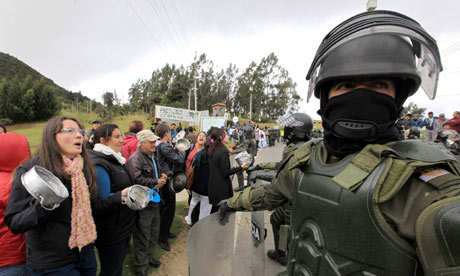
Demonstrators banging on pots in support of farmers at the entrance of La Calera near Bogotá. Photograph: Jose Miguel Gomez/Reuters
Colombia's largest cities were braced on Thursday for marches by students and labour unions in support of a growing nationwide strike by miners, truckers, coffee growers, milk producers and potato farmers protesting against everything from high fuel prices to free trade agreements that farmers say have them on the brink of bankruptcy.
The protests began on 19 August, with demonstrators joining striking miners,to block some of the country's main highways using tree branches, rocks and burning tyres. At least one protester and one policeman have died in the demonstrations, dozens have been injured and more than 150 have been arrested.
The protests spread to the cities where residents banged pots in solidarity with the farmers after president Juan Manuel Santos, in a failed effort to downplay the importance of the strikes, said the "supposed national farmers' strike does not exist".
Forced to apologise for the statement, he sent out high-level officials to begin negotiating separately with the different sectors. "We recognise that the farmers' protests respond to real needs and problems. We are listening to them and offering solutions," Santos said on Wednesday night.


Read More Here


*******************************************************

At least 20 injured as police, protesters clash in Colombian capital

Souce:Xinhua Publish By Updated 30/08/2013 7:05 pm i

At least 20 people were injured and some stores damaged here on Thursday in clashes between riot police and demonstrators gathering at central Bolivar Square to show support for striking farmers.
Local media reported that as many as 30,000 people, including more than 20,000 university students, began the protest three days ago at the square to support a nationwide farmers strike. The clashes broke out as several groups of young demonstrators attacked the police.
At least 20 people, including protesters as well as policemen, were injured as the police tried to disperse the crowd with tear gas, stun grenades and water cannons, local media said.
In a related development, supporters of the farmers also clashed with riot police trying to remove roadblocks and waterworks pipes placed by demonstrators on the South Highway to Bogota.


Read More Here


*******************************************************
Enhanced by Zemanta