democracynow
Published on Sep 19, 2013
http://www.democracynow.org
- Two years after the Occupy Wall Street movement shifted the
conversation on economic inequality, we look at its origins in New York
City's Zuccotti Park and its continued legacy in a number of different
groups active today. We speak with Nicole Carty, actions coordinator
with The Other 98 Percent, and a facilitator of general assemblies and
spokescouncil meetings during Occupy, where she was a member of the
Occupy People of Color Caucus. Also joining us is Nathan Schneider,
editor of the website Waging Nonviolence, and a longtime chronicler of
the Occupy movement for Harper's Magazine, The Nation, The New York
Times, and The Catholic Worker. Scheider's new book, "Thank You Anarchy:
Notes from the Occupy Apocalypse," chronicles Occupy's first year.
See all of the reports on Democracy Now! about Occupy Wall Street in our archive at
http://www.democracynow.org/topics/oc....
*************************************************************************
This is a rush transcript. Copy may not be in its final form.
JUAN GONZÁLEZ:
We turn now to look at the Occupy Wall Street movement and its legacy
on its second anniversary. On September 17, 2011, thousands of people
marched on the financial district, then formed an encampment in Zuccotti
Park, launching a movement that shifted the conversation on economic
inequality. Here in New York activists marked the occasion Tuesday with a
march to the New York Stock Exchange and the United Nations
highlighting a poll for taxing Wall Street transactions and directing
the funds to public causes.
AMY GOODMAN:
For more, we are joined by two guests. Nicole Carty is an actions
coordinator with The Other 98%. During Occupy Wall Street she was a
facilitator at general assemblies and spokes counsel meetings and she
was a member of the Occupy People of Color Caucus. Nathan Schneider is
also with us, editor of the website “Waging Nonviolence,” author of the
new book "Thank You Anarchy: Notes From the Occupy Apocalypse." We
welcome you both to Democracy Now!. Why “Occupy Apocalypse,” Nathan?
NATHAN SCHNEIDER:
That’s a great question. It’s a question I get a lot. The word in Greek
meant unveiling, right? It described a moment in which something is
revealed that changes our perception of everything and I think pretty
accurately describes what happened with Occupy Wall Street, both for us a
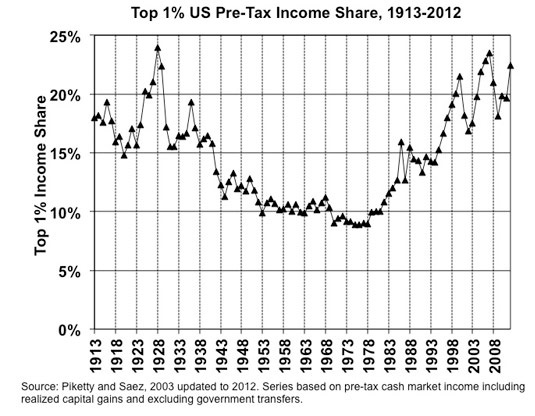
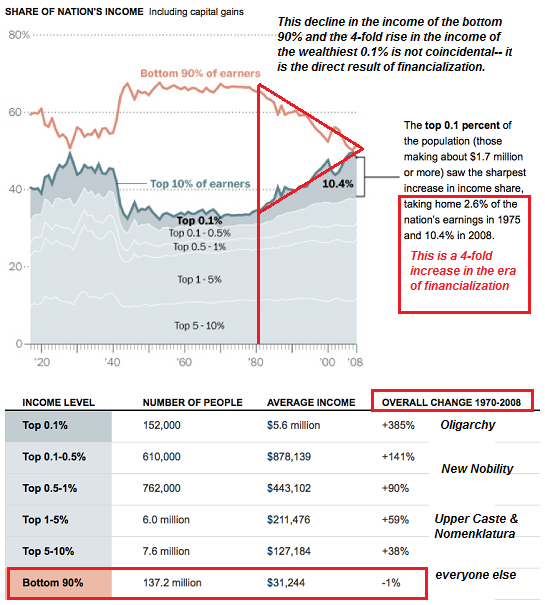
society in revealing the depth of income inequality, of the corruption
of the political system and also of the power of the militarized police
state; but also for so many individuals who took part across the
country. I have been privileged to meet so many people and to watch them
as their lives were changed by this movement, as they became activated
and haven’t been able to go back to the way their lives were before.
JUAN GONZÁLEZ:
Nathan, you write in the beginning of the book, you say for nearly two
months in the fall of 2011 a square block of granite and honey locust
trees in New York’s Financial District, right between Wall Street and
the World Trade Center, became a canvas for the image of another world.
Two years later how has that canvas been preserved and what are some of
the activities that the Occupiers are now involved with?
NATHAN SCHNEIDER:
Well, to talk about that canvas itself, it is interesting to see the
ways in which the movement is memorialized kind of informally in the
Financial District. There is still a wall of barricades around the
Charging Bull statue. There are still regularly barricades in Zuccotti
Park. There are still barricades around Chase Manhattan Plaza which was
the original planned sort of decoy site for the Occupation. It is
amazing how the security state is still living in fear of this movement.
But at the same activists who were involved in it, many of them are
spread out across the country in all kinds of networks that have formed
through the course of this movement, putting their bodies in the way of
the Keystone Pipeline, calling attention to issues like a financial
transaction tax, bringing housing activists together around the country
to create a stronger movement. There are a number of campaigns that have
been profoundly strengthened by networks formed in the Occupy Movement.
AMY GOODMAN: Nicole Carty, where were you two years ago?
NICOLE CARTY: Two years ago I was working for the
Sundance Channel
doing content management. I was just one of many precariate who didn’t
really have a solid job and I came in to Occupy because it was the first
time I ever had seen people my own age, or anyone for that matter,
talking about the deep inequality within this country. It was just kind
of this secret and I feel like part of the legacy is that that so
unveiled at this point. It is not even questioned.
AMY GOODMAN: So talk about what it was really like, what day did you go to Occupy and describe the community there.
*************************************************************************