Showing posts with label Poaching. Show all posts

Thursday, April 10, 2014

A new study says up to $2 billion worth of wild-caught seafood imports comes from pirate fishing around the world.


A photo of a fishmonger peeling the spine from a tuna.
A worker peels the spine from a tuna at New York's Fulton Fish Market—the world's largest after the Tsukiji Market in Tokyo, Japan—on March 29, 2013.
PHOTOGRAPH BY JOHN MINCHILLO, AP
Brian Clark Howard
Published April 9, 2014
Do you know if the fish on your plate is legal? A new study estimates that 20 to 32 percent of wild-caught seafood imported into the U.S. comes from illegal or "pirate" fishing. That's a problem, scientists say, because it erodes the ability of governments to limit overfishing and the ability of consumers to know where their food comes from.
The estimated illegal catch is valued at $1.3 billion to $2.1 billion annually and represents between 15 and 26 percent of the total value of wild-caught seafood imported into the U.S., report scientists in a new study in the journal Marine Policy.
Study co-author Tony Pitcher says those results surprised his team. "We didn't think it would be as big as that. To think that one in three fish you eat in the U.S. could be illegal, that's a bit scary," says Pitcher, who is a professor at the fisheries center of the University of British Columbia in Vancouver.
To get those numbers, Pitcher and three other scientists analyzed data on seafood imported into the U.S. in 2011. They combed through government and academic reports, conducted fieldwork, and interviewed stakeholders.
The scientists report that tuna from Thailand had the highest volume of illegal products, 32,000 to 50,000 metric tons, representing 25 to 40 percent of tuna imports from that country. That was followed by pollack from China, salmon from China, and tuna from the Philippines, Vietnam, and Indonesia. Other high volumes were seen with octopus from India, snappers from Indonesia, crabs from Indonesia, and shrimp from Mexico, Indonesia, and Ecuador.
Imports from Canada all had levels of illegal catches below 10 percent. So did imports of clams from Vietnam and toothfish from Chile.
Graphic showing percent of seafood imported into the U.S. that is illegal and unreported.
NG STAFF. SOURCE: P. GANAPATHIRAJU, ET AL., MARINE POLICY
In response to the study, Connie Barclay, a spokesperson for the National Oceanic and Atmospheric Association (NOAA) Fisheries, said, "We agree that [pirate] fishing is a global problem, but we do not agree with the statistics that are being highlighted in the report." Barclay says data are too scarce to make the conclusions verifiable.
But, she adds, "NOAA is working to stop [pirate] fishing and the import of these products into the U.S. market." She points to recent increased collaboration with other law enforcement agencies and improved electronic tracking of trade data.
Pirate Fishing
The U.S. is important to consider when it comes to fishing because it is tied with Japan as the largest single importer of seafood, with each nation responsible for about 13 to 14 percent of the global total, says Pitcher. Americans spent $85.9 billion on seafood in 2011, with about $57.7 billion of that spent at restaurants, $27.6 billion at retail, and $625 million on industrial fish products.
However, what few Americans realize, says Pitcher, is that roughly 90 percent of all seafood consumed in the United States is imported, and about half of that is wild caught, according to NOAA.
Pirate fishing is fishing that is unreported to authorities or done in ways that circumvent fishery quotas and laws. In their paper, the authors write that pirate fishing "distorts competition, harms honest fishermen, weakens coastal communities, promotes tax evasion, and is frequently associated with transnational crime such as narcotraffic and slavery at sea." (See: "West Africans Fight Pirate Fishing With Cell Phones.")
Scientists estimate that between 13 and 31 percent of all seafood catches around the world are illegal, worth $10 billion to $23.5 billion per year. That illegal activity puts additional stress on the world's fish stocks, 85 percent of which are already fished to their biological limit or beyond, says Tony Long, the U.K.-based director of the Pew Charitable Trust's Ending Illegal Fishing Project.
"The ocean is vast, so it is very difficult for countries to control what goes on out there," says Long. He explains that pirate fishers are often crafty, going to remote areas where enforcement is lax. They may leave a port with a certain name on the boat and the flag of a particular country, engage in illegal fishing, then switch the name and flag and unload their catch at a different port.

Read More Here
.....


The oceans are vast and humans are small — as the monthlong hunt for a vanished Malaysian jetliner demonstrates. Think of the challenge, then, for law enforcement and fisheries managers in going after fleets of shady boats that engage in illegal, unreported and unregulated fishing. These criminals ply the seas and sell their catches with impunity, making off with an estimated 11 million to 26 million metric tons of stolen fish each year, a worldwide haul worth about $10 billion to $23.5 billion. Many use banned gear like floating gillnets, miles long, that indiscriminately slaughter countless unwanted fish along with seabirds, marine mammals, turtles and other creatures.
The danger that illegal fishing poses to vulnerable ocean ecosystems is self-evident, but the harm goes beyond that. Illegal competition hurts legitimate commercial fleets. And lawless fishermen are prone to other crimes, like forced labor and drug smuggling. The convergence of illegal fishing with other criminal enterprises makes it in every country’s interest to devise an effective response.
That’s the job of the Port State Measures Agreement. It is a treaty adopted by the United Nations in 2009 that seeks to thwart the poachers in ports when they try to unload their ill-gotten catches. Many countries have been unable or unwilling to enforce their own laws to crack down on poachers flying their flags.

Read More Here
.....

Enhanced by Zemanta

Wednesday, January 8, 2014

Japanese ships killing whales 'inside sanctuary'

The Telegraph

Aerial footage released by the Sea Shepherd Conservation Society appears to show the bloodied remains of three minke whales


By
Activists have captured rare images of protected whales slaughtered by a Japanese fleet in what is said to be an internationally recognised ocean sanctuary, offering a stark insight into Japan’s secretive but much-criticised whaling practices.
The bloodied carcasses of three minke whales lie on the deck of the Japanese ship Nisshin Maru in the aerial shots and footage taken by the anti-whaling campaign group, Sea Shepherd, as its vessels pursued the fleet through the Southern Ocean. The group said a fourth whale had already been killed.
“There’s three carcasses on the ship, a fourth carcass has been cut up. There’s blood all over the place, meat being carted around on this factory ship deck, offal and innards being dumped in the ocean,” said Bob Brown, chairman of Sea Shepherd Australia
“That’s just a gruesome, bloody, medieval scene which has no place in this modern world.”
The images, purportedly taken inside the Southern Ocean Whale Sanctuary, drew international opprobium and renewed calls for Japan to end the controversial whaling programme which critics say is endangering populations of the marine mammals.

Read More and Watch Video Here
Enhanced by Zemanta

Tuesday, November 5, 2013

Tanzania halts anti-poaching drive : MP John Shibuda said while poachers have badly hit Tanzania's elephant population, killing the hunters was unacceptable.

AFRICA NEWS

Tanzania halts anti-poaching drive after abuse claims


by Staff Writers Dar Es Salaam (AFP) Nov 02, 2013

Tanzania has suspended a controversial anti-poaching operation following reports of rampant human rights abuses including the seizure of property, torture and killing of suspects, the speaker of parliament said Saturday.
Police and wildlife officers have cracked down on suspected poachers amid a surge of killings of elephant and rhino in the east African nation, operating under what was reported to be a shoot-to-kill policy and making sweeping arrests.
The campaign, launched two months ago, was dubbed "Operation Tokomeza", or "Operation Terminate".
"It is has been necessary for government to suspend the operation indefinitely," Speaker of Parliament Anne Makinda told AFP Saturday, adding that a probe into the conduct of the campaign would be launched next week.
Natural Resources and Tourism Minister Khamis Kagasheki told parliament Friday the operation would be called off, adding that any member of the security forces found to be involved in acts of torture, theft of property would be punished.
Shortly after the campaign's launch Kagasheki was widely quoted in Tanzanian media as saying that "rangers are allowed to shoot to kill poachers."
On Friday, MP John Shibuda said while poachers have badly hit Tanzania's elephant population, killing the hunters was unacceptable.
"Human life is more valuable than jumbos," he told parliament.

Read More Here

..........

Execute elephant poachers on the spot, Tanzanian minister urges

Khamis Kagasheki says radical shoot-to-kill policy would curb the slaughter of elephants for illicit ivory trade
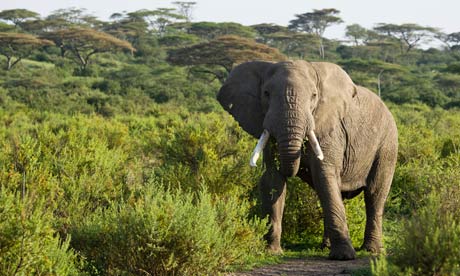
Elephant walking in Ngorongoro Conservation Area, Serengeti National Park, Tanzania
Tanzania, with 70,000-80,000 elephants in 2009, is thought to have nearly one-quarter of all African elephants. Photograph: Joe McDonald/Corbis
A government minister in Tanzania has called for a "shoot-to-kill" policy against poachers in a radical measure to curb the mass slaughter of elephants.
Khamis Kagasheki's proposal for perpetrators of the illicit ivory trade to be executed "on the spot" divided opinion, with some conservationists backing it as a necessary deterrent but others warning that it would lead to an escalation of violence.
There are already signs of an increasing militarisation of Africa's wildlife parks with more than 1,000 rangers having been killed while protecting animals over the past decade, according to the Thin Green Line Foundation. Tanzania is said to have lost half its elephants in the past three years.
"Poachers must be harshly punished because they are merciless people who wantonly kill our wildlife and sometimes wardens," said Kagasheki at the end of an International March for Elephants, which took place in 15 countries to raise awareness of the poaching scourge. "The only way to solve this problem is to execute the killers on the spot."

Read More Here

..........
Enhanced by Zemanta

Friday, August 2, 2013

How YouTube has put the world's only poisonous primates at risk

mongabay.com logo

Jeremy Hance
mongabay.com
July 25, 2013


It all started with a video: in 2009 a Russian man uploaded a video of himself tickling his exotic pet (a pygmy slow loris) from Vietnam onto the hugely popular site YouTube. Since then the video has been viewed over half a million times. But a new study in the open source journal in PLoS ONE, finds that such YouTube videos have helped fuel a cruel, illegal trade that is putting some of the world's least-known primates at risk of extinction. Lorises are small, shy, and nocturnal primates that inhabit the forests of tropical Asia, but the existence of all eight species is currently imperiled by a booming illegal pet trade that has been aided by videos of lorises being tickled, holding tiny umbrellas, or doing other seemingly cute (but wholly unnatural) things.

"In Indonesia alone, where six species of loris occur, a minimum of 15,000 lorises are trafficked each year; this does not count the numbers that die before making it to markets," lead author Anna Nekaris, with Oxford Brookes University and founder of the slow loris-organization Little Fireface Project, told mongabay.com. "In Indochina, no figures are available, but slow lorises have often been the most frequently encountered mammal in markets. In both regions, however, sellers report declines, saying they are 'finished' in the wild."
Given the popularity of YouTube videos showing illegal pet lorises, Nekaris and her team decided to analyze how people responded to the videos through viewer comments. Selecting the video of that pygmy slow loris (Nycticebus pygmaeus) being tickled in Russia, the researchers made their way through 12,000 comments. Worryingly, they found that around 25 percent of people expressed a desire for slow loris "pet." Many comments were along the lines of, "where can I get one?"

This baby Sumatran slow loris has little chance to survive. Only a few weeks old, it should live with its mother in the wild for 14 months, but instead is being sold into the pet trade, doomed to a diet of bananas and rice. Photo by: The Little Fireface Project.


But even beyond being illegal—slow lorises are protected in each of their range countries—the loris trade is problematic for a number of reasons. For one thing, slow lorises that end up in pet trade are not captive-bred but taken directly from the wild.
"Slow lorises are impossible to breed in captivity. The track record of some of the most renowned zoos shows that the number of slow lorises born in these facilities is way below what is needed for a self-sustaining population. Indeed several species have never been bred in captivity," Nekaris explains. "Without a shadow of a doubt the slow lorises we see in these YouTube videos are derived directly from the wild and not the result of some fictitious/magical captive breeding facilities."
In order to capture a slow loris baby for the trade, poachers must kill the mother and sometimes whole family groups. In other words, several slow lorises may die for one pet, and few pet owners realize their purchase is likely responsible for the death of their "pet's" mother. Further mortalities occur while the slow loris waits for a buyer.
"Slow lorises are the world's only venomous primates, so in hopes to keep them from biting, traders cruelly clip or rip out their teeth with pliers, wire cutters or nail clippers. This is done in the open street with no anesthesia, resulting usually in slow painful death due to infection," Nekaris says.

This wild baby Javan slow loris is just as it should be, with a full set of teeth, and still living with its family group in the wild. Photo by: Wawan Tarniwan.

This cruel operation also makes it possible to release confiscated lorises back into the forests, according to Nekaris, who adds that "the procedure is useless since their deadly venom can still be administered via their powerful jaws."
Keeping a loris is also incredibly difficult. Little is known about the animal's dietary needs even by scientists (for example the slow loris shown in the tickling video is clinically obese), and few of these pets live long.
However, the study also found a slight shift in opinions following the establishment of a Wikipedia page called 'Conservation of Slow Lorises' in 2011 and the airing of a documentary on the BBC about the slow loris trade called the Jungle Gremlins of Java in 2012. After this, comments expressing a desire to own a pet slow loris dropped to about 10 percent on the site per month, and those with a conservation message rose. But the videos are still seen as reinforcing both the illegal trade and the idea of slow lorises as "cute pets," instead of wild and poisonous primates that hugely sensitive to bright lights and human handling.
Today, all of the world's slow lorises are listed as either Vulnerable or Endangered by the IUCN Red List, and the Javan slow lorises is considered among the world's top 25 most imperiled primates. Lorises are also threatened by deforestation and the traditional medicine trade, but play hugely important roles in their ecosystems by pollinating plants and eating insect pests.
Nekaris told mongabay.com that one of the big problems for slow lorises and other animals exploited by sites like YouTube is that these social sites don't allow users to flag animal media as "illegal."

This Javan slow loris is already severely dehydrated, terrified, and shows injured hands and horrific fur condition. It is unlikely to make it to any YouTube video. Photo by: Wawan Tarniwan.
"Currently, no Web 2.0 site (e.g. Facebook, YouTube) allows viewers to report that animal material is illegal. Animal cruelty is available on YouTube, but is vastly different from illegal animal activity that threatens an entire group of species. If this flagging option were available, YouTube could then either embed flagged videos with warnings about illegal pet trade, poaching, medicinal, ivory or fur trade (for example), or ideally remove the videos altogether, as they would videos portraying illegal arms, pornography or drug use," Nekaris says.


Read More Here


Enhanced by Zemanta

Sunday, July 28, 2013

Seizure of 1,148 ivory tusks underscores Hong Kong's transit role in illicit trade

Wildlife Extra


More than 2 tonnes of ivory seized in Hong Kong

world/Asia/2013/Hong-Kong-ivory-July-2013 
 
The ivory tusks were packed in 30 sacks and covered by wooden boards in the innermost part of the container. © Hong Kong Customs and Excise Department
 
 
Seizure of 1,148 ivory tusks underscores Hong Kong's transit role in illicit trade
July 2013-Hong Kong Customs have seized 1,148 ivory tusks weighing 2.183 tonnes. The tusks were declared as timber and concealed in a 20 foot (6 m) container that arrived on a vessel from the West African country of Togo.
Repeated large scale seizures
It was the ninth large-scale ivory seizure made in Hong Kong since 2010, with a combined weight of just over 14 tonnes. CITES has defined large-scale seizures as 500 kg or more, and typically are indicative of organized criminal activity.
Hong Kong, Malaysia, the Philippines and Viet Nam
Hong Kong, together with Malaysia, the Philippines and Viet Nam, were identified through analysis of the Elephant Trade Information System (ETIS) database as the main transit points for ivory arriving in Asia from Africa before onward distribution to the major markets in Thailand and China. Collectively, they have made or been implicated in 21 (62%) of the 34 large-scale ivory seizures made between 2009 and 2011, totalling 41.1 tonnes of ivory.
ETIS is the world's foremost collection of ivory and other elephant product seizures containing nearly 20,000 records from some 90 countries or territories worldwide since 1989. It is managed by TRAFFIC on behalf of Parties to the Convention on International Trade in Endangered Species of Wild Fauna and Flora (CITES), who met this March in Bangkok, Thailand.


Read More Here


Enhanced by Zemanta