Showing posts with label Archaeology. Show all posts

Friday, November 13, 2015

Striking Anomaly Found in Great Pyramid


Pyramide Kheops.JPG
the Great Pyramid (Kheops pyramid).
Photo :  Alex lbh   Wikimedia.org
..........................................................................................................

Discovery News


A striking anomaly has been detected on the eastern side of the Great Pyramid at Giza, Antiquities Minister Mamdouh el-Damaty said on Monday.
The announcement comes at the end of a two-week project to scan Egypt’s main pyramids in order to identify the presence of unknown internal structures and cavities.
Called Scan Pyramids, the study is in its first stage and is carried out by a team from Cairo University’s Faculty of Engineering and the Paris-based organization Heritage, Innovation and Preservation under the authority of the Egyptian Ministry of Antiquities.

Photos: Scanning Pyramids
Pyramids are one of the wonders of the world. But why were they built, and why did humans STOP building them? Trace answers these questions and looks at some of the most amazing pyramids from South America to Egypt.
The project uses a mix of technologies such as infrared thermography, muon radiography, and 3-D reconstruction to look inside four pyramids, which are more than 4,500 years old. They include Khufu, or Cheops, Khafre or Chephren at Giza, the Bent pyramid and the Red pyramid at Dahshur.
Several thermal anomalies were observed in all the monuments, but one remarkable anomaly was detected in the Great Pyramid, known as Khufu or Cheops.


Read More Here

Tuesday, October 6, 2015

Woolly Mammoth Found Under Michigan Soybean Field


YouTube/University of Michigan
 

Tre extinct creature is believed to have roamed the Earth between 10,000 and 15,000 years ago.


When farmer James Bristle and his neighbor discovered a "wood-like" object while digging in his Michigan soybean field on Monday, the duo thought they had uncovered something fairly mundane.
"We thought it was a bent fence post," Bristle told the Detroit Free-Press. "It was covered in mud."
But upon closer inspection of the object, it started looking more and more like bone, said the farmer.
"We knew it was something that was out of the norm," he said. "My grandson came over to look at it, he's 5-years-old, he was speechless."

Paleontologists confirmed this week that the discovery, in Washtenaw County's Lima Township, was indeed "out of the norm." The "fence post" Bristle found turned out to be a part of a skeleton of a woolly mammoth that roamed the Earth between 10,000 and 15,000 years ago.

University of Michigan Professor Dan Fisher has been leading the dig to remove the mammoth’s remains from Bristle’s property this week. He told Ann Arbor News that the mammoth was probably 40 years old when it died, and had been hunted by humans who likely butchered it and stashed it in a pond.


Read More Here

Thursday, September 10, 2015

New Species of Human Discovered in "The Cradle of Humankind"


The Daily Galaxy

September 10, 2015

  99007_web

  Working in a cave complex deep beneath South Africa's Malmani dolomites, an international team of scientists has brought to light an unprecedented trove of hominin fossils -- more than 1,500 well-preserved bones and teeth -- representing the largest, most complete set of such remains found to date in Africa. The discovery, cached in a barely accessible chamber in a subterranean labyrinth not far from Johannesburg, adds a new branch to the human family tree, a creature dubbed Homo naledi.
The remains, scientists believe, could only have been deliberately placed in the cave.Skeletal fossils of Homo naledi are pictured above in the Wits bone vault at the Evolutionary Studies Institute at the University of the Witwatersrand, Johannesburg, South Africa, on Sept. 13, 2014. The fossils are among nearly 1,700 bones and teeth retrieved from a nearly inaccessible cave near Johannesburg. The fossil trove was created, scientists believe, by Homo naledi repeatedly secreting the bodies of their dead companions in the cave. Analysis of the fossils -- part of a project known as the Rising Star Expedition -- was led in part by paleoanthropologist John Hawks, professor of anthropology at the University of Wisconsin-Madison. So far, parts of at least 15 skeletons representing individuals of all ages have been found and the researchers believe many more fossils remain in the chamber. It is part of a complex of limestone caves near what is called "The Cradle of Humankind," a World Heritage Site in Gauteng province well known for critical paleoanthropological discoveries of early humans, including the 1947 discovery of 2.3 million-year-old Australopithecus africanus.  

Read More Here

Tuesday, April 1, 2014

Archaeologists and forensic scientists believe they have uncovered the truth about the nature of the Black Death

Black death was not spread by rat fleas, say researchers

Black death
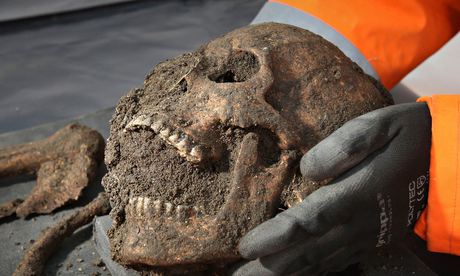
Black death researchers extracted plague DNA from 14th century skulls found in east London. Photograph: Philip Toscano/PA
Archaeologists and forensic scientists who have examined 25 skeletons unearthed in the Clerkenwell area of London a year ago believe they have uncovered the truth about the nature of the Black Death that ravaged Britain and Europe in the mid-14th century.
Analysis of the bodies and of wills registered in London at the time has cast doubt on "facts" that every schoolchild has learned for decades: that the epidemic was caused by a highly contagious strain spread by the fleas on rats.
Now evidence taken from the human remains found in Charterhouse Square, to the north of the City of London, during excavations carried out as part of the construction of the Crossrail train line, have suggested a different cause: only an airborne infection could have spread so fast and killed so quickly.
The Black Death arrived in Britain from central Asia in the autumn of 1348 and by late spring the following year it had killed six out of every 10 people in London. Such a rate of destruction would kill five million now. By extracting the DNA of the disease bacterium, Yersinia pestis, from the largest teeth in some of the skulls retrieved from the square, the scientists were able to compare the strain of bubonic plague preserved there with that which was recently responsible for killing 60 people in Madagascar. To their surprise, the 14th-century strain, the cause of the most lethal catastrophe in recorded history, was no more virulent than today's disease. The DNA codes were an almost perfect match.

Read More Here
Enhanced by Zemanta

Friday, January 24, 2014

Climate change, violence and disease played a key role in the collapse of the Harappan civilization more than 3,000 years ago, according to a new study.


Study Sheds More Light on Collapse of Harappan Civilization

Jan 21, 2014 by Sci-News.com
  

This is an artist's reconstruction of the gateway and drain at the city of Harappa. Image credit: Chris Sloan.
This is an artist’s reconstruction of the gateway and drain at the city of Harappa. Image credit: Chris Sloan.
Harappan civilization, or the Indus Valley civilization, developed in the middle of the third millennium BC, at the same time as contemporaneous civilizations in Egypt and Mesopotamia. It stretched over a million square kilometers of what is now Pakistan and India.
The city of Harappa and the city of Mohenjo-Daro – the greatest achievements of this culture – are well known for their impressive, organized layout.
Recent excavations have demonstrated that the cities grew rapidly from 2200-1900 BC, when they were largely abandoned.
“The collapse of the Indus Civilization and the reorganization of its human population has been controversial for a long time,” said Dr Robbins Schug of Appalachian State University, who is the lead author of the study appearing in the open-access journal PLoS ONE.
Climate, economic, and social changes all played a role in the process of urbanization and collapse, but little was known about how these changes affected the human population.
Dr Schug and her colleagues examined evidence for trauma and infectious disease in the human skeletal remains from three burial areas at the city of Harappa. Their findings counter longstanding claims that the Harappan civilization developed as a peaceful, cooperative, and egalitarian state-level society, without social differentiation, hierarchy, or differences in access to basic resources.
This is an artist's reconstruction of Mohenjo-Daro. Image credit: University of Minnesota.
This is an artist’s reconstruction of Mohenjo-Daro. Image credit: University of Minnesota.
The results suggest instead that some communities at Harappa faced more significant impacts than others from climate and socio-economic strains, particularly the socially disadvantaged or marginalized communities who are most vulnerable to violence and disease. This pattern is expected in strongly socially differentiated, hierarchical but weakly controlled societies facing resource stress.
The study adds to the growing body of research about the character of Harappan society and the nature of its collapse.
“Early research had proposed that ecological factors were the cause of the demise, but there wasn’t much paleo-environmental evidence to confirm those theories. In the past few decades, there have been refinements to the available techniques for reconstructing paleo-environments and burgeoning interest in this field,” Dr Schug said.
Read More Here
Enhanced by Zemanta

Friday, August 30, 2013

Archaeologists Unearth 10,400-Year-Old hunter-gatherer settlements in the Bolivian Amazon: the site of Isla del Tesoro

Archaeologists Unearth 10,400-Year-Old Settlements in Bolivia

Aug 29, 2013 by Sci-News.com

An international team of scientists from Switzerland, Australia, Germany and the United States has discovered remains of three hunter-gatherer settlements in the western Amazon.

This map shows location of three hunter-gatherer settlements in the Bolivian Amazon: the site of Isla del Tesoro – SM1, a site west of the Mamoré River – SM2, a site east of Trinidad – SM3 (Lombardo U et al).

Their study, reported in the open-access journal PLoS ONE, focuses on a region in the Bolivian Amazon thought to be rarely occupied by pre-agricultural communities due to unfavorable environmental conditions.
Hundreds of ‘forest islands’- small forested mounds – are found throughout the region. Their origins attributed to termites, erosion or ancient human activity.
The team reports that three of these islands are shell middens, mounds of seashells left by settlers more than 10,000 years ago. Samples of soil from these mounds revealed a dense accumulation of freshwater snail shells, animal bones and charcoal forming the middens.


Read More Here


Enhanced by Zemanta