Showing posts with label Evolution. Show all posts

Sunday, March 9, 2014

Greenpeace co-founder says ‘no scientific proof’ humans cause climate change


The Washington Times

-

Photo by: Matt Brown
**FILE** Smoke rises from the Colstrip Steam Electric Station, a coal burning power plant in in Colstrip, Mont., on July 1, 2013. Colstrip is kind of plant called on by President Barack Obama's climate change plan to reduce carbon dioxide emissions. On Feb. 24, 2014, the U.S. Supreme Court will hear arguments on the unanimous federal appeals court ruling that upheld the Environmental Protection Agency's unprecedented regulations, aimed at reducing the greenhouse gases blamed for global warming. The case comes to the court amid Obama's increasing use of his executive authority to act on environmental and other matters when Congress doesn't, or won't. (Associated Press)

A co-founder of Greenpeace told a Senate panel on Tuesday that there is no scientific evidence to back claims that humans are the “dominant cause” of climate change.
Patrick Moore, a Canadian ecologist who was a member of Greenpeace from 1971-86, told members of the Senate Environment and Public Works Committee environmental groups like Greenpeace use faulty computer models and scare tactics in further promoting a political agenda, Fox News reported.
“There is no scientific proof that human emissions of carbon dioxide (CO2) are the dominant cause of the minor warming of the Earth’s atmosphere over the past 100 years,” Mr. Moore said. “Today, we live in an unusually cold period in the history of life on earth and there is no reason to believe that a warmer climate would be anything but beneficial for humans and the majority of other species.
“It is important to recognize, in the face of dire predictions about a [two degrees Celsius] rise in global average temperature, that humans are a tropical species,” he continued. “We evolved at the equator in a climate where freezing weather did not exist. The only reasons we can survive these cold climates are fire, clothing, and housing.

Read More Here
Enhanced by Zemanta

Sunday, January 26, 2014

As Arctic ice melts, polar bears switch diets to survive, studies say


Arctic polar bears may be adjusting their eating habits as their sea ice habitat melts and the furry white predators stand to lose the floating platform they depend on to hunt seals, their primary food. According to researchers, however, the bears are displaying flexible eating habits as their world changes around them.
Indeed, scientific studies indicate polar bear populations are falling as the sea ice disappears earlier each spring and forms later in the fall. But a series of papers based on analysis of polar bear poop released over the past several months indicate that at least some of the bears are finding food to eat when they come ashore, ranging from bird eggs and caribou to grass seeds and berries.
"What our results suggest is that polar bears have flexible foraging strategies," Linda Gormezano, a biologist at the American Museum of Natural History in New York and a co-author of several of the papers, told NBC News.

Quinoa, a dog, finds polar bear scat
Robert Rockwell / American Museum of Natural History
Quinoa, a Dutch shepherd who was trained to sniff out polar bear scat, sits next to find. Analysis of the polar bear scat reveals the animals have a flexible foraging strategy.
The results stem from research in western Hudson Bay, near Chruchill, Manitoba, Canada, which is in the southern extent of polar bear habitat and serves as a harbinger of what the animals are likely to face throughout their Arctic range as the climate continues to warm and sea ice breaks up earlier and earlier each spring.
The flexible foraging strategy of polar bears "means that there may be more to this picture in terms of how polar bears will adjust to changing ice conditions" than indicated by models based on the spring breakup date of the sea ice and thus their access to seals, Gormezano said.
She added that nobody knows for sure how well polar bears will adapt to the changing food supply, but a big step toward an answer is to study what they eat on land "rather than assume that they may just be fasting."
Let them eat car parts
In addition to berries, birds and eggs, Andrew Derocher, a University of Alberta polar bear biologist who was not involved with the recent studies, said people have seen a polar bear drink hydraulic fluid as it was drained out of a forklift, chomp the seats of snow machines, and eat lead acid batteries.
"Polar bears will eat anything," he told NBC News. "The question is: Does is it do them any good? And everything we can see from what bears eat when they are on land is it has a very, very minimal energetic return relative to the cost."
Gormezano said the plants found in any given pile of poop were usually the same, suggesting the bears eat whatever they find in their immediate surroundings — they don't spend a lot energy searching for food. Mothers and cubs, who wander farthest inland, feast on berries found there. On the coast, where adult males linger, the poop is predominantly shoreline grass seeds.
Animal remains, however, showed no pattern, which fits with a landscape rich with nesting birds and caribou and polar bears opportunistically eating whatever crosses their path, according to a paper Gormenzano and colleague Robert Rockwell published in BMC Ecology in December 2013.
In a paper published in Polar Biology in May 2013, the researchers report observations of polar bears chasing and capturing snow geese with the efficiency of a skilled hunter — snagging one right after the other.
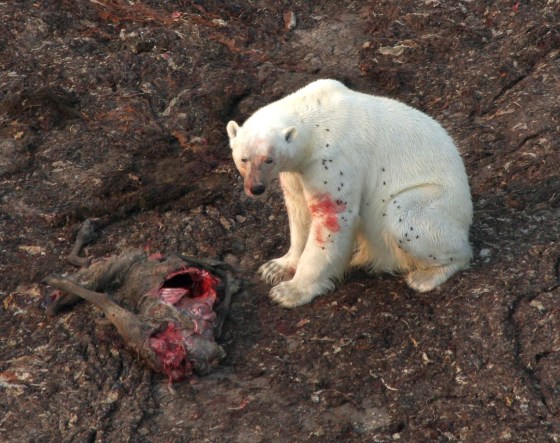
Polar bear eats a caribou
Robert Rockwell / American Museum of Natural History
A polar bear eats a caribou on land. Recent studies suggest polar bears have a flexible foraging strategy, which help them survive as they come ashore earlier due to melting Arctic sea ice.
"Previously, it had been thought that that would not be a very energetically profitable thing for a polar bear to do because they expend more energy in the chase than they get from consuming the food," Gormezano noted.

Read More Here


Enhanced by Zemanta

Friday, January 24, 2014

Scientists Discover 310-Million-Years-Old Nursery of Bandringa Sharks


Jan 10, 2014 by Sci-News.com

According to paleontologists from the University of Chicago and the University of Michigan, long-extinct Bandringa sharks migrated downstream from freshwater swamps to the ocean to spawn in shallow coastal waters and left behind fossil evidence of one of the earliest known shark nurseries.
This is an artist's impression of Bandringa shark. Image credit: John Megahan / University of Michigan.
This is an artist’s impression of Bandringa shark. Image credit: John Megahan / University of Michigan.
The long-snouted Bandringa shark (Elasmobranchii, Chondrichthyes) – a bottom-feeding predator that lived in an ancient river delta system in what is today the Upper Midwest – is likely one of the earliest close relatives of modern sharks.
It resembled present-day sawfish and paddlefish, with a spoon-billed snout up to half its body length. Juveniles were 4 to 6 inches long and grew into adults of up to 10 feet.
Bandringa sharks were discovered in 1969 and soon became one of the most prized fossils from the well-known Mazon Creek deposits in northern Illinois.
Until now, paleontologists believed that the genus Bandringa contained two species – B. rayi and B. herdinae, one that lived in freshwater swamps and rivers and another that lived in the shallow ocean.


Read More Here
Enhanced by Zemanta

Sunday, August 4, 2013

Plants are finally turning Monsanto's dreams into nightmares.

                                                                         Image Source

Prevent Disease .com


Amaranth Plants Are Now Succeeding Where GMO Activists Are Failing - They Are Resisting Monsanto's Glyphosate
Nature has a funny way of always coming on top and the Amaranth plant is a perfect example. All anti-GMO activism has led to little resistance against the powerful lobbyists at Monsanto and their dominion over government policy. But Amaranth is showing the biotech giant you can't mess with nature without consequences.
A Superstar of the Plant Kingdom
The Amaranth is a plant well known to our ancestors, since the Incas considered it a sacred plant. Ancient amaranth grains were cultivated on a large scale in ancient Mexico, Guatemala, and Peru. In a 1977 article in Science, amaranth was described as "the crop of the future."
Approximately 60 species are recognized and each plant produces about 12,000 seeds per year, with the leaves containing an abundance of vitamins and minerals. It has been proposed as an inexpensive native crop that could be cultivated by indigenous people in rural areas for several reasons:
  1. It is easily harvested.
  2. Its seeds are a good source of protein. Compared to other grains, amaranth is unusually rich in the essential amino acid lysine and some dieticians have argued that amaranth protein in higher than that of cow's milk and far richer than soy.
  3. The seeds of Amaranthus species contain about thirty percent more protein than cereals like rice, sorghum and rye.
  4. It is easy to cook. As befits its weedy life history, amaranth grains grow very rapidly and their large seedheads can weigh up to 1 kilogram and contain a half-million seeds in three species of amaranth.
Amaranth Is Fighting the GMO Battle Like No Other
Besides the incredible nutritional benefits which nature has bestowed upon the human race with Amaranth, it appears it also knows how to fight GMO manipulation.
Studies began documenting weed resistance several years ago but the problem continues to mount, with The New York Times warning of the “Rise of the Superweeds” analogous to that of the ‘superbugs’ in medicine. But nature only does what its designed to do.
Kept as a very secretive incident, in 2004 the first farmers noticed that some of amaranth seedlings were resistant to Monsanto's Roundup ready technology as they generously generously sprayed their soybean plants.
It turns out the amaranth seed received a resistance gene for Roundup.
Since then, the phenomenon has spread to other states: South Carolina, and northern Arkansas, Missouri and  Tennessee.
“There’s no question, we have a lot of problems in the Southeast,” York said. “For us, the horse is already out of the barn. For the Mid-South, you don’t want to go down this path we’re on right now.”
On July 25, 2005, the Guardian published an article by Paul Brown, who revealed that the modified genes were passed to the natural plants, creating a seed resistant to herbicides.


Read More Here


Enhanced by Zemanta