Showing posts with label History. Show all posts

Tuesday, April 29, 2014

Leftist candidate Hamdeen Sabahi to challenge Sisi in Egypt election

Abdel Fatah al-Sisi favourite in Egyptian election as nominations close

Interim government paints election as important step towards democracy but opponents have concerns about integrity of vote
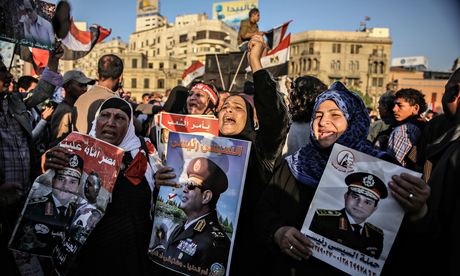
Sisi supporters
Abdel Fatah al-Sisi supporters in Cairo. Photograph: Anadolu Agency/Getty Images
\
Abdel Fatah al-Sisi moved one step closer to Egypt's presidency on Sunday as nominations closed, leaving the retired army chief and the leftist Hamdeen Sabahi as the only two high-profile candidates in the race.
Sisi is widely expected to easily win the election, which will take place on 26-27 May. He has more support than any other candidate, as well as an explicit mandate from the army, and he receives favourable coverage from most state and private media.
Egypt's interim government, installed by Sisi last July, has portrayed the presidential race as a sign that the country is back on the road to democracy. "It is a very important step," Egypt's foreign minister, Nabil Fahmy, told the Guardian, calling the electoral process "extremely free and fair".
"Once we get it done, we will then move into the parliamentary elections which will help us finish the roadmap [to democracy] – and we look forward to rebuilding our future," Fahmy said.
But among rights activists and opposition politicians there are concerns about the integrity of the poll. By the most conservative estimate at least 16,000 mainly Islamist dissidents have been arrested in an ongoing crackdown on dissent. At least three high-profile candidates from the 2012 presidential campaign have boycotted the race, complaining about the absence of free expression in Egypt, while the ousted president Mohamed Morsi's Muslim Brotherhood was banned by court order this week from taking part.
A late challenger – the flamboyant football-club chairman Mortada Mansour – dropped out on Saturday citing a divine vision, after a brief and bizarre campaign in which he promised to rip up the Camp David accords and to force non-believers to practise atheism in their bathrooms.
Khaled Ali, a labour lawyer, the Islamist Abdel Moneim Aboul Fotouh, and Hosni Mubarak's last prime minister, Ahmed Shafiq, all dropped out in recent weeks – with Aboul Fotouh highlighting the impossibility of campaigning in an environment where opposition is portrayed as treason.
Dozens of activists campaigning against Egypt's new constitution in January were arrested while putting up campaign posters, and colleagues complained they were ignored by most media networks. Withdrawn candidates said they feared a similar scenario in the presidential poll.
When Sisi announced his intention to run for office last month, state television gave him a prime-time television slot to make a speech directly to camera. It was a privilege not afforded to Sabahi, who was allowed only a short state-made documentary about his career – a taste of what may be to come, analysts said.
"If we are talking about these elections really being fair and free, all the candidates should have access to equal representation within the media," said HA Hellyer, Egypt analyst at the Royal United Services Institute. "And I just don't think that's going to happen unless things drastically change in the next four or five weeks."
On Saturday a privately-owned channel announced that it would not air any shows by Egypt's best-known political satirist Bassem Youssef, a prominent Sisi critic, until after the election – in order "to avoid influencing Egyptian voters' orientation".

Read More Here

.....

Egyptian presidential candidate reportedly vows to put Sisi on trial

Mideast Egypt Presidential Election
Egyptian presidential candidate Hamdeen Sabahi's campaign denied remarks attributed to him in an audio recording in which a person with a voice that sounds like his says he would put former army chief Abdel Fattah Sisi on trial for the deaths of hundreds of protesters. (Ahmed Gomaa / Associated Press / April 22, 2014)


CAIRO -- The only candidate running for president against Egypt’s former military chief, Abdel Fattah Sisi, has reportedly said that if elected he would put Sisi on trial in connection with the deaths of hundreds of protesters.
"I don't treat Sisi as a criminal, but I plan to bring him to court …. When I do this, I aim to heal wounds without opening up new confrontations," candidate Hamdeen Sabahi was quoted as saying by the Egyptian news outlet Youm7 on Friday.
Sabahi’s campaign denied the comments were his. But Youm7 posted an audio recording of a voice that sounded much like the candidate. According to Youm7, Sabahi was responding to a question over transitional justice in case he wins the presidency. He also said anyone proven responsible for demonstrators' deaths since the 2011 uprising against autocrat Hosni Mubarak should be held accountable.

Read More Here

.....

Al Jazeera America

Leftist candidate Hamdeen Sabahi to challenge Sisi in Egypt election

Lobna Tarek/El Shorouk/AP

Sabahi has received several political endorsements but his chances of beating the powerful Sisi are slight
Leftist politician Hamdeen Sabahi officially submitted his bid Saturday to run for Egypt's presidency, making him the second candidate for next month's election alongside former army chief Abdel Fattah el-Sisi who is widely expected to win.
The election is due to take place on May 26-27.
Sabahi, who heads a political alliance called the Popular Current, created after the 2012 presidential elections, was a member of parliament during ousted autocrat Hosni Mubarak's years in office and came third in the election won by Mohamed Morsi of the Muslim Brotherhood in 2012.
Sabahi submitted the required documents to the presidential election committee after gathering 31,100 signatures. The required number is 25,000.
A third candidate, controversial figure Mortada Mansour, announced Saturday that he would not run in the upcoming elections, after having declared his candidacy less than a week ago, Egyptian media reported.


Read More Here
.....

Egypt presidential candidate bows out, predicts Sisi victory

Egypt presidential candidate bows out, predicts Sisi victory

CAIRO — An Egyptian lawyer and TV personality who declared days ago that he was running for president pulled out of the race Saturday, and state media quoted him as saying he had received a sign from God that victory belonged to former army chief Abdel Fattah Sisi.
Mortada Mansour, known for his outspoken style and sometimes eccentric views, also took a parting swipe at the only Sisi opponent left in the race, leftist politician Hamdeen Sabahi, the Ahram website reported.

Mansour, who had announced his candidacy last weekend, has called for the abrogation of the Camp David accords that led to peace between Egypt and Israel, has threatened to go to war with Ethiopia over water rights, and has urged a ban on Facebook and Twitter.
Sisi, leader of the popularly supported military coup that ousted Islamist President Mohamed Morsi nearly 10 months ago, is heavily favored to win the presidential poll, to be held May 26 and 27.

Read More Here

.....
Enhanced by Zemanta

Wednesday, February 19, 2014

Snowden elected leader of students at UK school

MSN

Former intelligence contractor Edward Snowden poses for a photo during an interview in an undisclosed location in December 2013 in Moscow.

Students at the University of Glasgow elected former NSA contractor Edward Snowden as the official representative of the student body.
LONDON — Former National Security Agency contractor Edward Snowden was elected Tuesday as the official representative of the student body at the University of Glasgow.
Students at the institution say that they nominated Snowden to make a statement about democratic rights.
"We showed Edward Snowden and other brave whistleblowers that we stand in solidarity with them, regardless of where they are," they said in a statement.
Read More Here
.....

Edward Snowden wins UK university role

Updated: 11:19, Wednesday February 19, 2014
Edward Snowden wins UK university role
Edward Snowden, the former US National Security Agency analyst who revealed US surveillance of phone and internet communications, has been elected rector of Glasgow University.
The analyst was nominated by a group of students at the Scottish institution who said they had received his approval through his lawyer.
The group said: 'We are incredibly delighted to see Edward Snowden elected as the new rector of Glasgow University.'
The statement said the institution had a 'virtuous tradition of making significant statements through our rectors'.
It added: 'Our opposition to pervasive and immoral state intrusion has gone down in the records.
.....
Enhanced by Zemanta

Friday, January 31, 2014

Bless the Lady Plumber (Irena Sendler ) : In MEMORIAM of her service and the 2500 lives she saved from the Nazis and their sympathizers - 65 YEARS LATER

cid:824F64967BBF4313B3D68D76F0D90AD6@KaysToy

Watch Full Movie  "The Courageous Heart Of Irena Sendler Here


Irena Sendler bátor szíve from Merenyi Zoltan on Vimeo.


.....
Irena Sendler: In the Name of Their Mothers premiered May 2011.
Check Local Listings to see when it's airing on your local PBS station.
"I sit here as a testament to those people who were committed to saving a Jewish child's life."
— William Donat
Irena Sandler In the Name of Their Mothers is the story of a group of young Polish women, who outfoxed the Nazis during World War II and saved the lives of thousands of Jewish children.
A Polish mother and child
Julien Bryan Collection, USHMM
A Polish mother and child in the aftermath of the bombing of Warsaw, 1939.
Irena Sendler, a petite social worker, was not yet thirty years old when Nazi tanks rolled into Warsaw in September of 1939. When the city's Jews were imprisoned behind a ghetto wall without food or medicine, she appealed to her closest friends and colleagues, mostly young women, some barely out of their teens. Together, they smuggled aid in and smuggled Jewish orphans out of the ghetto by hiding infants on trams and garbage wagons and leading older children out through secret passageways and the city’s sewers. Catholic birth certificates and identity papers were forged and signed by priests and high ranking officials in the Social Services Department so that the children could be taken from safe houses in Warsaw to orphanages and convents in the surrounding countryside.
The scheme was fraught with danger. The city was crawling with ruthless blackmailers, and the Gestapo were constantly on the look out for Jews who had escaped from the ghetto. "You are not Rachel but Roma. You are not Isaac but Jacek. Repeat it ten times, a hundred, even a thousand times," says Irena, who knew that any child on the street could be stopped and interrogated. If he was unable to recite a Catholic prayer he could be killed.
Magda Rusinek tells us how she taught the children "little prayers that every child knows in Polish. I would wake them up during the night to say the prayer," says the Sendler collaborator who had joined the Polish Resistance as a teenager. "And then I had to teach them how to behave in a church, a Christian Church."
"They treated me like their own child," says Poitr Zettinger, recalling how the sisters would warn him when the Gestapo came to the convent. "They would tell me when I should hide so I'd run up to the attic. I'd hide in a cupboard there." William Donat, a New York businessman, describes the conflicts inherent in the extraordinary situation. "I was baptized and I was converted and, became a very, very strong Catholic. I was praying every day for perhaps a little more food and for Jesus to forgive me for the terrible sin that I had been born a Jew."
Sendler and her cohorts kept meticulous records of the children's Jewish names so that they could be reunited with their parents after the war. Donat was one of the few whose parents survived.
Irena Sendler
2B Productions
Irena Sendler at age 95 in Warsaw.
In 1942, as conditions worsened and thousands of Jews were rounded up daily and sent to die at the Treblinka death camp, less than hour outside Warsaw, Sendler and her cohorts began to appeal to Jewish parents to let their children go. Sixty years later, Irena still has nightmares about the encounters. "Those scenes over whether to give a child away were heart-rending. Sometimes, they wouldn't give me the child. Their first question was, 'What guarantee is there that the child will live?' I said, 'None. I don't even know if I will get out of the ghetto alive today."

Read More Here


.....
cid:7C72E425DE734F7A97847D5101B557E3@KaysToy
Irena Sendler

Died: May 12, 2008 (aged 98)
Warsaw , Poland
cid:A56EC79DAC004A2AAE23238FCE8CF515@KaysToy

During WWII, Irena, got permission to work in the Warsaw ghetto, as a Plumbing/Sewer specialist. She had an ulterior motive.
Irena smuggled Jewish infants out in the bottom of the tool box she carried.She also carried a burlap sack in the back of her truck, for larger kids.

Irena kept a dog in the back that she trained to bark when the Nazi soldiers let her in and out of the ghetto.
The soldiers, of course, wanted nothing to do with the dog and the barking which covered the kids/infants noises.

cid:824F64967BBF4313B3D68D76F0D90AD6@KaysToy
During her time of doing this, she managed to smuggle out and save 2500 kids/infants. Ultimately, she was caught, however, and the Nazi's broke both of her legs and arms and beat her severely.
Irena kept a record of the names of all the kids she had smuggled out, in a glass jar that she buried under a tree in her back yard. After the war, she tried to locate any parents that may have survived and tried to reunite the family. Most had been gassed. Those kids she helped got placed into foster family homes or adopted.
cid:199A7A16CC6B4D3FA61517DD9D43A6DE@KaysToy
In 2007 Irena was up for the Nobel Peace Prize. She was not selected. Al Gore won, for a slide show on Global Warming.
Later another politician, Barack Obama, won for his work as a community organizer for ACORN.
In MEMORIAM - 65 YEARS LATER
I'm doing my small part by forwarding this message.
I hope you'll consider doing the same. It is now more than 67 years since the Second World War in Europe ended.
This e-mail is being sent as a memorial chain, In memory of the six million Jews, 20 million Russians, 10 million Christians and 1,900 Catholic priests who were murdered, massacred, raped, burned, starved and humiliated!
Enhanced by Zemanta

Sunday, December 22, 2013

The American prisons that sterilized female inmates

Journeyman Pictures Journeyman Pictures


Published on Dec 16, 2013
Sterilised behind bars - how have Eugenics programs found their way into the US prison system?

Sterilised behind Bars - How have eugenics programs found their way into US prisons?

For downloads and more information visit: http://www.journeyman.tv/?lid=66340&a...

Eugenics is a concept so universally despised it is hard to imagine its existence in the Western world. But in California the forced sterilization of women in prisons is a terrifying, cruel reality.

"Tubal ligation, what are you talking about? I don't want any procedure. I just want to have my baby", one prisoner says, recounting how she went in to deliver her baby and ended up having a sterilization procedure forced upon her. Between 2006 and 2010 148 women were forced to undergo procedures like this. "We're basically society's trash in a lot of eyes, so it's easy for them to just treat us as such", Misty Rojo, a former inmate of Valley State Women's Prison, says. She argues that the prison system makes it very easy to force through the terrible sterilization procedures, because prisoners learn to just follow orders so that they can get out quickly. "You feel compelled to comply. Because that's what you do in there. It's not very consensual." Crystal, who worked in the infirmary of Dr Heinrich, the main GYN doctor in California, saw first hand how he pressurised women to be sterilized. Dr Heinrich is now being investigated, but so far the hearings to uncover what really happened haven't brought answers.

Centre for Investigative Reporting - ref 6001

Journeyman Pictures is your independent source for the world's most powerful films, exploring the burning issues of today. We represent stories from the world's top producers, with brand new content coming in all the time. On our channel you'll find outstanding and controversial journalism covering any global subject you can imagine wanting to know about.


Enhanced by Zemanta

Thursday, December 5, 2013

Nelson Mandela Dead at the age of 95

Nelson Mandela dead at 95


/
View images of civil rights leader Nelson Mandela, who went from anti-apartheid activist to prisoner to South Africa's first black president.
Nelson Mandela, the revered South African anti-apartheid icon who spent 27 years in prison, led his country to democracy and became its first black president, died Thursday at home. He was 95.
"He is now resting," said South African President Jacob Zuma. "He is now at peace."
"Our nation has lost his greatest son," he continued. "Our people have lost their father."
A state funeral will be held, and Zuma called for mourners to conduct themselves with "the dignity and respect" that Mandela personified.
"Wherever we are in the country, wherever we are in the world, let us reaffirm his vision of a society… in which none is exploited, oppressed or dispossessed by another," he said as tributes began pouring in from across the world.

Though he was in power for only five years, Mandela was a figure of enormous moral influence the world over – a symbol of revolution, resistance and triumph over racial segregation.
He inspired a generation of activists, left celebrities and world leaders star-struck, won the Nobel Peace Prize and raised millions for humanitarian causes.
South Africa is still bedeviled by challenges, from class inequality to political corruption to AIDS. And with Mandela’s death, it has lost a beacon of optimism.
Feb. 1990: NBC's Robin Lloyd reports on Nelson Mandela on the eve of his release from prison in 1990. Mandela's name has become a rallying cry for the overthrow of apartheid, but no one but prison guards and visitors have actually seen him since he was jailed 27 years ago.
In his jailhouse memoirs, Mandela wrote that even after spending so many years in a Spartan cell on Robben Island – with one visitor a year and one letter every six months – he still had faith in human nature.
“No one is born hating another person because of the color of his skin, or his background, or his religion,” he wrote in “Long Walk to Freedom.”
“People must learn to hate, and if they can learn to hate, they can be taught to love, for love comes more naturally to the human heart than its opposite.”
Mandela retired from public life in 2004 with the half-joking directive, “Don’t call me, I’ll call you,” and had largely stepped out of the spotlight, spending much of his time with family in his childhood village.
His health had been fragile in recent years. He had spent almost three months in a hospital in Pretoria after being admitted in June for a recurring lung infection. He was released on Sept. 1.
In his later years, Mandela was known to his countrymen simply as Madiba, the name of his tribe and a mark of great honor. But when he was born on July 18, 1918, he was named Rolihlahla, which translated roughly – and prophetically – to “troublemaker.”
Mandela was nine when his father died, and he was sent from his rural village to the provincial capital to be raised by a fellow chief. The first member of his family to get a formal education, he went to boarding school and then enrolled in South Africa’s elite Fort Hare University, where his activism unfurled with a student boycott.
As a young law scholar, he joined the resurgent African National Congress just a few years before the National Party – controlled by the Afrikaners, the descendants of Dutch and French settlers – came to power on a platform of apartheid, in which the government enforced racial segregation and stripped non-whites of economic and political power.
As an ANC leader, Mandela advocated peaceful resistance against government discrimination and oppression – until 1961, when he launched a military wing called Spear of the Nation and a campaign of sabotage.
April, 1994: Former political prisoner Nelson Mandela is on the verge of being elected South Africa's first black president.
The next year, he was arrested and soon hit with treason charges. At the opening of his trial in 1964, he said his adoption of armed struggle was a last resort born of bloody crackdowns by the government.
“Fifty years of non-violence had brought the African people nothing but more and more repressive legislation and fewer and few rights,” he said from the dock.
“I have cherished the ideal of a democratic and free society in which all persons live together in harmony and with equal opportunities. It is an ideal for which I hope to live for and achieve. But if needs be, it is an ideal for which I am prepared to die.”

Read More Here

..........

Nelson Mandela Dead at 95

The New York Times The New York Times


Published on Dec 5, 2013
Subscribe on YouTube: http://bit.ly/U8Ys7n
Nelson Mandela, who led the emancipation of South Africa from white minority rule and served as his country's first black president, died at 95.
Read the story: http://nyti.ms/1jrjEyE
..........


Enhanced by Zemanta

Thursday, November 21, 2013

Can a climate revolution from below challenge the rule of profit-driven entities that are driving us toward destruction

Analysis highlights the small number of profit-driven entities that are driving us towards destruction, but can a climate revolution from below challenge their rule?

- Jon Queally, staff writer

ChevronTexaco was the leading emitter among investor-owned companies, causing 3.5% of greenhouse gas emissions to date, with Exxon not far behind at 3.2%. In third place, BP caused 2.5% of global emissions to date. (Guardian)Narrow it down to the real power-brokers and decision-makers—the CEO's of fossil fuel companies or the energy ministers from the largest petro-states—says climate researcher Richard Heede, and the actual individuals most responsible for the political world's continued refusal to address the planetary crisis of climate change "could all fit on a Greyhound bus or two."
In a newly compeleted study by Heede and his colleagues at the Climate Accountability Institute, their analysis shows that a mere 90 companies, some private and some state-owned, account for a full two-thirds of all greenhouse gas emissions that are now driving perilous rates of global warming.
Offered in advance to the Guardian newspaper, which created an interactive representation of the study's findings, the report comes as climate negotiators from around the world continue talks in Warsaw, Poland this week in the latest (what looks so far like a failed) attempt to solidify an emissions agreeement designed to stave off the worst impacts of climate change this century.
As the Guardian's Suzanne Goldenberg reports:
Between them, the 90 companies on the list of top emitters produced 63% of the cumulative global emissions of industrial carbon dioxide and methane between 1751 to 2010, amounting to about 914 gigatonne CO2 emissions, according to the research. All but seven of the 90 were energy companies producing oil, gas and coal. The remaining seven were cement manufacturers.
The list of 90 companies included 50 investor-owned firms – mainly oil companies with widely recognised names such as Chevron, Exxon, BP , and Royal Dutch Shell and coal producers such as British Coal Corp, Peabody Energy and BHP Billiton.
Some 31 of the companies that made the list were state-owned companies such as Saudi Arabia's Saudi Aramco, Russia's Gazprom and Norway's Statoil.
Nine were government run industries, producing mainly coal in countries such as China, the former Soviet Union, North Korea and Poland, the host of this week's talks.
Though the global public has been flooded with one scientific research paper after another warning of the perils of not addressing the role of carbon emissions, experts agree that the political will on the state, national, and global level has simply not been created.
The reason for that, of course, is the stranglehold that the very profitable fossil fuel companies—whether state-owned  entities or private corporations—retain on the political systems within which they operate. At the global level, that political system is known as the United Nations, but so far the talks taking place in Warsaw are seeing almost no progress on a deal. On Wednesday, the world's poorest nation's walked out of the COP19 talks and the wealthiest nations—including the US, Canada, Australia, and the EU states—showing less and less courage despite the increasingly dire warnings from experts and scientists.
Michael Mann, a U.S. climate scientist who spoke to the Guardian about the possible impact of the list, said he hoped it would bring greater scrutiny to the gas, oil and coal companies who are most responsible for past emissions because these are the same companies poised to continue burning the vast carbon reserves still in the ground. "What I think could be a game changer here is the potential for clearly fingerprinting the sources of those future emissions," he said. "It increases the accountability for fossil fuel burning. You can't burn fossil fuels without the rest of the world knowing about it."
And Al Gore added: "This study is a crucial step forward in our understanding of the evolution of the climate crisis. The public and private sectors alike must do what is necessary to stop global warming. Those who are historically responsible for polluting our atmosphere have a clear obligation to be part of the solution."
The alternative, however—as almost zero progress, and possibly lost ground, has been the result of the last several rounds of international climate talks—is a global uprising from below, led by social justice organizations, environmentalists, and civil society who are willing to act where governments and the private sector have refused.
As Michael T. Klare, an energy expert and professor at Hampshire College, wrote earlier this week at TomDispatch:
If, as is now the case, governments across the planet back an extension of the carbon age and ever increasing reliance on “unconventional” fossil fuels like tar sands and shale gas, we should all expect trouble.  In fact, we should expect mass upheavals leading to a green energy revolution.

None of us can predict the future, but when it comes to a mass rebellion against the perpetrators of global destruction, we can see a glimmer of the coming upheaval in events of the present moment.  Take a look and you will see that the assorted environmental protests that have long bedeviled politicians are gaining in strength and support.  With an awareness of climate change growing and as intensifying floods, fires, droughts, and storms become an inescapable feature of daily life across the planet, more people are joining environmental groups and engaging in increasingly bold protest actions.  Sooner or later, government leaders are likely to face multiple eruptions of mass public anger and may, in the end, be forced to make radical adjustments in energy policy or risk being swept aside.
In fact, it is possible to imagine such a green energy revolution erupting in one part of the world and spreading like wildfire to others.  Because climate change is going to inflict increasingly severe harm on human populations, the impulse to rebel is only likely to gain in strength across the planet.  While circumstances may vary, the ultimate goal of these uprisings will be to terminate the reign of fossil fuels while emphasizing investment in and reliance upon renewable forms of energy.  And a success in any one location is bound to invite imitation in others.
______________________________________________________
Enhanced by Zemanta