Showing posts with label Land. Show all posts

Thursday, October 1, 2015

Monsanto’s Cancer Causing Herbicide Doesn’t Even Work, Actually Makes Weeds Stronger


...............................................

 
grass-76069_640


As we have covered extensively in recent months, Monsanto’s herbicide Glysophate, the primary ingredient in their top-selling product “RoundUp” has been proven to cause cancer. Now, according to new reports, the chemical doesn’t even work and is creating a new resistance in weeds that make them more resiliant and more difficult to get rid of.

Nebraska farmer Mike Pietzyk recently discussed how the weeds are becoming resistant to RoundUp in a recent interview with Chemicals And Engineers News.

“The days of going out and spraying RoundUp twice a year—those are long gone,” he said, adding that he was forced to use a cocktail of different chemicals, some of which are even more dangerous than RoundUp. Pietzyk and other farmers are now seeking new solutions to avoid the harsh pesticides used in conventional farming.
 
“People in urban areas and towns need to understand—we live here, we drink the water under the ground out here,” he says. “We want to be good stewards of what we’ve been entrusted with,” he said.

According to U.S. weed scientist Dallas Peterson, one type of weed, in particular, called Palmer amaranth, has become especially resistant to pesticides and is overgrowing farms across the country.
Complaints of herbicide-resistant weeds have become so common that the House Agriculture Committee has scheduled a meeting on December 4th to specifically address the situation.

Roundup, formulated to be used on GMO or “Roundup Ready” crops engineered to be resistant to it, is the most widely used herbicide in the world. It was originally introduced in the 1970s to control weeds and then took off when the planting of GMO crops skyrocketed in the past 15 years.

According to a U.S. Geological Survey (USGS), glyphosate use in the U.S. increased from about 20 million pounds in 1992 to 110 million pounds in 2002 to more than 280 million pounds in 2012.
In a statement released earlier this year, the World Health Organization’s International Agency for Research on Cancer (IARC) announced that glyphosate, the main ingredient in RoundUp, is “probably carcinogenic.”


John Vibes writes for True Activist and is an author, researcher and investigative journalist who takes a special interest in the counter culture and the drug war.

Thursday, February 6, 2014

Native American communities along proposed route vow resistance against 'black snake' pipeline


- Sarah Lazare, staff writer
(Image: Honor the Earth)Native American communities are promising fierce resistance to stop TransCanada from building, and President Barack Obama from permitting, the northern leg of the Keystone XL pipeline.
"No Keystone XL pipeline will cross Lakota lands," declares a joint statement from Honor the Earth, the Oglala Sioux Nation, Owe Aku, and Protect the Sacred. "We stand with the Lakota Nation, we stand on the side of protecting sacred water, we stand for Indigenous land-based lifeways which will NOT be corrupted by a hazardous, toxic pipeline."
Members of seven Lakota nation tribes, as well as indigenous communities in Idaho, Oklahoma, Montana, Nebraska and Oregon, are preparing to take action to stop Keystone XL.
“It will band all Lakota to live together and you can’t cross a living area if it’s occupied,” said Greg Grey Cloud, of the Rosebud Sioux Tribe, in an interview with Aboriginal Peoples Television Network. “If it does get approved we aim to stop it.”
The indigenous-led 'Moccasins on the Ground' program has been laying the groundwork for this resistance for over two years by giving nonviolent direct action trainings to front-line communities.
"We go up to wherever we've been invited, usually along pipeline routes," said Kent Lebsock, director of the Owe Aku International Justice Project, in an interview with Common Dreams. "We have three-day trainings on nonviolent direct action. This includes blockade tactics, and discipline is a big part of the training as well. We did nine of them last summer and fall, all the way from Montana to South Dakota, as well as teach-ins in Colorado and a training camp in Oklahoma."
"We are working with nations from Canada and British Columbia, as well as with the people where tar sands are located," Lebsock added.
"As an example of this nonviolent direct action," explains Lebsock, in March 2012 people at the Pine Ridge Reservation in South Dakota held a blockade to stop trucks from transporting parts of the Keystone XL pipeline through the reservation.
In August 2013, members of the Nez Perce tribe blockaded megaloads traveling Idaho's Highway 12 to the Alberta tar sands fields.
Descendants of the Ponca Tribe and non-native allies held a Trail of Tears Spiritual Camp in Nebraska in November to prevent the construction of the pipeline.
More spiritual camps along the proposed route of the pipeline are promised, although their date and location are not yet being publicly shared.
The promises of joint action follow the U.S. State Department’s public release on Friday of the Final Environmental Impact Statement (FEIS). This report has been widely criticized as tainted by the close ties between Transcanada and the Environmental Resource Management contractor hired to do the report.
While the oil industry is largely spinning the report as a green-light for the pipeline, green groups emphasize that it contains stern warnings over the massive carbon pollution that would result if the pipeline is built, including the admission that tar sands oil produces approximately 17 percent more carbon than traditional crude.
The release of the FEIS kicked off a 90-day inter-agency review and 30-day public comment period. The pipeline's opponents say now is a critical time to prevent Obama from approving the pipeline, which is proposed to stretch 1,179 miles from Alberta, Canada, across the border to Montana, and down to Cushing, Oklahoma where it would link with other pipelines, as part of a plan to drastically increase Canada's tar sands production.
The southern half of the Keystone XL pipeline — which begins in Cushing, passes through communities in Oklahoma and East Texas, and arrives at coastal refineries and shipping ports — began operations last month after facing fierce opposition and protest from people in its path.
"Let's honor the trail blazers from the Keystone XL south fight," said Idle No More campaigner Clayton Thomas-Muller. "Time for some action, and yes, some of us may get arrested!”
_____________________
Enhanced by Zemanta

Saturday, August 17, 2013

Allan Savory: How to green the world's deserts and reverse climate change


Published on Mar 4, 2013
"Desertification is a fancy word for land that is turning to desert," begins Allan Savory in this quietly powerful talk. And terrifyingly, it's happening to about two-thirds of the world's grasslands, accelerating climate change and causing traditional grazing societies to descend into social chaos. Savory has devoted his life to stopping it. He now believes -- and his work so far shows -- that a surprising factor can protect grasslands and even reclaim degraded land that was once desert.
TEDTalks is a daily video podcast of the best talks and performances from the TED Conference, where the world's leading thinkers and doers give the talk of their lives in 18 minutes (or less). Look for talks on Technology, Entertainment and Design -- plus science, business, global issues, the arts and much more.

Find closed captions and translated subtitles in many languages at http://www.ted.com/translate
Follow TED news on Twitter: http://www.twitter.com/tednews
Like TED on Facebook: https://www.facebook.com/TED


******************************************************************************

Could cows and sheep halt climate change and tackle rural poverty?

Agriculture is destructive, but doesn't have to be. Livestock could help tackle climate change, desertification and rural poverty

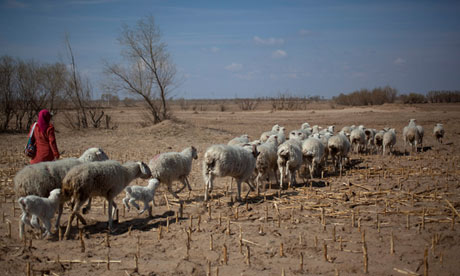
Desertification in China
A herder leads her sheep in search of grazing grounds in Inner Mongolia, which is fighting severe desertification. Photograph: How Hwee Young/EPA
Holistic management, with its counterintuitive claim that more, rather than fewer, cattle can improve the land, has been around for decades – a kind of perennial cattleman's quarrel, and a thorn in the hide of ranchers and anti-ranchers alike.
The use of livestock as a tool for restoration has been scoffed at by scientists, reviled by vegetarians and those who blame cows for climate change, and a flashpoint for tension over how to conserve land in the American West.

Reviving grasslands

But that was before Allan Savory, who developed holistic management, won the 2010 Buckminster Fuller Challenge for a programme with "significant potential to solve one of humanity's most pressing problems." And before governmental agencies such as USAID and large NGOs like the Nature Conservancy teamed up with the Savory Institute on international projects after seeing the benefits on the ground. And, in an era when one viral video makes the difference between anonymity and renown, before Savory's TED talk, How to Green the Desert and Reverse Climate Change, flew round the Internet with some 2m views.
At the end of June, I attended the first Savory Institute International Conference, Transforming Landscapes for Global Impact, in Boulder, Colorado. This two-day event, attended by 300 ranchers, scholars and investors from around the world, showed that holistic management is now launched as a global movement – one that's positioned itself as a vehicle for addressing seemingly intractable problems of climate change, desertification, and rural poverty.
The impetus is to bolster the deployment of holistic planned grazing to revive the grasslands of the world. Grasslands, also known as prairie, savanna, steppes or pampas, represent 40% of the world's land surface. Much of this land is desertifying, or losing the capacity to sustain life; more than 10m hectares of productive land succumb to desertification every year.

Deploying cows, sheep and yaks to fight desertification

Since I began exploring soil as a crucible for our many overlapping ecological and economic crises – and for solutions - I've been intrigued by holistic management's use of the humble cow, sheep, goat or, more exotically, camel or yak to remake the land. The results are most dramatic on "brittle" landscapes, that are dry much of the year and need to sustain moisture from one rainy season to the next.
Savory's insight is that grasslands and ungulates evolved together, so that the land needs animals in the same way that animals need the land. All domestic animals have an impact on land; this impact can be positive or negative, depending on how they are managed. Land can be overgrazed but it can also be undergrazed, meaning that it suffers from lack of animal impact.
This notion surprises many people, who assume that leaving land alone is always better. But when, say, cattle are moved in a planned way, their behaviour kickstarts key biological processes that might have stalled, a situation that could lead to desertification.


Read More Here


******************************************************************************
Enhanced by Zemanta