Local and Global Community News – Activism / Protests - Animal Advocacy - Animal Rescue- Archaeology/Anthropology/Paleontology/Crypto-zoology , Corporate Assault on our Lives and Our Health, Environmental- Internet/IT - Signs of the Times – Wildlife : News Affiliate of Family Survival Protocol.com
Interior
Sally Jewell testifies on Capitol Hill in Washington, Wednesday, Dec.
9, 2015, before the House Natural Resources Oversight Committee hearing
on the Animas River Spill in Colorado. (AP Photo/Manuel Balce Ceneta) more >
By Valerie Richardson - The Washington Times - Wednesday, December 9, 2015
Interior Secretary Sally Jewell
said Wednesday she is unaware of anyone being fired, fined or even
demoted for the Gold King Mine spill, prompting Republicans to accuse
her of taking the EPA off the hook for the toxic blowout.
“So you’re letting the EPA get off scot-free it sounds like. They are not being held accountable,” said Rep. Doug Lamborn, Colorado Republican, at the House Natural Resources Committee hearing.
Republicans took Ms. Jewell to task for the Interior Department’s
investigation into the Aug. 5 spill, saying the October report failed
to hold anyone responsible for unleashing 3 million gallons of orange,
toxic wastewater into the Animas River near Silverton, Colorado.
“You’re directly responsible for this report. The EPA
had promised this committee a thorough investigation,” said Rep. Tom
McClintock, California Republican. “We have not gotten one. What we have
gotten is a complete, deliberate whitewash.”
Licences
for more than half of the Kgalagadi transfrontier park, one of Africa’s
largest conservation areas, have been granted to drill for shale gas
The Kgalagadi transfrontier park straddles Botswana and South Africa
and is home to the cheetah and black-maned Kalahari lion. Photograph:
Jeffrey Barbee/Alliance Earth.org
Wednesday 2 December 2015 04.53 EST Last modified on Wednesday 2 December 2015 19.00 EST `
The Botswana
government has quietly sold the rights to frack for shale gas in one of
Africa’s largest protected conservation areas, it has emerged.
The Kgalagadi transfrontier park, which spans the border with South Africa,
is an immense 3 6,000 sq km wilderness, home to gemsbok desert
antelope, black-maned Kalahari lions and pygmy falcons. But
conservationists and top park officials – who were not informed of the
fracking rights sale – are now worried about the impact of drilling on
wildlife.
Prospecting licences for more than half of the park were
granted to a UK-listed company called Nodding Donkey in September 2014,
although the sale has not been reported previously. That company
changed its name earlier this month to Karoo Energy.
Park
officials said that no drilling has yet taken place, but the Guardian
found oil sediment on the ground near a popular camp site. There was an
overwhelming smell of tar and a drill stem protruded from an apparently
recently drilled hole. It is not known who had carried out the drilling
or when.
Scientist Gus Mills worked and lived in Kgalagadi for 18
years studying cheetahs and hyenas. He said he is worried about the
impact on wildlife and environment.
“The development that is going
to have to go on there, with infrastructure that has to be moved in,
seems to be yet another nail in the coffin of wild areas in the world.”
Dr Peter Apps, who studies large predators for the Botswana Predator Conservation Trust , said drilling could have a range of impacts, notably on water sources in the park.
Biodegradable is Bunk: World's 'Ocean Waste Baskets' Still Filled With Plastic Trash
Such
products 'will not bring about a significant decrease either in the
quantity of plastic entering the ocean or the risk of physical and
chemical impacts on the marine environment,' UN report states.
And
while they may be assumed to be more eco-friendly, plastics labeled
"biodegradable" still pose a threat to marine environments, a new United
Nations study has found.
The report from the UN Environment Programme (UNEP), Biodegradable Plastics and Marine Litter. Misconceptions, Concerns and Impacts on Marine Environments (pdf), explains how these products still fail to tackle the growing problem.
The
agency's executive director, Achim Steiner, underscored the magnitude
of the problem. "Recent estimates from UNEP have shown as much as 20
million tonnes of plastic end up in the world's oceans each year. Once
in the ocean, plastic does not go away, but breaks down into
microplastic particles."
The report notes that just what proportion of this plastic is biodegradable versus non-biodegradable has yet to be analyzed.
One
of the problems, the report states, is that in order for some of the
plastic debris to be completely broken down, conditions found in
industrial compositing units that can achieve prolonged temperatures of
above 50°C are needed. Yet those conditions "are rarely if ever met in
the marine environment."
And while some have the inclusion of a
pro-oxidant, which would induce degradation, "[t]he fate of these
fragments (microplastics) is unclear, but it should be assumed that
oxo-degradable polymers will add to the quantity of microplastics in the
oceans, until overwhelming independent evidence suggests otherwise."
Contributing
to the problem, the report says, is evidence suggesting the
biodegradable label could make the public more likely to litter.
The
report concludes that "the adoption of plastic products labelled as
'biodegradable' will not bring about a significant decrease either in
the quantity of plastic entering the ocean or the risk of physical and
chemical impacts on the marine environment, on the balance of current
scientific evidence."
Peter Kershaw, one of the authors of the study, put the problem in blunt terms.
"Essentially
the ocean is being used as a waste basket and the waste basket is
getting fuller and fuller, and so the impacts of that plastic litter are
just going to keep on increasing," he toldCBC News.
Finally,
there’s documented medical proof that electromagnetic hypersensitivity
is a real-time health issue that actually can be verified using standard
medical procedures and testing capabilities.
An international
group of researchers aced it when they published their findings from the
clinical study “Metabolic and Genetic Screening of Electromagnetic
Hypersensitive Subjects as a Feasible Tool for Diagnostics and
Intervention” in the November 2014 issue of Mediators of Inflammation.
So,
the million-dollar-question has to be, “When will utility companies get
up to speed on the latest in microwave technology damage to the human
body?” Also, “When will public utility commissions nationwide institute
proper procedures to protect consumers from such damage?”
Pennsylvanians
currently are being bombarded by non-thermal health problems from
public utility companies’ electric, natural gas and water Smart Meters,
which operate using microwave technology.
Furthermore, the PA
House Consumer Affairs Committee Chair Robert Godshall sits on Opt-Out
Bills that will permit electrosensitive consumers and others to keep
safe analog meters, which have been in use for decades.
UC
Davis researchers found plastic and fibrous debris in 25 percent of the
fish sold in Indonesian and California markets. (Dale Trockel/photo)
Roughly
a quarter of the fish sampled from fish markets in California and
Indonesia contained human-made debris — plastic or fibrous material — in
their guts, according to a study from the University of California,
Davis, and Hasanuddin University in Indonesia.
The study,
published today in the journal Scientific Reports, is one of the first
to directly link plastic and human-made debris to the fish on consumers’
dinner plates.
“It’s interesting that there isn’t a big difference in the amount
of debris in the fish from each location, but in the type — plastic or
fiber,” said lead author Chelsea Rochman, a David H. Smith postdoctoral
fellow in the Aquatic Health Program at the UC Davis School of
Veterinary Medicine. “We think the type of debris in the fish is driven
by differences in local waste management.”
‘Waiter, there’s some plastic in my fish’
The
researchers sampled 76 fish from markets in Makassar, Indonesia, and 64
from Half Moon Bay and Princeton in California. All of the fragments
recovered from fish in Indonesia were plastic. In contrast, 80 percent
of the debris found in California fish was fibers, whereas not a single
strand of fiber was found in Indonesian fish.
I
have to admit, even the title sounds disturbing! But I believe it’s
high time to stop sugar coating the reality we live in. I see in my
practice more and more children who share their parents’ nutritional
deficiencies and toxicity. Yes, a pure, innocent baby who’s barely
starting life is also touched by the harsh environment we live in these
days, and parents can pass down their imbalances to their baby. This
article is not supposed to offer a pessimistic view, but rather to help
raise awareness, prepare and teach you about how to better take care of
your children’s health.
This became really necessary considering that:
Environmental toxicity is one of the most important causes of chronic illness in the world today.
Heavy metals as well as petrochemicals play an important role in toxic buildup and disease.
Every
man, woman and child in the United States has at least one
petrochemical solvent in their blood stream and likely more than 100.
In the past 40 years, every single person tested in the United States has been found to have styrene in their blood…
…
and given that everyone has styrene in their blood, the excretion of
this petrochemical solvent in the urine should also show up on
everyone’s test.
The most symptomatic and chronically ill individuals are those with poor excretion patterns.
How Toxic Is Our World Today?
Over 80,000 man-made chemicals have been added to our environment. Most of them are toxins and a great many are carcinogens and endocrine disrupters. The situation with each passing year grows worse, not better. Toxins now pervade the air we breathe, the water we drink, the food we eat, and the seemingly endless array of body care products — toothpastes, mouthwashes, hair products, makeup, shampoos, soaps, lip balms, body lotions, sun products, etc.
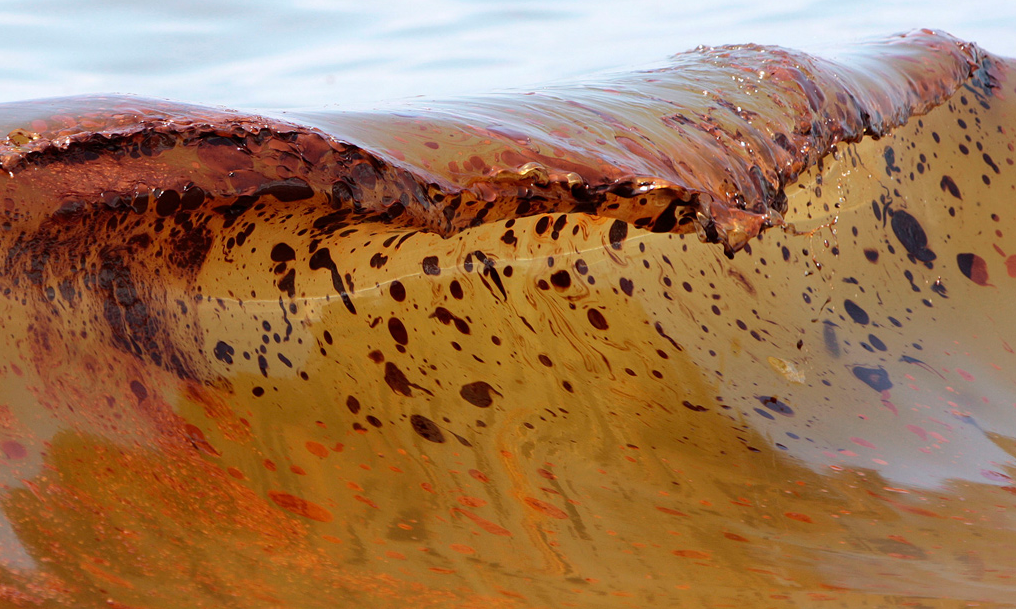
Study: Dispersants did not help oil degrade in BP spill
November 9, 2015 by By Seth Borenstein
Samantha Joye, a professor of marine sciences in the University of
Georgia Franklin College of Arts and Sciences, studies the oil plumes
generated by the 2010 Deepwater Horizon blowout. Credit: Todd
Dickey/University of Georgia The chemical
sprayed on the 2010 BP oil spill may not have helped crucial
petroleum-munching microbes get rid of the slick, a new study suggests.
And
that leads to more questions about where much of the Deepwater Horizon
oil spill went. If the new results are true, up to half the oil can't be
accounted for, said the author of a new study on the spill in the Gulf
of Mexico.
After the 172 million gallon (650 million liter) spill,
the chemical dispersant Corexit 9500 was applied by airplane on the
slick to help it go away and help natural microbes in the water eat the
oil faster. The oil appeared to dissipate, but scientists and government
officials didn't really monitor the microbes and chemicals, said
University of Georgia marine scientist Samantha Joye.
So Joye and
colleagues recreated the application in a lab, with the dispersant, BP
oil and water from the gulf, and found that it didn't help the microbes
at all and even hurt one key oil-munching bug, according to a study
published Monday in the journal Proceedings of the National Academy of Sciences.
"The
dispersants did a great job in that they got the oil off the surface,"
Joye said. "What you see is the dispersants didn't ramp up
biodegradation."
In fact, she found the oil with no dispersant "degraded a heckuva lot faster than the oil with dispersants," Joye said.
Since then we have seen little accountability, despite a nominal fine
against BP for its role in unleashing 4 million barrels of oil (approx.
200 million gallons). In fact, the EPA lifted a ban which subsequently
resulted in BP being awarded $40 Billion in new contracts, essentially erasing all that was “lost” by BP from their criminality.
Running in tandem with BP’s negligence was the use of Corexit 9500 oil dispersant (owned by Nalco, a Goldman Sachs subsidiary)
as a supposed means to drastically minimize the impact. Contrary to
that assertion, evidence continues to mount that it did the exact
opposite.
Early on, reports began to
surface of health anomalies that many believed were attributable to the
spraying of the chemical dispersant. Corexit was not only sprayed over
the water, but over houses as well. One family documented how all of them became sickened,
and afterward tested very high for chemical poisoning. A crew of
activists called Project Gulf Impact were on the scene to expose what
was taking place, and similarly reported sickness to their own crew, as well as suppression of their media coverage.
The
U.S. Environmental Protection Agency (EPA) announced Friday a proposal
that would ban a pesticide commonly sprayed on citrus fruits, almonds,
and other crops.
Chlorpyrifos has been
in use since 1965 as an insecticide for oranges, apples, cherries,
grapes, broccoli, and asparagus. Dozens of farmworkers have been
sickened by chlorpyrifos is recent years. In September 2014, a coalition
of environmental health groups sued the EPA, asking the agency to ban the toxic chemical.
The
agency cited scientific evidence in defense of its ban on chlorpyrifos
for household use in 2000. Prior to the ban, chlorpyrifos was the most
widely used household pesticide in the U.S. Sold as Dursban, the
Dow-made chemical was found in flea collars and was routinely used to
kill household pests, such as roaches, termites and ants.
At the
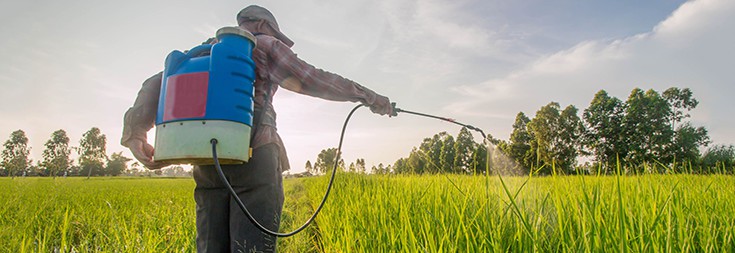
time, the agency warned that farmworkers who mixed chlorpyrifos, sold
for farms as Lorsban, or applied it using backpack sprayers or open-cab
tractors faced a potentially unacceptable level of risk. The agency also
said it needed to research how chlorpyrifos drifting from nearby fields
or tracked home on clothing put children’s health at risk.
The National Resources Defense Council (NRDC) and Pesticide Action Network North America (PANNA) say that chlorpyrifos interferes with the brain development of fetuses, infants and children. [1] It has also been found to cause genetic damage in children, though it is reversible, and one study linked the insecticide to an increased risk of autism in unborn children.
A
U.S. military burn pit at forward operating base Zeebrudge in Helmand
province, Afghanistan pictured in March 2013. (Photo: Sgt. Anthony L.
Ortiz)
Mainstream
media outlets are systematically disregarding the hazardous health
impacts of widespread U.S. military burn pits on civilians in Iraq and
Afghanistan, thereby playing a direct role in "legitimating the
environmental injustices of war," a harrowing new scholarly report concludes.
"During
the Iraq and Afghanistan wars, the US Department of Defense burned the
majority of its solid waste in open-air pits or trenches, producing
large amounts of potentially hazardous emissions," noted Eric Bonds,
assistant professor of sociology at University of Mary Washington, in
his investigation, published in the journal Environmental Politics.
"It
is well known that the uncontrolled burning of plastics, Styrofoam,
electronics, unexploded weapons, and other manufactured and highly
processed materials releases harmful toxins and particulate matter into
the air," Bonds continued.
"This echoes the
other history of Agent Orange when the U.S. government turned its back
on the people of Vietnam and walked away, cleaning up just a handful of
contaminated places but never acknowledging harm done to Vietnamese
civilians or compensating them for their suffering." —Eric Bonds, University of Mary Washington
However,
when he surveyed major U.S. newspaper stories from 2007 to 2014, Bonds
found that discussions of the negative health impacts of these burn pits
overwhelmingly focused on the plight faced by U.S. military service
members and veterans—but the actual civilians nearby were almost
entirely missing from the picture.
"The search produced 49
distinct stories. While five of these stories made passing reference to
civilian impacts, and one story mentioned potential impacts to civilians
on par with impacts to soldiers, the vast majority of news stories made
no mention that Iraqi and Afghan civilians might also have been harmed
by the U.S. military's burning of waste," he wrote.
What's more,
Bonds noted, "When journalists describe the pollution itself, how it
billowed over military bases and covered living quarters with ash and
soot, such accounts never mention that this pollution would not have
stopped at the cement barricades and concertina wire at base boundaries,
but must have also settled over civilians' homes and the surrounding
landscapes."
From Balad air base in
Iraq to Shindad base in Afghanistan, these sites are in fact located in
close proximity to "farmsteads, townships, cities, cropland, orchards,
and rivers."
As Common Dreamspreviously reported, Dr. Mozhgan Savabieasfahani, independent environmental toxicologist based in Ann Arbor, Michigan, has identified a correlation between burn pits and spikes in birth defects among Iraqi communities nearby.
According
to Bonds, by failing to tell the stories of the Iraqi and Afghan people
impacted, the media has a hand in the injustices committed against
them.
"This echoes the other history of Agent Orange when the U.S.
government turned its back on the people of Vietnam and walked away,
cleaning up just a handful of contaminated places but never
acknowledging harm done to Vietnamese civilians or compensating them for
their suffering," Bonds told Common Dreams.
As in
Vietnam, people in Iraq and Afghanistan are demanding acknowledgment
of—and reparations for—the harm done by U.S. burn pits and toxic
munitions.
Iraqi civil society groups including the Organization
of Women's Freedom in Iraq and the Federation of Workers Councils and
Unions in Iraq have organized
within their communities and levied international demands for the U.S.
to clean up its burn pits, depleted uranium, white phosphorous, and
other toxic waste which is creating an ongoing public health crisis in
Iraq.
This work is licensed under a Creative Commons Attribution-Share Alike 3.0 License
By Taylor Hill | Takepart.com 2 hours ago TakePart.com
.
View photo
Australia Approves Massive Coal Mine—Again
Just two months after an Australian federal court threw out
the government’s approval of one of the world’s largest coal mines
because of its expected impact on an endangered snake and lizard, the
country’s environment minister has green-lighted the project again.
That
means the Indian-owned Carmichael mine in the state of Queensland is
back on track to produce an amount of coal that, when burned, would
exceed the annual greenhouse gas emissions of 52 countries. Over its
60-year lifetime, it could emit 128 million tons of heat-trapping greenhouse gases, according to a Greenpeace report. Environmentalists also fear the project will damage the iconic Great Barrier Reef.
“Minister
[Greg] Hunt’s reapproval risks threatened species, precious
groundwater, the global climate, and taxpayers’ money,” said Peter
McCallum, spokesperson for the Mackay Conservation Group, which brought
the challenge of the mine to the federal court.
In
August, a federal court ruled that then Prime Minister Tony Abbott’s
conservative government had illegally ignored evidence showing the mine
would damage prime habitat of two endangered critters: the yakka skink—a
type of lizard—and the ornamental snake.
About
250 barrels of oil spilled from a platform in the North Sea during the
transfer of products to an oil tanker, Norwegian energy company Statoil
said. Statoil said the oil spill was discovered during the loaded of oil
from the Statfjord A platform in the North Sea to oil tanker Hilda
Knutsen. The company said in its latest update on the spill that about
250 barrels in total were released into the North Sea. "Further
assessment and investigations will uncover the scope and causes [of the
spill] in more detail," the company said in a statement. Loading to
Hilda Knutsen was halted, though operations at the Statfjord A platform
were proceeding as normal. Statoil said the relevant authorities were
notified, though there were no statements from the Norwegian Petroleum
Safety Authority. In January last year, the company shut down operations
at the Statfjord C platform after emergency systems detected an oil
leak. More than 250 crewmembers were evacuated to lifeboats but returned
to their living quarters later in the day. No injuries were reported.
Statoil said the weather in the area at the time of the Stratfjord C
incident was "harsh." Statoil said the region is producing an average
80,000 barrels of oil per day.
Norwegian
energy company Statoil said about 250 barrels of oil spilled during
incident at North Sea platform. Photo courtesy of Statoil
STAVANGER, Norway, Oct. 9 (UPI) --
About 250 barrels of oil spilled from a platform in the North Sea
during the transfer of products to an oil tanker, Norwegian energy
company Statoil said.
Statoil said the oil spill was discovered
during the loaded of oil from the Statfjord A platform in the North Sea
to oil tanker Hilda Knutsen. The company said in its latest update on the spill that about 250 barrels in total were released into the North Sea.
"Further
assessment and investigations will uncover the scope and causes [of the
spill] in more detail," the company said in a statement.
Loading to Hilda Knutsen was halted, though operations at the Statfjord A platform were proceeding as normal.
Child cancers up fiftyfold after Fukushima disaster
Damir Sagolj/Corbis
104 cases of thyroid cancer have been identified, a far higher rate than the national averageDamir Sagolj/Corbis
Richard Lloyd ParryTokyo
Last updated at 8:45AM, October 8 2015
Cases
of thyroid cancer among children living close to the Fukushima nuclear
power plant have increased fiftyfold since the meltdown in 2011,
according to Japanese scientists.
Study shows alarming thyroid cancer rates in children living near Fukushima
Associated PressSource:
Children
living near the Fukushima nuclear meltdowns have been diagnosed with
thyroid cancer at a rate 20 to 50 times that of children elsewhere.
A
young evacuee is screened at a shelter for leaked radiation from the
tsunami-ravaged Fukushima Dai-ichi nuclear plant in Fukushima,
Source: Associated Press
Most
of the 370,000 children in Fukushima prefecture (state) have been given
ultrasound checkups since the March 2011 meltdowns at the
tsunami-ravaged Fukushima Dai-ichi nuclear plant. The most recent
statistics, released in August, show that thyroid cancer is suspected or
confirmed in 137 of those children, a number that rose by 25 from a
year earlier. Elsewhere, the disease occurs in only about one or two of
every million children per year.
"This is more than expected and emerging faster than expected," lead author Toshihide Tsuda said.
Fukushima radiation hits home as thyroid cancer rises among children
Thyroid cancer rates were about 20 to 50 times the national average, according to the analysis.
By Elizabeth Shim | Oct. 8, 2015 at 2:19 PM
TOKYO, Oct. 8 (UPI) --
Fukushima radiation has been linked to a surge in thyroid cancer among
children near the disaster area, and radiation woes have reach South
Korea, where findings revealed imported tobacco from Japan contained
higher than normal levels of radioactive cesium.
A team of
Japanese researchers led by Toshihide Tsuda, a professor of
environmental epidemiology at Okayama University, said cases of thyroid
cancer in Fukushima Prefecture have skyrocketed since March 2011, Kyodo
News reported..
The rates were about 20 to 50 times the national
average, according to the analysis. The findings were based on
screenings of 370,000 Fukushima residents age 18 or younger, and the
culprit was increased radiation exposure since the Fukushima nuclear
disaster hit the area in March 2011. In late August, the prefecture had
identified 104 cases of thyroid cancer..
ASSOCIATED PRESSIn
this Tuesday, Feb. 3, 2015 photo, Genetha Campbell carries free water
being distributed at the Lincoln Park United Methodist Church in Flint,
Mich, Since the financially struggling city broke away from the Detroit
water system last year, residents have been unhappy with the smell,
taste and appearance of water from the city’s river as they await the
completion of a pipe to Lake Huron. They also have raised health
concerns, reporting rashes, hair loss and other problems. A General
Motors plant stopped using the water, saying it was rusting its parts.
(AP Photo/Paul Sancya)
DETROIT
(AP) -- A public health emergency has been declared in cash-strapped
Flint after tests showed the Michigan city's water supply is causing
elevated levels of lead in children and following months of complaints
about the smell and taste.
Gov. Rick Snyder
this week questioned the switch to the Flint River from the Detroit
water system in 2014, a decision that was made as a cost-saving move
while a new regional pipeline is built to Lake Huron.
And
on Thursday, the Genesee County health department declared a public
health emergency, recommending that people not drink the water unless it
has been filtered and tested to rule out elevated levels of lead. More
steps will be announced Friday.
The problem: Although the river water is treated, it is corrosive and releasing lead from old plumbing in thousands of homes.
A
coalition of residents and national groups petitioned the U.S.
Environmental Protection Agency to order the state to reconnect Flint to
Detroit water.
As we have covered extensively in recent months,
Monsanto’s herbicide Glysophate, the primary ingredient in their
top-selling product “RoundUp” has been proven to cause cancer. Now,
according to new reports, the chemical doesn’t even work and is creating a new resistance in weeds that make them more resiliant and more difficult to get rid of.
Nebraska farmer Mike Pietzyk recently discussed how the weeds are becoming resistant to RoundUp in a recent interview with Chemicals And Engineers News.
“The days of going out and spraying RoundUp twice a year—those are long gone,”
he said, adding that he was forced to use a cocktail of different
chemicals, some of which are even more dangerous than RoundUp. Pietzyk
and other farmers are now seeking new solutions to avoid the harsh
pesticides used in conventional farming.
“People
in urban areas and towns need to understand—we live here, we drink the
water under the ground out here,” he says. “We want to be good stewards
of what we’ve been entrusted with,” he said.
According to
U.S. weed scientist Dallas Peterson, one type of weed, in particular,
called Palmer amaranth, has become especially resistant to pesticides
and is overgrowing farms across the country.
Complaints of
herbicide-resistant weeds have become so common that the House
Agriculture Committee has scheduled a meeting on December 4th to
specifically address the situation.
Roundup, formulated to be used on GMO
or “Roundup Ready” crops engineered to be resistant to it, is the most
widely used herbicide in the world. It was originally introduced in the
1970s to control weeds and then took off when the planting of GMO crops
skyrocketed in the past 15 years.
According to a U.S. Geological Survey
(USGS), glyphosate use in the U.S. increased from about 20 million
pounds in 1992 to 110 million pounds in 2002 to more than 280 million
pounds in 2012.
In a statement
released earlier this year, the World Health Organization’s
International Agency for Research on Cancer (IARC) announced that
glyphosate, the main ingredient in RoundUp, is “probably carcinogenic.”
John Vibes
writes for True Activist and is an author, researcher and investigative
journalist who takes a special interest in the counter culture and the
drug war.
With
one person missing and presumed dead in an explosion at a natural gas
well in a small Pennsylvania town, the company responsible is now under
fire after apparently apologizing to the local community by handing out
vouchers for free pizza.
It took five days for emergency crews to
safely extinguish a fire that was set by an explosion that shook the
small town of Bobtown, located in the far southwestern corner of the
state. The blast gave off a loud hissing noise that could be heard from
hundreds of yards away.
One resident told the Pittsburgh
Post-Gazette that the explosion in a shale formation where Chevron Corp.
has spent time fracking “sounded like a jet engine going five feet above your house.” John Kuis, 57, of nearby Dilliner said his dog started growling unusually at 6:45 a.m. on February 11 “then the house just sort of shock and there was a big loud bang.”
At
least one employee who was working on the rig has not been found and is
widely thought to have been killed – either in the initial explosion or
during the five days the flames burned. Another worker was injured in
the event.
Chevron has denied any knowledge of what caused the
explosion. Company spokesman Ken Robertson told the local ABC affiliate
that workers were preparing to run tubing, which is done when wells are
being readied for production, and that “there is not enough fuel being
emitted to sustain combustion, and with the cooling of the crane, the
ignition source has been removed.”
The Philadelphia Daily News has
since discovered that residents of Bobtown – a census-designated
community of fewer than 1,000 people that revolves mostly around coal
mining – have started receiving coupons for one free pizza and a
two-liter of soda from the local Bobtown pizza.
“Chevron recognizes the effect this has had on the community,” the company said on its website. “We
value being a responsible member of this community and will continue to
strive to achieve incident-free operations. We are committed to taking
action to safeguard our neighbors, our employees, our contractors and
the environment.”
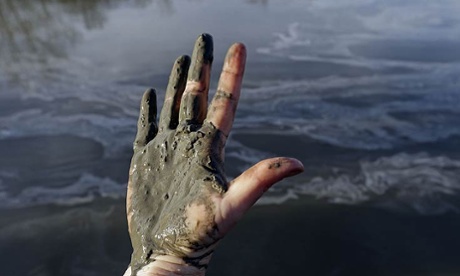
Officials said the coal ash is burying aquatic animals and their food. Photograph: Gerry Broome/AP
Federal officials said Tuesday that toxic coal ash has coated the
bottom of a North Carolina river as many as 70 miles downstream of a
Duke Energy dump where a massive spill occurred two weeks ago.
The
US Fish and Wildlife Service advised that a massive pile of coal ash
about 75ft long and as much as 5ft deep has been detected on the bottom
of the Dan river near the site of the February 2 spill. Deposits varying
from 5in deep to less than 1in coated the river bottom across the state
line into Virginia and to Kerr Lake, a major reservoir.
Federal
authorities expressed concern for what long-term effect the contaminants
will have on fish, mussels and other aquatic life. Public health
officials have advised people to avoid contact with the water and not
eat the fish.
“The deposits vary with the river characteristics,
but the short- and long-term physical and chemical impacts from the ash
will need to be investigated more thoroughly, especially with regard to
mussels and fish associated with the stream bottom and wildlife that
feed on benthic invertebrates,” said Tom Augspurger, a contaminants
specialist at the federal wildlife agency. Benthic invertebrates are
small animals that live in the sediments of rivers and lakes, such as
clams, worms and crustaceans.
RALEIGH,
N.C. (AP) — North Carolina officials said Tuesday that groundwater
containing unsafe levels of arsenic apparently leaching from a Duke Energy coal ash dump is still pouring into the Dan River, which is already contaminated from a massive Feb. 2 spill.
The state Department of Environment and Natural Resources
ordered Duke to stop the flow of contaminated water coming out a pipe
that runs under a huge coal ash dump at its Eden power plant. A nearby
pipe at the same dump collapsed without warning two weeks ago, coating
the bottom of the Dan River with toxic ash as far as 70
miles downstream.
State
regulators expressed concern five days ago that the second pipe could
fail, triggering a new spill. The water coming out of that pipe contains
poisonous arsenic at 14 times the level considered safe for human
contact, according to test results released by the state on Tuesday.
"We are ordering Duke Energy to eliminate this unauthorized discharge immediately," said Tom Reeder, director of the N.C. Division of Water Resources.
Video
taken last week by a robot sent inside the 36-inch-wide concrete pipe
showed wide gaps between seams through which groundwater is gushing in,
likely from the toxic dump above.
Tests
on water from the pipe before it goes under the dump showed none of the
dangerous contamination detected at the other end. The concrete inside
the pipe is heavily stained around the numerous leaks, suggesting the
contamination is likely not new.
A
state inspector received the video recorded by Duke during a Feb. 11
visit to the site, but did not review it until Thursday. On Friday
night, the state agency went public with concerns about the pipe's
structural integrity.
Duke spokeswoman Paige Sheehan quickly issued a statement, downplaying the risk.
"After reviewing the videotape, we determined that no immediate action was necessary," it said.
In
the wake of the initial spill, public health officials issued
advisories telling people to avoid contact with the river water and not
eat the fish.
Authorities
said public drinking water in Danville, Va., and other communities
downstream of the Duke plant remain safe. Heavy metals detected in the
river at levels exceeding state and federal safety standards — including
arsenic, lead and selenium — are being successfully filtered out of
water drawn from the river at municipal treatment plants, they said.
The U.S. Fish and Wildlife Service
said Tuesday a massive pile of coal ash about 75 feet long and as much
as 5 feet deep has been detected in the river by the site of the Feb. 2
spill. Deposits varying from 5 inches deep to less than 1 inch coated
the river bottom across the state line into Virginia and to Kerr Lake, a
major reservoir.
Federal
authorities expressed concern for what long-term effect the
contaminants will have on fish, mussels and other aquatic life.
"The
deposits vary with the river characteristics, but the short- and
long-term physical and chemical impacts from the ash will need to be
investigated more thoroughly, especially with regard to mussels and fish
associated with the stream bottom and wildlife that feed on benthic
invertebrates," said Tom Augspurger, a contaminants specialist at the federal wildlife agency.