Local and Global Community News – Activism / Protests - Animal Advocacy - Animal Rescue- Archaeology/Anthropology/Paleontology/Crypto-zoology , Corporate Assault on our Lives and Our Health, Environmental- Internet/IT - Signs of the Times – Wildlife : News Affiliate of Family Survival Protocol.com
Empty
coal gondolas in a rail yard in Danville, W.Va. Patrick Morrisey, West
Virginia's attorney general, said President Obama's climate change
regulations would have "devastating impacts" on families in his state.Credit Luke Sharrett for The New York Times
WASHINGTON — As many as 25 states will join some of the nation’s most influential business groups in legal action to block President Obama’s climate change regulations when they are formally published Friday, trying to stop his signature environmental policy.
In August, the president announced in a White House ceremony that the Environmental Protection Agency rules had been completed, but they had not yet been published in the government’s Federal Register.
Within hours of the rules’ official publication on Friday, a legal
battle will begin, pitting the states against the federal government. It
is widely expected to end up before the Supreme Court.
“I
predict there will be a very long line of people at the federal
courthouse tomorrow morning, eagerly waiting to file their suits on this
case,” said Jeffrey R. Holmstead, a lawyer for the firm Bracewell &
Giuliani who represents several companies that are expected to file
such suits.
While
the legal brawls could drag on for years, many states and companies,
including those that are suing the administration, have also started
drafting plans to comply with the rules. That strategy reflects the
uncertainty of the ultimate legal outcome — and also means that many
states could be well on the way to implementing Mr. Obama’s climate plan
by the time the case reaches the Supreme Court.
By Taylor Hill | Takepart.com 2 hours ago TakePart.com
.
View photo
Australia Approves Massive Coal Mine—Again
Just two months after an Australian federal court threw out
the government’s approval of one of the world’s largest coal mines
because of its expected impact on an endangered snake and lizard, the
country’s environment minister has green-lighted the project again.
That
means the Indian-owned Carmichael mine in the state of Queensland is
back on track to produce an amount of coal that, when burned, would
exceed the annual greenhouse gas emissions of 52 countries. Over its
60-year lifetime, it could emit 128 million tons of heat-trapping greenhouse gases, according to a Greenpeace report. Environmentalists also fear the project will damage the iconic Great Barrier Reef.
“Minister
[Greg] Hunt’s reapproval risks threatened species, precious
groundwater, the global climate, and taxpayers’ money,” said Peter
McCallum, spokesperson for the Mackay Conservation Group, which brought
the challenge of the mine to the federal court.
In
August, a federal court ruled that then Prime Minister Tony Abbott’s
conservative government had illegally ignored evidence showing the mine
would damage prime habitat of two endangered critters: the yakka skink—a
type of lizard—and the ornamental snake.
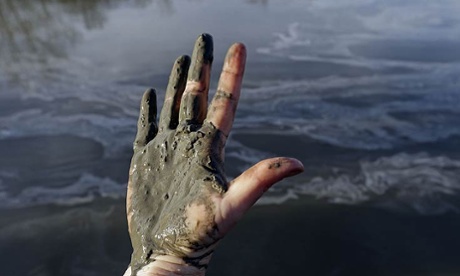
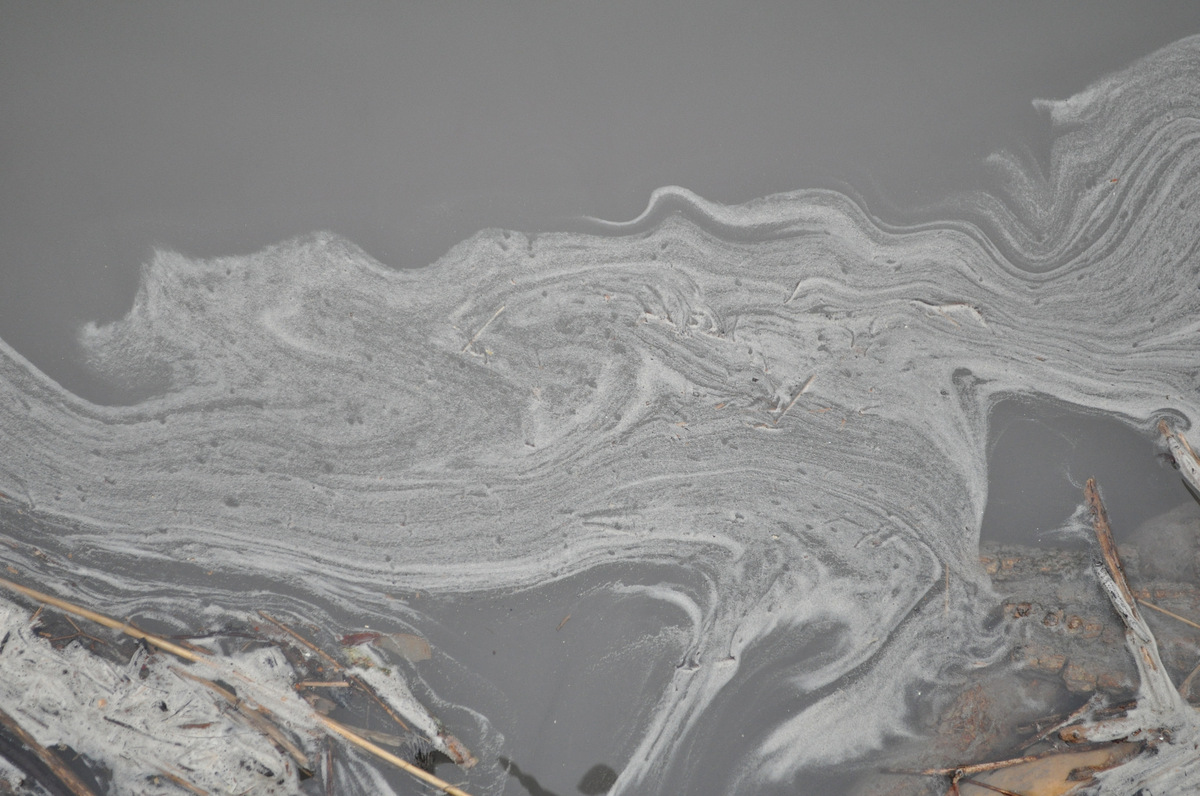
Officials said the coal ash is burying aquatic animals and their food. Photograph: Gerry Broome/AP
Federal officials said Tuesday that toxic coal ash has coated the
bottom of a North Carolina river as many as 70 miles downstream of a
Duke Energy dump where a massive spill occurred two weeks ago.
The
US Fish and Wildlife Service advised that a massive pile of coal ash
about 75ft long and as much as 5ft deep has been detected on the bottom
of the Dan river near the site of the February 2 spill. Deposits varying
from 5in deep to less than 1in coated the river bottom across the state
line into Virginia and to Kerr Lake, a major reservoir.
Federal
authorities expressed concern for what long-term effect the contaminants
will have on fish, mussels and other aquatic life. Public health
officials have advised people to avoid contact with the water and not
eat the fish.
“The deposits vary with the river characteristics,
but the short- and long-term physical and chemical impacts from the ash
will need to be investigated more thoroughly, especially with regard to
mussels and fish associated with the stream bottom and wildlife that
feed on benthic invertebrates,” said Tom Augspurger, a contaminants
specialist at the federal wildlife agency. Benthic invertebrates are
small animals that live in the sediments of rivers and lakes, such as
clams, worms and crustaceans.
RALEIGH,
N.C. (AP) — North Carolina officials said Tuesday that groundwater
containing unsafe levels of arsenic apparently leaching from a Duke Energy coal ash dump is still pouring into the Dan River, which is already contaminated from a massive Feb. 2 spill.
The state Department of Environment and Natural Resources
ordered Duke to stop the flow of contaminated water coming out a pipe
that runs under a huge coal ash dump at its Eden power plant. A nearby
pipe at the same dump collapsed without warning two weeks ago, coating
the bottom of the Dan River with toxic ash as far as 70
miles downstream.
State
regulators expressed concern five days ago that the second pipe could
fail, triggering a new spill. The water coming out of that pipe contains
poisonous arsenic at 14 times the level considered safe for human
contact, according to test results released by the state on Tuesday.
"We are ordering Duke Energy to eliminate this unauthorized discharge immediately," said Tom Reeder, director of the N.C. Division of Water Resources.
Video
taken last week by a robot sent inside the 36-inch-wide concrete pipe
showed wide gaps between seams through which groundwater is gushing in,
likely from the toxic dump above.
Tests
on water from the pipe before it goes under the dump showed none of the
dangerous contamination detected at the other end. The concrete inside
the pipe is heavily stained around the numerous leaks, suggesting the
contamination is likely not new.
A
state inspector received the video recorded by Duke during a Feb. 11
visit to the site, but did not review it until Thursday. On Friday
night, the state agency went public with concerns about the pipe's
structural integrity.
Duke spokeswoman Paige Sheehan quickly issued a statement, downplaying the risk.
"After reviewing the videotape, we determined that no immediate action was necessary," it said.
In
the wake of the initial spill, public health officials issued
advisories telling people to avoid contact with the river water and not
eat the fish.
Authorities
said public drinking water in Danville, Va., and other communities
downstream of the Duke plant remain safe. Heavy metals detected in the
river at levels exceeding state and federal safety standards — including
arsenic, lead and selenium — are being successfully filtered out of
water drawn from the river at municipal treatment plants, they said.
The U.S. Fish and Wildlife Service
said Tuesday a massive pile of coal ash about 75 feet long and as much
as 5 feet deep has been detected in the river by the site of the Feb. 2
spill. Deposits varying from 5 inches deep to less than 1 inch coated
the river bottom across the state line into Virginia and to Kerr Lake, a
major reservoir.
Federal
authorities expressed concern for what long-term effect the
contaminants will have on fish, mussels and other aquatic life.
"The
deposits vary with the river characteristics, but the short- and
long-term physical and chemical impacts from the ash will need to be
investigated more thoroughly, especially with regard to mussels and fish
associated with the stream bottom and wildlife that feed on benthic
invertebrates," said Tom Augspurger, a contaminants specialist at the federal wildlife agency.
West
Virginia Governor Earl Ray Tomblin speaking at a press conference
following the Jan. 9 Elk River spill. (Photo via The Lincoln Journal)Seeking the opinions of 'stakeholders' for new proposed legislation meant to prevent future toxic chemical leaks like the January 9 Elk River spill, West Virginia Governor Earl Ray Tomblin invited a host of industry leaders and trade associations to weigh in.
However, notably absent from the talks were any environmentalists or public health officials, according to an investigative report by the Charleston Gazette published Tuesday.
West Virginia journalist Ken Ward Jr. reports:
The
West Virginia Chamber of Commerce was invited. So were the Oil and Gas
Association and the Coal Association. Trade associations representing
grocers, manufacturers, trucking firms and energy companies were
included, according to the Governor's Office.
But the chief
lobbyist for the West Virginia Environmental Council — the environmental
community's umbrella lobby group at the Capitol — said that his
organization wasn't included in the governor's meeting.
"Neither I
nor anyone else I know of in the environmental community knew about
that meeting," Garvin said Monday. "You telling me about it is the first
I've heard about that meeting."
"If you want a bill
that protects clean water, you should probably listen to people who
advocate for clean water, not the polluters," said West Virginia Sierra
Club leader Jim Kotcon at a public hearing Monday night.
At the
same meeting, West Virginia Coal Association Vice President Chris
Hamilton said that he and other industry leaders "stand ready to offer
our resources and expertise" in crafting the legislation.
The Gazette
learned of the Jan. 20 closed-door meeting through documents released
in a Freedom of Information Act Request about the proposed legislation.
The
bill reportedly creates a new regulatory program for aboveground
chemical storage tanks—such as the Freedom Industries tanks from which
10,000 gallons of coal cleaning chemicals spilled into the regional
water supply.
Also included in the documents were "email messages
in which several prominent industry lawyers and lobbyists offered
suggestions for the governor's legislation," Ward reports.
Both the governor's bill, introduced on Jan. 22, and one passed a week later by the state Senate included versions of those recommendations.
_____________________
This work is licensed under a Creative Commons Attribution-Share Alike 3.0 License.
.....
February 4, 2014
Tomblin meeting on chemical tank bill excluded environmentalists
By Ken Ward Jr.
CHARLESTON,
W.Va. -- Two weeks ago, Gov. Earl Ray Tomblin held a news conference to
announce his legislative response to the Elk River chemical leak. The
governor unveiled proposed legislation aimed at creating a new
regulatory program for aboveground chemical storage tanks.
"This
proposed legislation includes reasonable, commonsense provisions to
regulate aboveground storage tanks across the state, including those
located in areas of critical concern near our public water supply and
distribution systems," the governor said at the Jan. 20 news conference.
A
day earlier, a select group of business lawyers and industry lobbyists
met with the governor's staff and officials from the state Department of
Environmental Protection to go over the governor's bill.
"See
everyone there and please be prepared to discuss the bill section by
section," Jason Pizatella wrote in an email message announcing the
meeting.
Pizatella called the event a meeting "with the stakeholders."
The
West Virginia Chamber of Commerce was invited. So were the Oil and Gas
Association and the Coal Association. Trade associations representing
grocers, manufacturers, trucking firms and energy companies were
included, according to the Governor's Office.
But the chief
lobbyist for the West Virginia Environmental Council -- the
environmental community's umbrella lobby group at the Capitol -- said
that his organization wasn't included in the governor's meeting.
"Neither
I nor anyone else I know of in the environmental community knew about
that meeting," Garvin said Monday. "You telling me about it is the first
I've heard about that meeting."
Asked what discussions the
environmental council had about the governor's bill prior to its
unveiling at that news conference, Garvin said, "There were none."
Garvin
said that environmental group lobbyists weren't asked by the Governor's
Office for their input as the bill was developed, and had only brief,
informal discussions with DEP officials prior to the legislation being
introduced.
"I've had some just offhand discussions with DEP,"
Garvin said. "Other than that, we really weren't given an opportunity to
just sit down and tell the DEP or the governor what we thought."
Pizatella's
announcement of the "stakeholders" meeting, held at the state Lottery
Commission building on Pennsylvania Avenue on a Sunday afternoon, was
among the records released by the Governor's Office in response to a
Freedom of Information Act request about the chemical tank legislation.
Also
included were email messages in which several prominent industry
lawyers and lobbyists offered suggestions for the governor's legislation
-- before the bill was finalized Jan. 20 or introduced Jan. 22. Read More Here
EDEN, N.C. (AP) — A pipe under a coal ash pond broke in
northern North Carolina, releasing an unknown amount of coal ash into
the Dan River, Duke Energy Corp. said Monday.
The pipe broke
Sunday afternoon at the now-closed Dan River Steam Station in Eden, the
utility said. The ash pond covers about 27 acres, and the dam holding
the water in was not affected by the leak, officials said.
A water quality-monitoring team is checking the river, but Duke Energy said downstream water supplies have not been affected.
Officials
in Danville, Va., which draws its water from the Dan River downstream
from the ash pond, said the spill did not affect the quality of the
city's water supply.
"All water leaving our treatment facility has
met public health standards. We do not anticipate any problems going
forward in treating the water we draw from the Dan River," said Barry
Dunkley, division director of water and wastewater treatment for
Danville Utilities.
The N.C. Department of Environment and Natural
Resources said in a statement that it is investigating, as well as
helping to monitor water quality and work with Duke energy to clean up
the spill.
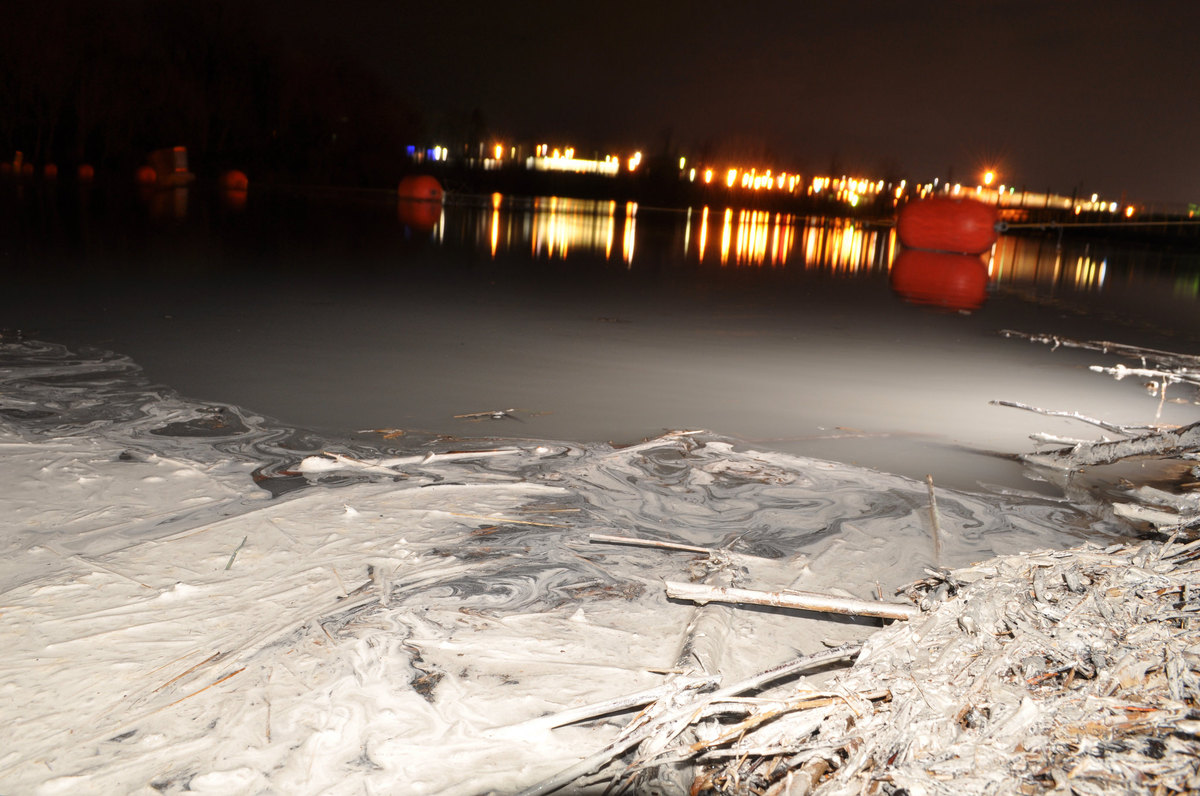
Photo courtesy of Appalachian Voices.
Engineers have not figured out exactly how much ash and
water made it into the Dan River in Rockingham County, although Duke
Energy promised to make that figure public as soon as calculations are
complete.
INSTITUTE INDEX: Duke Energy coal ash spill latest in ongoing regulatory disaster
Date
on which a break in a stormwater pipe beneath a coal ash disposal pit
at a shuttered Duke Energy power plant near Eden, N.C. contaminated the
Dan River with toxic coal ash: 2/2/2014
Estimated
tons of coal ash -- which contains toxins including arsenic, lead,
mercury, and radioactive elements -- that were released to the river: 50,000 to 82,000
Number of Olympic-size swimming pools that amount of coal ash would fill: 20 to 32
Estimated gallons of coal ash-contaminated water from the storage pit that also reached the river: 24 million to 27 million
Number of rail cars the toxic pollution could fill: 413 to 677
Rank of the spill among the largest coal ash spills in U.S. history: 3
Hours that Duke Energy waited from the time it discovered the spill to report it to the public: 26
Miles downstream of the spill site that Danville, Va. draws its drinking water: 6
Age in years of Duke Energy's Dan River ash pits: 53
Year
in which Environmental Protection Agency (EPA) inspections found
problems with leakage at the plant's coal ash dam as well as dilapidated
and poorly maintained stormwater pipes: 2009
Number of coal-fired power plants that Duke Energy owns across North Carolina: 14
Percent of those plants where there have been unpermitted discharges of coal ash to the environment: 100
Amount
that is being spent to run a municipal water line to the North Carolina
community of Flemington because a leaky Duke Energy coal ash pit
contaminated the local groundwater supply: $2.25 million Read More Here
.....
Breaking: Duke Energy Coal Ash Spill Pollutes River and Threatens Drinking Water
[This is the first article in a two-part series. Read part two.]
Yesterday
afternoon, Duke Energy reported that it spilled between 50,000 to
82,000 tons of coal ash into the Dan River near Eden, NC. To put the
volume in perspective, the spill is the equivalent of 413 to 677 rail
cars of wet coal ash poured into a public drinking water source. The
spill is located on a stretch of the Dan River between Eden, NC and
Danville, VA. An estimated 22 million gallons of coal ash could already be in the Dan River moving downstream.
Equally disturbing is that neither Duke Energy nor any of the
government regulators issued a press release and informed the public
about this massive spill until 24 hours after it was discovered. If a
freight train full of this toxic waste had derailed, there would have
been immediate notification and quick news coverage in order to inform
and protect the public. The delay in reporting this spill is
inexcusable.
A security guard who noticed unusually low water in the ash pond at
the shuttered coal plant led to the discovery of the spill. This means
most of the water had escaped and contaminated the river before anyone
at Duke noticed.
Upon investigation, Duke discovered that a 48-inch stormwater pipe
underneath the unlined 27-acre, 155-million-gallon ash pond broke Sunday
afternoon and drained tens of thousands of tons of coal ash and water
into the Dan River.
Activists
from Energietisch, the organization leading the push to get Berlin to
bid for the city's grid, protest in front of Berlin's famous Brandenburg
Gate. The large yellow sign reads, "Referendum. New Energy for Berlin.
Democratic, Ecological, Social." The small black sign reads, "Pull the
Plug on Vatenfall." Credit: UweHiksch, flickr BERLIN, Germany—A
decision 90 years ago by the people of Sacramento, Calif. to oust a
private electric company and start a government-owned utility has been
the unlikely inspiration for Berliners trying to wrest control of
Germany's largest grid from a coal-fired utility.
While little known in America, the creation of Sacramento's Municipal Utility District
was the model for a November referendum to give Berlin a municipal
utility that would pump more clean energy into the grid. The 1923 vote
in Sacramento helped the California city build a rare, green
record—constructing the nation's first big solar plant, voting to shut
down a nuclear reactor and approving a goal of slashing climate-changing
emissions by 90 percent by 2050.
"Sacramento stopped nuclear with direct elections," said Stefan Taschner, spokesperson for Energietisch, the group behind the push to take over Berlin's grid. It provides the "best example of democratic control."
Berlin's
referendum failed by a tiny margin—but it's not the end of the story.
The contract to operate the grid expires at the end of next year, and
the near-approval sent a strong message to the mayor and other officials
that the city should buy the contract. The referendum needed 25 percent
of Berlin's 2.5 million registered voters to pass; it missed that mark
by less than 1 percent.
It seems unlikely that Berliners would
look to Sacramento, or anywhere but their own country, for a model on
how to build a greener grid—given that Germany is driving the world's most aggressive clean energy transformation.
But Berlin has been largely left out of the shift, and activists here
have been scrambling for tactics to limit influence of corporate fossil
fuel interests. Less than 2 percent of the electricity produced in
Berlin comes from renewables, compared to 25 percent in Germany overall.
The vast majority of Berlin's electricity is coal-fired and generated by energy giant Vattenfall, whose parent company won a contract in 1994 to operate the grid for 20 years.
Ending the privatization of energy is a major part of the Energiewende,
Germany's plan to transition to renewables from fossil fuels and
nuclear. A 2000 law gave citizens incentives to produce their own clean
power and compete with utilities. As a result, 51 percent of the
country's renewable power capacity is now owned by individuals who have
built solar on rooftops and wind turbines on farms. That has left
Germany's "Big Four" utilities, including Vattenfall, with just a
sliver—6.5 percent—of this burgeoning sector. Read More Here
(Reuters) - Poland could halve its demand for coal
by 2030 with a shift to renewable energies that would end its image as a
laggard in European Union efforts to slow climate change, a study
showed on Friday. The report, by researchers in Germany
and Poland, renewable energy groups and environmental group Greenpeace,
included a foreword by ex-Polish Environment Minister Maciej Nowicki
who called it a "feasible, realistic scenario".
It estimated that Poland, which now generates 90 percent of its electricity from coal, could create 100,000 jobs with a shift to wind, hydro, biomass, geothermal and solar power by 2030.
The scenario would require investment of $264 billion, double the $132 billion cost of business
as usual. Still, free renewable energies would be cheaper in the long
run by eliminating costs of fuel to generate electricity, it said.
Poland
"has a once-in-a-generation opportunity to move beyond coal," it said.
"Poland is home to a geriatric energy system, based on coal. Its power
plants are old with about 70 percent of them being over 30 years old."