Showing posts with label jobs. Show all posts

Saturday, December 12, 2015

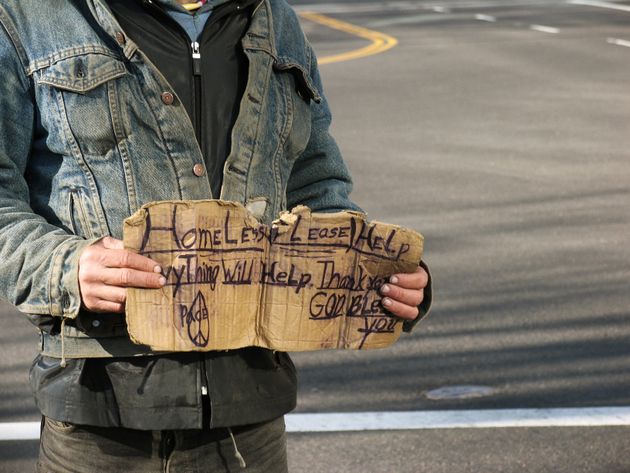
Albuquerque officials are working to reform their policies of mistreating and at times, outright persecuting, homeless people by offering jobs to people on the streets.


Instead Of Arresting Panhandlers, Albuquerque's Giving Them Jobs

Five people have found full-time employment since the program started in September.

12/09/2015 02:12 pm ET

Kevin Russ via Getty Images
 
Albuquerque officials are working to reform their policies of mistreating and at times, outright persecuting, homeless people by offering jobs to people on the streets.

After a series of incidents of police brutality, which included the fatal shooting of a schizophrenic homeless man this year, advocates and the Justice Department demanded that the Albuquerque Police Department overhaul its approach to how it treats homeless people and people with mental illness, The New York Times reported. And part of that reform includes a program that scouts homeless people and offers them jobs.

The city, together with St. Martin’s Hospitality Center, an organization that provides services to homeless people, dispenses outreach workers who offer odd jobs -- which have the potential of turning into full-time opportunities -- to people on the streets, according to KOAT.


Read More Here

Tuesday, November 3, 2015

Industrial hemp poised to become NC’s newest legal crop


.

Legalization bill will become law unless McCrory vetoes
Spring Hope has one of the only hemp processing plants in the country
Supporters battle stigma: ‘We’re for rope, not dope’

 
Read More Here

Thursday, October 22, 2015

Numerous States Prepare Lawsuits Against Obama’s Climate Policy


Photo
 
Empty coal gondolas in a rail yard in Danville, W.Va. Patrick Morrisey, West Virginia's attorney general, said President Obama's climate change regulations would have "devastating impacts" on families in his state. Credit Luke Sharrett for The New York Times 
 
WASHINGTON — As many as 25 states will join some of the nation’s most influential business groups in legal action to block President Obama’s climate change regulations when they are formally published Friday, trying to stop his signature environmental policy.

In August, the president announced in a White House ceremony that the Environmental Protection Agency rules had been completed, but they had not yet been published in the government’s Federal Register. Within hours of the rules’ official publication on Friday, a legal battle will begin, pitting the states against the federal government. It is widely expected to end up before the Supreme Court.
“I predict there will be a very long line of people at the federal courthouse tomorrow morning, eagerly waiting to file their suits on this case,” said Jeffrey R. Holmstead, a lawyer for the firm Bracewell & Giuliani who represents several companies that are expected to file such suits.

 
While the legal brawls could drag on for years, many states and companies, including those that are suing the administration, have also started drafting plans to comply with the rules. That strategy reflects the uncertainty of the ultimate legal outcome — and also means that many states could be well on the way to implementing Mr. Obama’s climate plan by the time the case reaches the Supreme Court.


Read More Here

Monday, October 19, 2015

Many Low-Income Workers Say ‘No’ to Health Insurance


MSN News

Many Low-Income Workers Say ‘No’ to Health Insurance

By STACY COWLEY
 

An employee at Golden Corral taking clean cups from the kitchen. Some Golden Corral restaurants began offering health insurance to employees, but few have opted in.© Logan R. Cyrus for The New York Times An employee at Golden Corral taking clean cups from the kitchen. Some Golden Corral restaurants began offering health insurance to employees, but few have…
 
 JACKSONVILLE, N.C. — When Billy Sewell began offering health insurance this year to 600 service workers at the Golden Corral restaurants that he owns, he wondered nervously how many would buy it. Adding hundreds of employees to his plan would cost him more than $1 million — a hit he wasn’t sure his low-margin business could afford.
His actual costs, though, turned out to be far smaller than he had feared. So far, only two people have signed up.

“We offered, and they didn’t take it,” he said.

Evidence is growing that his experience is not unusual. The Affordable Care Act’s employer mandate, which requires employers with more than 50 full-time workers to offer most of their employees insurance or face financial penalties, was one of the law’s most controversial provisions. Business owners and industry groups fiercely protested the change, and some companies cut workers’ hours to reduce the number of employees who would be eligible.

But 10 months after the first phase of the mandate took effect, covering companies with 100 or more workers, many business owners say they are finding very few employees willing to buy the health insurance that they are now compelled to offer. The trend is especially pronounced among smaller and midsize businesses in fields filled with low-wage hourly workers, like restaurants, retailing and hospitality. (Companies with 50 to 99 workers are not required to comply with the mandate until next year.)


Read More Here

Friday, October 9, 2015

Hundreds of outraged Air France staff stormed a meeting where Company plans to cut 2,900 jobs were being discussed. Execs had shirts torn from their backs as they escaped the angry mob


No need to get shirty! Air France executive is forced to climb a fence after staff attack him and rip off his shirt when he announces 2,900 job losses

  • Air France executives attacked after staff stormed company headquarters
  • Company plans to cut 2,900 jobs and 14 aircraft from its long-haul fleet
  • HR vice president and long-haul flights deputy had their shirts torn off
Air France managers have been forced to flee the company's headquarters after being attacked by a baying mob of workers that tore their clothes off.
Hundreds of angry staff stormed the Air France building at the Charles de Gaulle International Airport in Roissy, near Paris, after the company announced plans to cut 2,900 jobs on Monday.
Two senior executives, Xavier Broseta, Vice President for Human Resources, and Pierre Plissonnier, deputy of Air France long-haul flights, both had their shirts ripped off their backs as they were evacuated through the crowds.

Under attack: A shirtless Xavier Broseta, Executive Vice President for Human Resources at Air France, is evacuated by security after employees interrupted a meeting with representatives staff at the Air France headquarters building at the Charles de Gaulle International Airport in Roissy, near Paris
Shortly before the attack, Mr Broseta and Air France Chief Executive Frederic Gagey had outlined a drastic cost cutting plan, which would see 2,900 jobs cut by 2017.
The cuts include 1,700 ground staff, 900 cabin crew and 300 pilots, as part of efforts to lower costs, two union sources said.
Air France also confirmed in the meeting that it plans to shed 14 aircraft from its long-haul fleet, reducing the business by ten per cent, and that it wants to cancel its order for Boeing 787 Dreamliner aircraft.
This outraged staff, who are already at loggerheads with the company, and hundreds stormed the building, interrupting the meeting.
  
Mr Broseta and Mr Plissonnier were aided by security as they tried to escape the baying mob

Saturday, May 10, 2014

UK : Jobseekers face losing their benefits for three months or more if they refuse to take zero-hours contract roles, a letter from a Conservative minister has revealed.

Jobseekers being forced into zero-hours roles

Letter from Conservative minister reveals plans to sanction unemployed people if they fail to agree to controversial contracts
Jobseekers
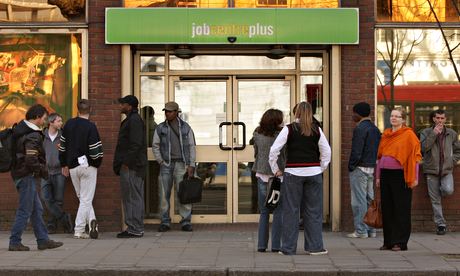
Jobseekers queue outside a Jobcentre Plus branch at London Bridge. Photograph: Oli Scarff/Getty Images

For the first time, benefit claimants are at risk of sanctions if they do not apply for and accept certain zero-hours jobs under the new universal credit system, despite fears that such contracts are increasingly tying workers into insecure and low paid employment.
Last week, the Office for National Statistics revealed the number of contracts that do not guarantee minimum hours of work or pay but require workers to be on standby had reached 1.4 million.
More than one in 10 employers are using such contracts, which are most likely to be offered to women, young people and people over 65. The figure rises to almost half of all employers in the tourism, catering and food sector.
Currently, people claiming jobseekers' allowance are not required to apply for zero-hours contract vacancies and they do not face penalties for turning them down.
However, the change in policy under universal credit was revealed in a letter from Esther McVey, an employment minister, to Labour MP Sheila Gilmore, who had raised the issue of sanctions with her.
The senior Tory confirmed that, under the new system, JobCentre "coaches" would be able to "mandate to zero-hours contracts", although they would have discretion about considering whether a role was suitable.
Separately, a response to a freedom of information request to the Department for Work and Pensions (DWP) published on its website reveals: "We expect claimants to do all they reasonably can to look for and move into paid work. If a claimant turns down a particular vacancy (including zero-hours contract jobs) a sanction may be applied, but we will look into the circumstances of the case and consider whether they had a good reason."
Higher level sanctions – imposed if a jobseeker refuses to take a position without good reason or leaves a position voluntarily – will lead to a loss of benefits for 13 weeks on the first occasion, 26 weeks on the second occasion and 156 weeks on the third occasion.
Asked about the issue by the Guardian, the DWP said jobseekers would not be required to take a zero-hours contract that tied them in exclusively to work for a single employer. The government is already consulting on whether to ban this type of contract altogether.
The change has been made possible because universal credit will automatically adjust the level of benefits someone receives depending on the number of hours they work. This means claimants should not face periods without the correct benefits when their earnings fluctuate or they change job.
However, critics raised concerns that the new policy will force people into uncertain employment and restrict the ability of claimants to seek better work while still placing a burden on many to increase their hours.
Labour's Sheila Gilmore said she was concerned about the situation because JobCentre decision makers already do not appear to be exercising enough discretion before applying sanctions under the old regime.
"While I don't object to the principle of either universal credit or zero-hours contracts, I am concerned about this policy change," she said. "I also fear that if people are required to take jobs with zero-hours contracts, they could be prevented from taking training courses or applying for other jobs that might lead to more stable and sustainable employment in the long term."

Read More Here
Enhanced by Zemanta

Monday, December 2, 2013

Walmart Workers, Community Supporters Join Nationwide Protests : Walmart collecting food donations to feed employees

Washington DC Area Walmart Workers, Community Supporters Join Nationwide Protests

UFCW400 UFCW400


Published on Nov 29, 2013
Walmart workers and community supporters in the Washington, D.C. area today protested against Walmart—the nation's largest retailer—joining 1,500 protests across the nation in one of the largest mobilizations of working families in American history. Workers in the Washington, D.C. area were joined by tens of thousands of Americans in Los Angeles, the Bay Area, Seattle, Sacramento, Miami, Minneapolis and other locations who called on Walmart to end illegal retaliation and publicly commit to improving labor standards, including providing workers with more full-time work and $25,000 a year. At a protest at the Walmart store located on Richmond Highway in Alexandria, Va., nine people, including one Walmart worker, were arrested in an act of civil disobedience calling for an end to the exploitation of Walmart workers by their company.

...........


Fast Food Giants Starve Workers' Wages, Gorge on Taxpayers: Report

- Jacob Chamberlain, staff writer
Demonstration outside McDonald's in Times Square in support of employees on strike New York November 29, 2012. (Reuters/Andrew Kelly)As the nation's largest fast food giants continue to push back against the ongoing fight for better wages by fast food workers across the country, a report released Monday reveals a world in which those companies are "pocketing massive taxpayer subsidies" as they feed their CEOs' growing paychecks.
According to the report, Fast Food CEOs Rake in Taxpayer-Subsidized Pay, published by the Institute for Policy Studies, current tax code allows corporations such as Taco Bell, KFC, Pizza Hut, and McDonald's "to deduct unlimited amounts from their income taxes for the cost of stock options, certain stock grants, and other forms of so-called 'performance pay' for top executives," meaning that the more corporations pay their top earners, the less they pay in federal taxes.
As IPS reports, over the past two years, CEOs of the top six publicly held fast food chains brought home over $183 million in deductible "performance pay," which in turn reduced their companies' taxes by an estimated $64 million.
As Sarah Anderson from IPS points out in an op-ed Monday, $64 million is enough to cover the average cost of food stamps for 40,000 American families for a year.
Fast food profits, in this way, come at the taxpayer's expense from two sides: while CEOs' paychecks expand and corporations pay less in taxes, those companies have simultaneously worked "to keep low-level workers' wages so low that many must rely on public assistance."
As another report from UC Berkeley recently showed, low-wage fast-food jobs currently cost the American public nearly $7 billion a year, as 52% of fast food workers, including those who work full-time, are payed so little they must rely on safety net programs including Medicaid, the Supplemental Nutrition Assistance Program, also known as food stamps, Temporary Assistance for Needy Families, the Children's Health Insurance Program, as well as Earned Income Tax Credit payments.
"What makes all this even more galling is that these fast food giants are pocketing massive taxpayer subsidies for their CEO pay while fighting to keep their workers’ wages at rock bottom," writes Anderson.
"All of the big fast food corporations are members of the National Restaurant Association," Anderson writes, "which is aggressively working to block a raise in the federal minimum wage to a level that would let millions of fast food workers make ends meet without public support."
Meanwhile, across the country workers are fed up with low wages and have embarked on a series of local and national strikes against their fast food employers over the course of the past year.
On Thursday, fast food workers organized by groups Fast Food Forward and Fight for 15, with backing from unions such as the Service Employees International Union, will strike in one hundred cities across the U.S. at McDonald’s, Wendy’s and other fast-food restaurant locations, demanding a $15-an-hour wage.
_______________________

...........


tocha shona


..........

A volunteer loads food at the Capital Area Food Bank, Nov. 14, 2013 in Washington, DC.
Brendan Smialowski/Getty Images

Walmart collecting food donations to feed employees

11/18/13 04:45 PM Updated 11/19/13 08:15 AM
Organized labor, protesting workers and other activist groups have been saying for years that low-wage Walmart employees can’t afford to meet basic needs like food. Now, one Cleveland, Ohio, location is doing something about it: soliciting food donations from other workers.
In an employees-only section of the store, management has placed two bins underneath a sign reading, “Please donate food items here so Associates in Need can enjoy Thanksgiving Dinner,” local paperThe Plain Dealer reported on Monday. Walmart spokesperson Kory Lundberg told the newspaper that it is for employees “who have had some hardships come up.”
“This is part of the company’s culture to rally around associates and take care of them when they face extreme hardships,” said Lundberg.
The majority of Walmart employees reportedly make less than $25,000 annually, and many of them rely on food stamps. A case study compiled by the Democratic staff of the House Committee on Education and the Workforce found that employees in one Walmart location received between $96,007 and $219,528 in food stamps over the course of a single year.

Read More Here
..........
Enhanced by Zemanta

Saturday, November 30, 2013

American Made : That ‘Made in U.S.A.’ Premium


That ‘Made in U.S.A.’ Premium


Margaret Cheatham Williams/The New York Times
American Made: Nanette Lepore: Nanette Lepore, a fashion designer, is an advocate for clothing that is manufactured in the United States. Most of her contemporary label, sold by major retailers, is produced in New York City.
The designer Nanette Lepore is a cheerleader for New York City’s garment district. Most of her contemporary women’s clothing line, which sells at stores like Saks Fifth Avenue and Bloomingdale’s, is made locally.

American Made

The Price Barrier
This series examines the challenges associated with manufacturing in the United States.
The Fessler USA factory in Pennsylvania was unable to keep running.
Her company occupies six floors in a building on West 35th Street and uses, among other businesses, six nearby sewing factories, a cutting room and even a maker of fabric flowers in the neighborhood. She organizes “Save the Fashion District” rallies, writes about the danger of losing local production and lobbies lawmakers in Washington to support the American fashion industry.
“If my only option as a young designer was to make my clothing overseas, I could not have started my business,” she said.
Yet Ms. Lepore says that when she signed a deal with J. C. Penney for a low-cost clothing line for teenagers — clothing that sells for about one-tenth the price of her higher-end lines — Penney could not afford production in New York.
Of the 150 or so items she now has featured on Penney’s website, none are made in this country. “That price point can’t be done here,” Ms. Lepore said of lower-end garments.
As textile and apparel companies begin shifting more production to the United States, taking advantage of automation and other cost savings, a hard economic truth is emerging:  Production of cheaper goods, for which consumers are looking for low prices, is by and large staying overseas, where manufacturers can find less expensive manufacturing. Even when consumers are confronted with the human costs of cheap production, like the factory collapse in Bangladesh that killed more than 1,000 garment workers, garment makers say, they show little inclination to pay more for clothes.
Essentially, to buy American is to pay a premium — a reality that is acting as a drag on the nascent manufacturing resurgence in textiles and apparel, while also forcing United States companies to focus their American-made efforts on higher-quality goods that fetch higher prices.
Last year, Dillard’s, the midtier department store, wanted to promote American-made clothing, according to Fessler USA, an apparel maker in eastern Pennsylvania. It turned to Fessler to produce tops. Theirs was a brief relationship. “Almost overnight, they called and said, ‘Made in America just doesn’t sell better than made in Asia, and you can’t beat the price,’ ” said Walter Meck, Fessler’s chief executive and principal owner.
The pattern repeats across retailers. Brooks Brothers’ American-made cashmere sport coats sell for $1,395; comparable imported ones go for $1,098. At Lands’ End, American-made sweatshirts cost $59, while the ones made in Vietnam cost $25. The label on an Abercrombie & Fitch American-made sweater, which sells for $150, screams about its American origins. But most of the sweaters for sale at Abercrombie are the cheaper ones priced at $68 and up, and made abroad.
Eric Schiffer, known as Ricky, and his business partner, Leonard Keff, last year opened Keff NYC, a knitting operation in New York’s garment district. Business has been good, with contracts from higher-price retailers like Abercrombie, Anthropologie and Ralph Lauren. One afternoon earlier this year, Mr. Schiffer watched as a table full of women knotted loose threads on Ralph Lauren gloves destined for the American team in the Winter Olympics next year in Sochi, Russia. (Ralph Lauren chose American manufacturing only under pressure from consumers and government officials up in arms after it supplied Olympics uniforms made in China for the 2012 Summer Games.)
Though labor costs about 40 percent more than in China, and retail prices end up 20 percent higher, Mr. Schiffer says Keff’s clients — and, more important, their customers — can afford it.
“We can’t work with the Targets and the J. C. Penneys of the world,” he said. “It’s not for everyone. It’s really just for the higher-end companies.”
Paying for Quality, or Not
Americans spend more than $340 billion a year on clothes and shoes, more than double what they spend on new cars, according to the American Apparel and Footwear Association. And they say they want to buy American, even if it hits them harder in the pocketbook.
Two-thirds of Americans say they check labels when shopping to see if they are buying American goods, according to a New York Times poll taken early this year. Given the example of a $50 garment made overseas, almost half of respondents — 46 percent — said they would be willing to pay from $5 to $20 more for a similar garment made in the United States.
Previous Articles:
A Wave of Sewing Jobs as Orders Pile Up at U.S. Factories
U.S. Textile Plants Return, With Floors Largely Empty of People
Related Video
Matt Rourke/Associated Press


..........

Save the Garment Center

Blowback601


Uploaded on Nov 3, 2009
The Garment Industry used to be the number one employer in New York City. Today, a small core of businesses remains that are being pushed out by high rents and overseas competition. They have banded together to petition the city for policies that would Save the Garment Center.

..........

 
Enhanced by Zemanta

Thursday, October 24, 2013

The middle class in America is being systematically wiped out.


The American Dream

 25 Stats That Prove That The American Dream Is Being Systematically Destroyed

The Middle Class Is Being Systematically Wiped Out Of Existence In AmericaThe 25 statistics that you are about to read are solid proof that the middle class in America is being systematically wiped out.  Once upon a time, the United States had the largest and most prosperous middle class in the history of the world.  It seemed like almost everyone owned a home, had a couple of nice vehicles and could provide a very comfortable lifestyle for their families.  Sadly, that has all changed.  In America today, prices are rising at a very brisk pace but incomes are not.  There aren’t nearly enough jobs for everyone anymore, and most of the jobs that are being “created” are jobs that pay very little.  The largest employer in America is Wal-Mart, and the second largest employer is actually a temp agency (Kelly Services).  In a desperate attempt to make ends meet, millions of American families endlessly pile up more debt, and millions of other American families find themselves forced to turn to the government for help.  At this point, more than 49 percent of all Americans receive benefits from the federal government each month.  The percentage of Americans that cannot financially take care of themselves is rising every single year, and our independence is being whittled away as we become increasingly dependent on the government.  Unfortunately, our politicians continue to stand aside and do nothing as our jobs are shipped overseas, inflation steals our purchasing power and the middle class continues to shrink.  The following are 25 stats that prove that the American Dream is being systematically destroyed…
1. According to the most recent numbers from the U.S. Census Bureau, 49.2 percent of all Americans are receiving benefits from at least one government program.
2. The U.S. government has spent an astounding 3.7 trillion dollars on welfare programs over the past five years.
3. An increasing number of employers are encouraging their low wage employees to supplement their wages by going on government welfare programs.  For example, McDonald’s workers that need help making ends meet are being instructed to go on food stamps…
McDonald’s workers who are unable to pay their bills or stay above the poverty line should find help from food pantries or enlist in government benefit programs instead of seeking higher wages, according to a company resource line meant to help employees.
Nancy Salgado has worked for the fast-food corporation for over 10 years yet still earns $8.25 an hour, barely more than the $7.25 federal minimum wage. With help from the worker’s rights group Low Pay Is Not Ok, she phoned the company’s employee hotline, known as McResource, attempting to find some answers on how to improve her situation.
A recording of the call was made available to CNN, which reported that Salgado asked the helpline operator multiple questions regarding how McDonalds would help her pay her heating bill, buy groceries, and whether she could afford to help pay for her sister’s medical treatment.
Despite never asking how much money Salgado earned per hour or asking how many hours a week she worked, the McDonalds representative said she “definitely should be able to qualify for both food stamps and heating assistance.”
4. Total consumer credit has risen by a whopping 22 percent over the past three years.
5. Student loans are up by an astounding 61 percent over the past three years.
6. According to the U.S. Census Bureau, median household income in the United States has fallen for five years in a row.
7. Right now the middle class is taking home a smaller share of the overall income pie than has ever been recorded before.
8. Ordinary Americans are being priced out of the housing market.  Today, nearly half of all home purchases are all-cash deals.
9. The homeownership rate in the United States is now at the lowest level it has been in nearly 18 years.
10. The gap between the rich and the poor in the United States is at an all-time record high.
11. U.S. families that have a head of household that is under the age of 30 have a poverty rate of 37 percent.
12. Every single day, thousands of Americans are receiving letters in the mail informing them that their old health insurance policies have been canceled.  According to a recent Kaiser Health News article, some companies have already sent out hundreds of thousands of cancellation notices…
Read More Here
..........


business


McDonald's Tells Worker She Should Sign Up For Food Stamps


mcdonalds food stamps
McDonald's workers struggling to get by on poverty wages should apply for food stamps and Medicaid.
That's the advice one activist McDonald's worker received when she called the company's "McResource Line," a service provided to McDonald's workers who need help with issues like child and health care.
"You can ask about things like food pantries. Are you on SNAP? SNAP is Supplemental Nutritional Assistance [Program] -- food stamps ... You would most likely be eligible for SNAP benefits," a McResource representative told 27-year-old Nancy Salgado, who works at a Chicago McDonald's. "Did you try and get on Medicaid? Medicaid is a federal program. It's health coverage for low income or no income adults -- and children."
Salgado is one of many fast-food workers who have walked off the job in recent months to protest the industry's low wages, part of a nationwide movement aiming to raise pay to $15 an hour. She has worked at McDonald's for 10 years, and earns $8.25 an hour in her current job as a cashier. Earlier this month, Salgado was detained after pressing McDonald's President Jeff Stratton for higher wages.
"Do you think this is fair that I have to be making $8.25 when I've been working at McDonald's for 10 years?" Salgado said during the confrontation.
The audio of Salgado's call to the McResource Line was posted Thursday on YouTube by advocacy group Low Pay Is Not OK. In the call, the McResource representative points the worker towards government assistance when she explains she needs help.


Read More Here

..........



McOutrage: Poverty Wages For Workers, Corporate Jet for Execs


McOutrage: Poverty Wages For Workers, Corporate Jet for Execs
Nancy Salgado has been working at McDonald’s in Chicago for 10 years, and for that whole time she has been working at Illinois’ minimum wage, now $8.25 an hour. As a mother with two young children, that puts her below the poverty line of $19,530.
McDonald’s says it can’t afford to pay her and the company’s more than 700,000 other American nonmanagement employees a wage that would lift them above the poverty line. What McDonald’s Corp. can afford to do, though, is buy itself a new corporate jet.
That’s right. Bloomberg News reported earlier this week that McDonald’s Corp. has purchased for the use of its executives a Bombardier Challenger 605, a 12-seat plane that goes for between $27 million and $35 million. (Fries and soft drink not included.)
Meanwhile, Salgado and other McDonald’s employees have been offered a “McResources” telephone help line to call that offers them helpful advice if they are having problems meeting their expenses on their minimum-wage McPaycheck. The advice: Sign up for Supplemental Nutrition Assistance Program (“food stamp”) benefits and Medicaid. This video features the exchange between Salgado and an unidentified respondent on the McResources line.


..........

Enhanced by Zemanta

Wednesday, October 23, 2013

Strike over: Bay Area transit workers reach compromise with management

SF transit agency, unions reach deal to end strike


Associated Press


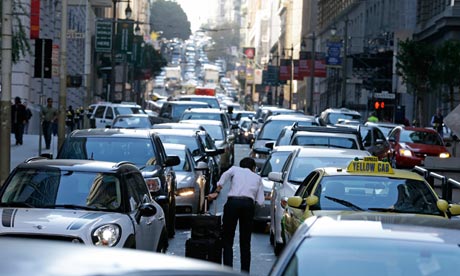
With the BART transit system on strike, people line up along the Embarcadero near the Ferry Building to catch a ferry to Oakland, Calif., during the afternoon commute Monday, Oct. 21, 2013, in San Francisco. Frustrated bay area commuters started the work week Monday facing gridlocked roadways and long lines for buses and ferries as a major transit strike entered its fourth day, increasing pressure on negotiators to reach a deal that resumes train service. (AP Photo/Eric Risberg)
.
View gallery
With the BART transit system on strike, people line up along the Embarcadero near the Ferry Building to catch a ferry to Oakland, Calif., during the afternoon commute Monday, Oct. 21, 2013, in San Francisco. Frustrated bay area commuters started the work week Monday facing gridlocked roadways and long lines for buses and ferries as a major transit strike entered its fourth day, increasing pressure on negotiators to reach a deal that resumes train service. (AP Photo/Eric Risberg)
OAKLAND, Calif. (AP) — The San Francisco Bay Area's main commuter train system and its unions reached a tentative agreement on a new contract Monday night, ending a crippling four-day strike.
Union officials announced the deal, which still requires approval from union members, then from the Bay Area Rapid Transit's board of directors.
BART spokeswoman Alicia Trost said limited service would begin Tuesday at 4 a.m. on all lines. BART officials hoped trains would be running at full strength in time for the afternoon commute.
BART is the nation's fifth-largest rail system, with an average weekday ridership of 400,000.
Workers walked off the job on Friday after talks broke down. Commuters endured jammed roadways and long lines for buses and ferries, as they looked for alternate ways around the region.
The talks between BART and its two largest unions dragged on for six months— a period that saw two chaotic dayslong strikes, contentious negotiations and frazzled commuters wondering if they would wake up to find the trains running or not.
"The public expects us to resolve our differences and to keep the Bay Area moving," BART general manager Grace Crunican said Monday night.
Crunican said there would be no immediate announcements on the details while union leaders explained the agreement to their members, but she said it was a compromise and added: "This deal is more than we wanted to pay."

Read More Here
.....


Strike over: Bay Area transit workers reach compromise with management

A transit strike that for four days halted normal commutes in San Francisco has ended, but the deal was not immediately released


Bart strike over
Striking Bart workers picket on Friday in Oakland. Photo: Marcio Jose Sanchez/AP

A transit strike that crippled the San Francisco Bay Area has ended, raising hopes of a swift return to normality after four days of commuting chaos.
Union leaders and managers of the Bay Area Rapid Transit (Bart) system agreed a tentative deal late on Monday; service is expected to slowly come back on line over the course of Tuesday.
The stand-off had paralysed the US's fifth-largest commuter rail system, which has an average weekday ridership of 400,000. Gridlocked roads and long queues for buses and ferries caused widespread disruption and recrimination since Bart workers walked off the job last Friday in a dispute over pay and conditions, and both sides were under immense pressure to come to an agreement.
"This offer is more than we wanted to pay but it is a new path with our workers and it delivers the Bart of the future," said the agency's general manager, Grace Crunican, after emerging from negotiations on Monday.
Bart strike over
The standoff had paralysed the US's fifth-largest commuter rail system, which has an average weekday ridership of 400,000. Photograph: Eric Risberg/AP
Details of the deal were not immediately released, and it is still pending ratification by Bart's board of directors and members of the Employees International Union Local 1021 and Amalgamated Transit Union Local 1555. The accord was brokered by a federal mediator, Greg Lim. A previous strike in July had halted services for four days.

Read More Here

.....
Enhanced by Zemanta