Showing posts with label Silicon Valley. Show all posts

Wednesday, October 21, 2015

Rent is so high in San Francisco that I’m a software engineer and I live in a van


QUARTZ

October 17, 2015
 
About a year ago, I was having lunch with a friend when I made a throwaway comment: “Have you seen the rent in San Francisco? If I get a job in the Bay Area, I’ll totally live in a van.”
As I sit in darkness writing this, I’m trying to keep my typing quiet, lest a real inhabitant of the neighborhood I’m parked in should walk by and wonder about the sounds coming from the rusty bus loitering on their block. Yes, you understood that correctly: Today, I work in a multi-million dollar office complex, and I live in a van.

This summer, after receiving a job offer in Silicon Valley, I went on Craigslist and began sifting through housing listings: “verrrrrryyy cheap bedroom ;),” “great deal on rent!” A single room with a shared bathroom? Two thousand per month on the low-end. A small studio apartment, you ask? If your startup wasn’t recently bought for seven figures, forget about it.

I perked up after finding a listing for $1,000 per month. Now this could work. Clicking through to the details section however revealed the offer was for a single bunk in a room with eight people, a set-up referred to as a “hacker house” by an (evil) marketing genius.

Even if I was to spend the huge majority of my salary on rent, I knew I would likely still be in a grim living situation, resenting every penny I handed over that could have gone towards paying back my student loans. And as a software engineer, I’m one of the lucky ones! Imagine those who aren’t lucky enough to be on the tech payroll.

Anyway, three weeks ago I took the equivalent of three months’ rent and bought an old red bus. It’s a 1969 VW camper van with a hole in the floor and a family of spiders that has more of a right to be here than I do (sleeping in your car on public land in California is illegal).


(Katharine Patterson/blog.thinkkappi.com)
But with the help of Ikea and an army of cleaning supplies I was able to get the bus into livable condition.

Read More Here

Thursday, April 17, 2014

The 1% wants to ban sleeping in cars – because it hurts their 'quality of life'

Depriving the homeless of their last shelter is Silicon Valley at its worst – especially when rich cities aren't doing anything to end homelessness


homeless in california
There are nearly 90,000 homeless people live in Los Angeles County but only 9,000 to 10,000 beds available in homeless shelters, single-room occupancy hotels, and other facilities. Photograph: David McNew / Getty Images
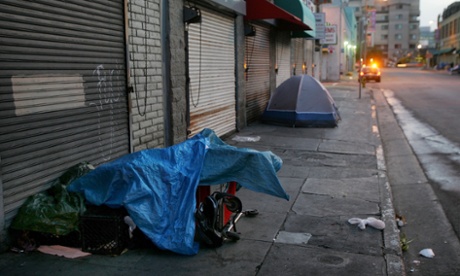
Across the United States, many local governments are responding to skyrocketing levels of inequality and the now decades-long crisis of homelessness among the very poor ... by passing laws making it a crime to sleep in a parked car.
This happened most recently in Palo Alto, in California's Silicon Valley, where new billionaires are seemingly minted every month – and where 92% of homeless people lack shelter of any kind. Dozens of cities have passed similar anti-homeless laws. The largest of them is Los Angeles, the longtime unofficial "homeless capital of America", where lawyers are currently defending a similar vehicle-sleeping law before a skeptical federal appellate court. Laws against sleeping on sidewalks or in cars are called "quality of life" laws. But they certainly don't protect the quality of life of the poor.
To be sure, people living in cars cannot be the best neighbors. Some people are able to acquire old and ugly – but still functioning – recreational vehicles with bathrooms; others do the best they can. These same cities have resisted efforts to provide more public toilet facilities, often on the grounds that this will make their city a "magnet" for homeless people from other cities. As a result, anti-homeless ordinances often spread to adjacent cities, leaving entire regions without public facilities of any kind.
Their hope, of course, is that homeless people will go elsewhere, despite the fact that the great majority of homeless people are trying to survive in the same communities in which they were last housed – and where they still maintain connections. Americans sleeping in their own cars literally have nowhere to go.
Indeed, nearly all homelessness in the US begins with a loss of income and an eviction for nonpayment of rent – a rent set entirely by market forces. The waiting lists are years long for the tiny fraction of housing with government subsidies. And rents have risen dramatically in the past two years, in part because long-time tenants must now compete with the millions of former homeowners who lost their homes in the Great Recession.
The paths from eviction to homelessness follow familiar patterns. For the completely destitute without family or friends able to help, that path leads more or less directly to the streets. For those slightly better off, unemployment and the exhaustion of meager savings – along with the good graces of family and friends – eventually leaves people with only two alternatives: a shelter cot or their old automobile.

Read More Here
Enhanced by Zemanta