Wednesday, December 9, 2015

Home-delivered meals reduce feelings of loneliness among seniors


Published: Tuesday 8 December 2015 at 3am PST


Homebound seniors who have home-delivered meals report significantly less loneliness than those who do not, according to a study published in Journals of Gerontology, Series B.
 
 
Senior man receives home delivered meal from female visitor
 
There was a significant reduction in self-reported feelings of loneliness among homebound seniors who had home-delivered meals, compared with those who did not.
Image credit: Michael Cohea/Brown University
 
The pressure to cut costs brings with it the possibility of overlooking the less tangible benefits when seeking alternative models in the provision of a public service.

Nutrition service providers are no exception, and the new study - conducted as a randomized, controlled trial - shows that home-delivered meals do more than nourish physical well-being; they also have a positive emotional effect in the lives of older people who are stuck at home.

It appears that the regular knock on the door, with the opportunity to exchange some friendly words with the person delivering the meal, goes a long way to reducing feelings of loneliness in older people in need.

Lead author Kali Thomas, assistant professor (research) of health services, policy and practice at Brown University School of Public Health in Providence, RI, says:
"This continues to build the body of evidence that home-delivered meals provide more than nutrition and food security."

Prof. Thomas, a former volunteer for Meals on Wheels, believes the study is one of only a few that has rigorously examined the long-presumed psychological benefits of home-delivered meal service. It is certainly the first randomized, controlled trial to measure the effect on loneliness, she notes.

Many participants socially isolated

The trial participants were 626 older adults from eight American cities who were on waiting lists to receive Meals on Wheels. They were randomly assigned to three groups.

In one group, the participants received a daily fresh meal, in another they received a weekly delivery of frozen meals, and in the third group they remained on the waiting list - this was the control group.
The trial ran for 15 weeks. All participants were interviewed at the start and end of the period.


Read More Here

Monday, December 7, 2015

'Taningia Danae' or 'whiplash squid' rarely seen alive caught on video footage.


Hawaii marine biologists celebrate extremely rare footage of the giant Whiplash squid as it glides through the darkest depths of the Pacific

  • The majestic squid is called 'Taningia Danae' or 'whiplash squid' 
  • Experts say that the whiplash squid has rarely been seen alive 
  • The squid can travel between two and two-and-a-half miles per hour 
  • It attached itself onto a remotely operated underwater vehicle
  • Scientists will study the footage to learn more about the squid
This is the magical moment that National Oceanic and Atmospheric Administration scientists captured footage of a rare deep sea squid.

The majestic sea creature, which is around one to two meters long, is called 'Taningia Danae' or 'whiplash squid.'

As it descended to the sea floor of the Pacific Ocean in Hawaii on September 19, 2015 a remotely operated underwater vehicle caught it on camera.
 

This is the magical moment that NOAA scientists captured footage of a rare deep sea squid


Read More Here

A woman was stabbed at a Miami art gallery after accusing her attacker of following her around and repeatedly bumping into her. Visitors didn't bat an eyelid, assuming it was a performance.


Woman stabbed at Art Basel Miami, gallery visitors confuse crime for modern art

 
© life.of.chai
A woman was stabbed at a Miami art gallery after accusing her attacker of following her around and repeatedly bumping into her. But although the victim was left bloody and fearing for her life, visitors didn't bat an eyelid, assuming it was a performance.
 
The victim, 33-year-old Shin Seo Young, said the Friday night altercation at the Miami Beach Convention Center began after she accused her attacker, 24-year-old college student Siyuan Zhao, of following her around the Art Basel gallery and bumping into her numerous times.

Following the short confrontation, Zhao stabbed Young in the shoulder and neck with an X-Acto knife, according to The Miami Herald.

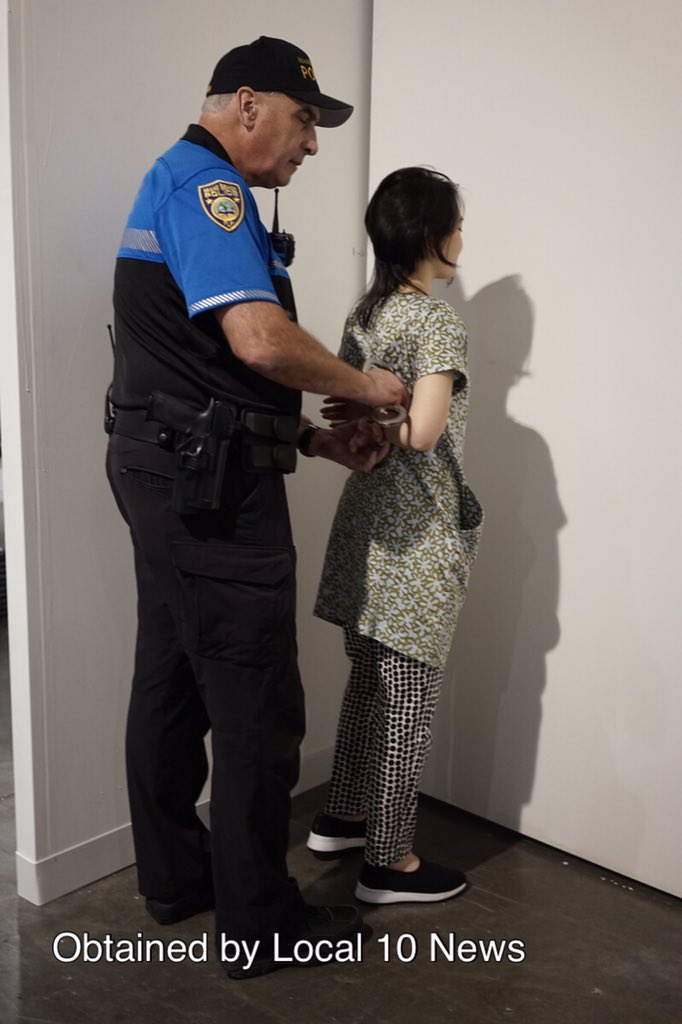
JUST IN: Photos show moments after stabbing. Victim bleeding, woman in cuffs. Story at 11 on .


"I had to kill her and two more," and "I had to watch her bleed!" Zhao said, according to her arrest report. She also confessed to the stabbing during questioning, according to police.


Read More Here


“It should shake us up that on our continent, Christians are not safe.” - EP President Martin Schulz


BREITBART

EuroParliament Prez: Christians ‘Not Safe In Our Continent’


In a high-level meeting on religious persecution in Brussels, the President of the European Parliament (EP) said that Europe cannot afford to continue ignoring the fate of Christians, who are “clearly the most persecuted group” in the world.

In Wednesday’s meeting, EP President Martin Schulz said that the persecution of Christians is “undervalued” and does not receive enough attention, which has also meant that it “hasn’t been properly addressed.”

Schulz’s concerns were echoed by EP Vice President Antonio Tajani, who warned that Europe sometimes “falls into the temptation of thinking we can ignore this task,” referring to the protection Christians throughout the world who suffer persecution.

Speakers cited the work of Open Doors, a human rights organization that monitors the persecution of Christians, noting that 150 million Christians worldwide suffer torture, rape and arbitrary imprisonment. Christians in Iraq, Somalia, Syria, Pakistan, North Korea and Nigeria are among those hardest hit.

The Open Doors report for 2015 found that “Islamic extremism is by far the most significant persecution engine” of Christians in the world today and that “40 of the 50 countries on the World Watch List are affected by this kind of persecution.”


Read More Here

Sunday, December 6, 2015

Several Native American tribes have passed down legends of a race of white giants who were wiped out.


This photo of Monument Valley Navajo Tribal Park is courtesy of  


This photo of Monument Valley Navajo Tribal Park is courtesy of  


.....
The epoch times home

Ancient Race of White Giants Described in Native Legends From Many Tribes


In Beyond Science, Epoch Times explores research and accounts related to phenomena and theories that challenge our current knowledge. We delve into ideas that stimulate the imagination and open up new possibilities. Share your thoughts with us on these sometimes controversial topics in the comments section below.

Several Native American tribes have passed down legends of a race of white giants who were wiped out. We’ll take a look at a few such legends, including those among the Choctaw and the Comanches of the United States down to the Manta of Peru.

Choctaw

Horatio Bardwell Cushman wrote in his 1899 book “History of the Choctaw, Chickasaw, and Natchez Indians”: “The tradition of the Choctaws . . . told of a race of giants that once inhabited the now State of Tennessee, and with whom their ancestors fought when they arrived in Mississippi in their migration from the west. … Their tradition states the Nahullo (race of giants) was of wonderful stature.”
The tradition of the Choctaws told of a race of giants that once inhabited the now State of Tennessee.
— Horatio Bardwell Cushman
A Choctaw stick-ball player, depicted by George Catlin in 1834. (Public Domain)

A Choctaw stick-ball player, depicted by George Catlin in 1834. (Public Domain)
Cushman said “Nahullo” came to be used to describe all white people, but it originally referred specifically to a giant white race with whom the Choctaw came into contact when they first crossed the Mississippi River. The Nahullo were said to be cannibals whom the Choctaw killed whenever the opportunity arose.

Read More Here


.........................................................................................

Humans Are Free

The Great Smithsonian Cover-Up: 18 Giant Skeletons Discovered in Wisconsin


Here’s one for your “Forbidden Archaeology” file. Scientists are remaining stubbornly silent about a lost race of giants found in burial mounds near Lake Delavan, Wisconsin, in May 1912.

The dig site at Lake Delavan was overseen by Beloit College and it included more than 200 effigy mounds that proved to be classic examples of 8th century Woodland Culture.

But the enormous size of the skeletons and elongated skulls found in May 1912 did not fit very neatly into anyone’s concept of a textbook standard. They were enormous. These were not average human beings.

Strange Skulls


First reported in the 4 May 1912 issue of the New York Times the 18 skeletons found by the Peterson brothers on Lake Lawn Farm in southwest Wisconsin exhibited several strange and freakish features.

Their heights ranged between 7.6ft and 10 feet and their skulls...
“presumably those of men, are much larger than the heads of any race which inhabit America to-day.” 
They tend to have a double row of teeth, 6 fingers, 6 toes and like humans came in differant races. The teeth in the front of the jaw are regular molars. Heads usually found are elongated believed due to longer than normal life span.

One must wonder how much can they lift if twice the size of a average human today? Are these the Giants the Bible & many other civilizations have in their history and painted on their walls?

The Bible in Genisis 6:4
"There were giants in the earth in those days; and also after that, when the sons of God came in unto the daughters of men, and they bare children to them, the same became mighty men which were of old men of renown." 
Now this is faulty logic to any scientist out there because I am using religous/cultural history to fill a hole in science.

Over 200 Giant digs have been found in recent years. Giant skeleton finds have not made the local/national news since the 1950’s for the most part. It seems in most peoples opinion do to the fear that people would question evolution. If anything a de-evolution.

In 2002, National Geographic reported a dozen Cyclops skeletons found in Greece that stood 12-15 1/2 Ft tall. That is 3 humans tall. One eye socket. Giants in history are typically cannibalistic in nature.

The reason why I am bringing up giants will all tie into politics, and word happenings. Look at a basketball hoop and add 5 feet. That tall. Greek Mythology talks about war with cyclops learning they had to bring down by taking out their legs rendering them slow and helpless.

American Giants (Red Hair Giants) where found with egyptian writing on their tombs have been found in multiple locations.


Mystery of The Wisconsin Giants

Was this some sort of prank, a hoax played by local farm boys or a demented taxidermist for fun and the attention of the press? The answer is no.

The Lake Delavan find of May 1912 was only one of dozens and dozens of similar finds that were reported in local newspapers from 1851 forward to the present day. It was not even the first set of giant skeletons found in Wisconsin.

On 10 August 1891, the New York Times reported that scientists from the Smithsonian Institution had discovered several large “pyramidal monuments” on Lake Mills, near Madison, Wisconsin.
“Madison was in ancient days the centre of a teeming population numbering not less than 200,000,” the Times said.
The excavators found an elaborate system of defensive works which they named Fort Aztalan.
“The celebrated mounds of Ohio and Indiana can bear no comparison, either in size, design or the skill displayed in their construction with these gigantic and mysterious monuments of earth — erected we know not by whom, and for what purpose we can only conjecture,” said the Times.
On 20 December 1897, the Times followed up with a report on three large burial mounds that had been discovered in Maple Creek, Wisconsin. One had recently been opened.
“In it was found the skeleton of a man of gigantic size. The bones measured from head to foot over nine feet and were in a fair state of preservation. The skull was as large as a half bushel measure. Some finely tempered rods of copper and other relics were lying near the bones.”
Giant skulls and skeletons of a race of “Goliaths” have been found on a very regular basis throughout the Midwestern states for more than 100 years. Giants have been found in Minnesota, Iowa, Illinois, Ohio, Kentucky and New York, and their burial sites are similar to the well-known mounds of the Mound Builder people.

The spectrum of Mound builder history spans a period of more than 5,000 years (from 3400 BCE to the 16th CE), a period greater than the history of Ancient Egypt and all of its dynasties.

There is a “prevailing scholarly consensus” that we have an adequate historical understanding of the peoples who lived in North America during this period. However, the long record of anomalous finds like those at Lake Delavan suggests otherwise.

Related: Alien Base for Giants Discovered in the Bucegi Mountains

The Great Smithsonian Cover-Up

Has there been a giant cover-up? Why aren’t there public displays of gigantic Native American skeletons at natural history museums?

The skeletons of some Mound Builders are certainly on display. There is a wonderful exhibit, for example, at the Aztalan State Park where one may see the skeleton of a “Princess of Aztalan” in the museum.

But the skeletons placed on display are normal-sized, and according to some sources, the skeletons of giants have been covered up.

Specifically, the Smithsonian Institution has been accused of making a deliberate effort to hide the “telling of the bones” and to keep the giant skeletons locked away.

In the words of Vine Deloria, a Native American author and professor of law:
“Modern day archaeology and anthropology have nearly sealed the door on our imaginations, broadly interpreting the North American past as devoid of anything unusual in the way of great cultures characterized by a people of unusual demeanor.

“The great interloper of ancient burial grounds, the nineteenth century Smithsonian Institution, created a one-way portal, through which uncounted bones have been spirited.

“This door and the contents of its vault are virtually sealed off to anyone, but government officials. Among these bones may lay answers not even sought by these officials concerning the deep past.”
Two Giant Skeletons Near Potosi, WI

The January 13th, 1870 edition of the Wisconsin Decatur Republican reported that two giant, well-preserved skeletons of an unknown race were discovered near Potosi, WI by workers digging the foundation of a saw mill near the bank of the Mississippi river.

One skeleton measured seven-and-a-half feet, the other eight feet. The skulls of each had prominent cheek bones and double rows of teeth. A large collection of arrowheads and “strange toys” were found buried with the remains.

Giant Skeleton Discovered in Maple Creek, WI

On December 20th, 1897 the New York Times reported that three large burial mounds had been discovered near Maple Creek, WI. Upon excavation, a skeleton measuring over nine feet from head to toe was discovered with finely tempered copper rods and other relics.

Giant Skeleton in West Bend, WI

A giant skeleton was unearthed outside of West Bend near Lizard Mound County Park and assembled by local farmers to a height of eight feet. More about this can be found in Washington County Paranormal: A Wisconsin Legend Trip by local author and investigator J. Nathan Couch.

While a normal-sized skeleton of a supposed mound builder (the “Princess of Aztalan”) is on display at the site of several large pyramidal monuments near Madison called Aztalan State Park, the goliath remains of Wisconsin’s giants have vanished along with the hundreds of others discovered throughout the midwest.

Many have accused the Smithsonian Institution of covering up these discoveries, locking the giant skeletons away and depriving the public of their findings.

Continue reading: Smithsonian Admits to Destruction of Thousands of Giant Human Skeletons in Early 1900′s

By Mark Shernick, Old Curiosity Shop; | References:
  1. Anon. "Strange Skeletons Found: Indications that Tribe Hitherto Unknown Once Lived In Wisconsin," New York Times, 4 May 1912.
  2. Anon. "The Wisconsin Mounds: Interesting Relics of Pre-Historic Civilization" New York Times, 10 August 1891.
  3. Burlington News, "The Princess of Aztalan" (Photos), Mound Builders page.
  4. Dahly, Terje "Old Newspapers Are Serious About Giant Skeletons" from the "Giants: Did They Live?" website.
  5. Deloria Jr., Vine. Red Earth, White Lies: Native Americans and the Myth of Scientific Fact (Fulcrum Publications, 1997).
  6. Hamilton, Ross. "A Holocaust of Giants: The Great Smithsonian Cover-Up" Xpeditions Magazine website.
  7. Sutherland, Mary. "Giants... Giants... Giants... Giants" A Big Page About Giants, BUFO Radio / Burlington News website.
  8. Unknown. "Greater Humans" page. Greater Ancestors World Museum website.
  9. Wikipedia, "Aztalan State Park" Wisconsin.

Botswana's government recently sold the rights to Drill for Shale Gas, in a National Park, to the British Karoo Energy company


the guardian

Botswana sells fracking rights in national park

Licences for more than half of the Kgalagadi transfrontier park, one of Africa’s largest conservation areas, have been granted to drill for shale gas

The Kgalagadi transfrontier park straddles Botswana and South Africa and is home to the cheetah and black-maned Kalahari lion.
The Kgalagadi transfrontier park straddles Botswana and South Africa and is home to the cheetah and black-maned Kalahari lion. Photograph: Jeffrey Barbee/Alliance Earth.org

The Botswana government has quietly sold the rights to frack for shale gas in one of Africa’s largest protected conservation areas, it has emerged.

The Kgalagadi transfrontier park, which spans the border with South Africa, is an immense 3 6,000 sq km wilderness, home to gemsbok desert antelope, black-maned Kalahari lions and pygmy falcons. But conservationists and top park officials – who were not informed of the fracking rights sale – are now worried about the impact of drilling on wildlife.

Prospecting licences for more than half of the park were granted to a UK-listed company called Nodding Donkey in September 2014, although the sale has not been reported previously. That company changed its name earlier this month to Karoo Energy.

Park officials said that no drilling has yet taken place, but the Guardian found oil sediment on the ground near a popular camp site. There was an overwhelming smell of tar and a drill stem protruded from an apparently recently drilled hole. It is not known who had carried out the drilling or when.
Scientist Gus Mills worked and lived in Kgalagadi for 18 years studying cheetahs and hyenas. He said he is worried about the impact on wildlife and environment.

“The development that is going to have to go on there, with infrastructure that has to be moved in, seems to be yet another nail in the coffin of wild areas in the world.”

Dr Peter Apps, who studies large predators for the Botswana Predator Conservation Trust , said drilling could have a range of impacts, notably on water sources in the park.


Read More Here

Saturday, December 5, 2015

Researchers from the University of Helsinki and Edinburgh first to find the genetic material of a human virus from old human bones.

..
EurekAlert! Science News
Public Release: 

Viruses, too, are our fingerprint

University of Helsinki
EurekAlert! Science News
IMAGE
IMAGE: The researchers document the presence of parvovirus DNA in the bones of Finnish World War II casualties who remained exposed to diverse climatic conditions in former Finnish, current Russian territory,... view more
Credit: Veikko Somerpuro / University of Helsinki

A group of researchers from the University of Helsinki and the University of Edinburgh have been the first to find the genetic material of a human virus from old human bones. Published in the journal Scientific Reports, the study analyzed the skeletal remains of Second World War casualties from the battlefields of Karelia.

Upon infection, many viruses remain in the tissues and their DNA can be analyzed even decades thereafter. Although their genetic material has been found in many organs, the researchers show that viral DNA is also present in bone.

"Human tissue is like a life-long archive that stores the fingerprint of the viruses that an individual has encountered during his or her lifetime," describes Klaus Hedman, professor of clinical virology.
The finding has important implications since bone is most likely to be preserved after death, thus opening the door to the study of the viruses that caused infections in the past. In a publication in Scientific Reports, the researchers show that this is indeed the case. They document the presence of parvovirus DNA in the bones of Finnish World War II casualties who remained exposed to diverse climatic conditions in former Finnish, current Russian territory, until recent years when they were repatriated to their homeland.


Read More Here