Showing posts with label Collateral Damage. Show all posts

Sunday, October 18, 2015

Israeli bus station attack: IDF soldier killed, 11 injured, police mistakenly shoot foreigner


Israeli security personals stand next to blood on the floor, at the Beersheba central bus station where a Palestinian gunman went on a stabbing and shooting rampage, October 18, 2015 © Dudu Grunshpan
An IDF soldier was killed and 11 others injured when an Arab attacker, armed with a gun and a knife, opened fire at a bus station in the city of Beersheba in the south of the country. Local media also said that an Eritrean man was mistaken for an assailant and attacked by police.
READ MORE: Escalating Israeli-Palestinian violence Live Updates 


The perpetrator made his way into the station and started shooting and stabbing people inside, in what is one of the most violent attacks since the escalation began, the police said. An Israeli soldier was killed, four police officers were lightly injured and seven civilians received wounds of varying degrees in the attack.

Despite bringing a gun with him, the man also snatched the weapon from the soldier he gunned down, Yoram Halevy, a police commander in southern Israel, told journalists. The Arab attacker, whose identity was not immediately revealed, was shot and killed by the police, she added.


It was initially reported that the attacker had an accomplice, who was wounded and detained by the police. But it later turned out that the Israeli security forces shot a foreign national after mistaking him for the assailant.

Police responding to the attack entered the bus station from another area and saw a “foreign national,” opening fire and wounding him, Halevy confirmed.

The Jerusalem Post reported that the injured man was a citizen of Eritrea, who has been residing in Israel.

An angry Israeli crowd, chanting “death to Arabs” gathered outside the bus station after the attack, Reuters reported.

The Sunday attack has become the most serious incident in the string of violence in Israel caused by tensions surrounding a Jerusalem holy site, the al-Aqsa mosque, which is sacred to both Muslims and Jews.


Read More Here

Monday, October 5, 2015

Howard Zinn, The Outer Limits of Empire : Tomdispatch Interview

...


Occupy Oakland, November 12, 2011, Howard Zinn quotation


The Outer Limits of Empire: A Tomdispatch Interview with Howard Zinn
He's tall and thin, with a shock of white hair. A bombardier in the great war against fascism and an antiwar veteran of America's wars ever since, he's best known as the author of the pathbreaking A People's History of the United States, and as an expert on the unexpected voices of resistance that have so regularly made themselves heard throughout our history. At 83 (though he looks a decade younger), he is also a veteran of a rugged century and yet there's nothing backward looking about him. His voice is quiet and he clearly takes himself with a grain of salt, chuckling wryly on occasion at his own comments. From time to time, when a thought pleases him and his well-used face lights up or breaks out in a bona fide grin, he looks positively boyish.
We sit down on the back porch of the small coffee shop, alone, on a vacation morning. He has a croissant and coffee in front of him. I suggest that perhaps we should start after breakfast, but he assures me that there's no particular contradiction between eating and talking and so, as a novice interviewer, I awkwardly turn on my two tape recorders -- one of which, on pause, will still miss several minutes of our conversation (our equivalent, we joke, of Nixon's infamous 18-minute gap). In preparation, he pushes aside his half-eaten breakfast, never to touch it again, and we begin.
Tomdispatch: You and Anthony Arnove just came out with a new book, Voices of a People's History of the United States, featuring American voices of resistance from our earliest moments to late last night. Now, we have a striking new voice of resistance, Cindy Sheehan. I was wondering what you made of her?

Howard Zinn: Often a protest movement that's already underway -- and the present antiwar movement was underway even before the Iraq War began -- gets a special impetus, a special spark, from one person's act of defiance. I think of Rosa Parks and that one act of hers and what it meant.
TD: Can you think of other Cindy Sheehan-like figures in the past who made movements coalesce?
Zinn: In the antiwar movement of the Vietnam years, there wasn't one person, but when I think back to the abolitionist movement, Frederick Douglass was a special figure in that way. When he came north, out of slavery, and spoke for the first time to a group of antislavery people, the beginnings of a movement existed. [William Lloyd] Garrison had already started [his antislavery newspaper] the Liberator, but Frederick Douglass was able to represent slavery itself in a way that Garrison and the other abolitionists could not. His dramatic appearance, his eloquence, provided a special spark for the abolitionist movement.
TD: I guess Cindy Sheehan also represents something that can't be represented by anyone else, almost, in fact, can't be represented -- the American dead in the war and, of course, her own dead son.
Zinn: It's interesting. There have been mothers other than Cindy Sheehan who have spoken out, but she decided on an act that had a special resonance, which was simply to find where Bush was going [he chuckles to himself at the thought] and have a confrontation between the two poles of this war, between its maker and the opposition. She just parked herself near Bush and became the center of national attention, of gravity, around which people gathered, hundreds and hundreds of people.

Read More Here

Sunday, September 20, 2015

Yemen: Explosions rock Sanaa as Saudi-led coalition try to push back Houthis

UN condemns ‘virtual silence’ on civilian casualties in Yemeni conflict

© Khaled Abdullah
UN officials have openly criticized the “the virtual silence” with regards to civilian suffering in the Yemeni conflict from the world community, warning that unless violence on the ground is stopped via political compromise more people will suffer.
Adama Dieng, the Special Adviser on the Prevention of Genocide, and Jennifer Welsh, the Special Adviser on the Responsibility to Protect, “expressed concern at the ever increasing impact on civilians of the ongoing conflict in Yemen, and the virtual silence of the international community about the threat to populations.”

Read More Here

Underground lifelines used by residents of the town of Rafah are being flooded by Egypt, worsening existing isolation.


TRT World - World in Focus: Egypt to Flood Gaza Tunnels


Published on Sep 10, 2015
POPULATION UNDER SIEGE

The Gaza Strip one of the most densely populated areas in the world. Around 1.8 million people call this coastal strip of just 360 square kilometres, home. And eight years of blockades and wars have crippled its economy. 43 percent of Gazans are unemployed, and 39 percent live in poverty. They’re still rebuilding after last year’s war with Israel and depend on international aid to survive. Much has been pledged, but Israel only allows a portion of the essentials to pass through.
TUNNELS OF LIFE
Tunnels that run beneath the Egyptian border provide a vital lifeline for many struggling families in Gaza. Smugglers often risk their lives to use the tunnels - as Egypt has restricted access to the Rafah crossing since its military deposed former president Mohamed Morsi in July 2013. So far this year, the crossing’s only been open for 15 days. Egypt also begun to demolish the tunnels in Sinai - over 1,400 of them since the beginning of 2014. And now, it seeks to flush out the smugglers once and for all by flooding the tunnels.
EGYPTIAN FISH FARMS
Egypt says it wants to use its 14-kilometre border with Gaza for a different purpose - to build fish farms. And Egypt’s military has already begun to dig along border to set up 18 fisheries. But Gazans fear the project is just a ploy to reinforce the blockade. Hamas official Mushir al Masri said it was to tighten the siege on Gaza. Egypt previously cleared homes along the border to expand a buffer zone and its military regime has accused Hamas of supporting militant groups in the Sinai peninsula. But Hamas, which is an offshoot of the Muslim Brotherhood now outlawed by Egypt, has denied the claims.
STRUGGLE TO SURVIVE
But because of the fisheries, prices of supplies smuggled into Gaza have skyrocketed.
Smugglers are now installing water pumps into tunnels to ease the flooding. Currently, it’s believed that only 20 tunnels are still actively being used. The mayor of Rafah, Subhi Radwan, has warned that the flooding of the tunnels could cause homes on the Gazan side of the border to collapse. He also said that filling them with sea water could contaminate Gaza’s drinking water. But for now, Gazans have little choice but to watch on from behind the borders.


Gaza after Egypt floods tunnels

Published on Sep 20, 2015
People rarely came this far, she told us, and it seemed to her that very few of those that did, cared enough to ask how they were doing.
"Not well at all," she said needing little prodding. "Not well at all."
Mansura was clearly exhausted from having stayed up the night before.
Fearful for her family, she sat outside her makeshift house just a few hundred metres from the border between Gaza and Egypt, on guard until dawn.
"We're used to the guns and the rockets and the explosions," she said. "But now - water?"
Witness: The Gaza tunnels
Her voice trembled, and tears began to pool in her eyes.
"This is our life," she said hopelessly.
"We are so, so tired."
Mansura lives in Rafah, the town divided between Gaza and Egypt by international

*****************************************************************

Al JAZEERA
 

Strangled: Gaza after Egypt floods tunnels


Marga Ortigas
Marga Ortigas covers the Asia-Pacific region for Al Jazeera English.

Seventy-three year old Mansura Abu Shaar was more than happy to talk to strangers.
People rarely came this far, she told us, and it seemed to her that very few of those that did, cared enough to ask how they were doing.
"Not well at all," she said needing little prodding. "Not well at all."
Mansura was clearly exhausted from having stayed up the night before.
Fearful for her family, she sat outside her makeshift house just a few hundred metres from the border between Gaza and Egypt, on guard until dawn.
"We're used to the guns and the rockets and the explosions," she said. "But now - water?" Her voice trembled, and tears began to pool in her eyes.
"This is our life," she said hopelessly.
"We are so, so tired."
Mansura lives in Rafah, the town divided between Gaza and Egypt by international political agreements in the 1980s.
With Israel the only other way in or out, Gazans saw the border with fellow-Arab Egypt as the "friendly" alternative.
It was a pressure valve when all else around them seemed to be closing in.
But the "friendly border" closed when Hamas took control of the government in Gaza in 2007.
At least in theory.

Read More Here
 ******************************************


Al JAZEERA


'Rafah has turned into a ghost town'

As Egypt works to create a buffer zone, the destruction of tunnels has further crippled Gaza's already besieged economy.

Walaa Ghussein |
Egyptian authorities have ordered residents living along the border with Gaza to evacuate their homes [Al Jazeera]Egyptian authorities have ordered residents living along the border with Gaza to evacuate their homes [Al Jazeera]


Rafah, Gaza - Ahmed al-Afifi cannot focus on studying as midterm exams approach. For the past two weeks, the constant sounds of explosions have echoed from across the border.
"We are not psychologically ready for this," said al-Afifi, 22, a Gaza-based university student who lives in the Palestinian side of Rafah, which shares a border with Egypt's restive Sinai peninsula. His home is about 400m from the border, and the explosions are part of an Egyptian military operation to initially create a 500m-deep buffer zone.
But on Tuesday November 18, Egyptian authorities said they were to expand the buffer zone to one km.
The army is clearing the area by using dynamite and bulldozers, a systematic campaign also aimed at destroying smuggling tunnels into Gaza. The operation followed the killing of 33 Egyptian soldiers in an attack in North Sinai in October. Egyptian authorities have ordered residents living along the country's eastern border with Gaza to evacuate their homes, which are targeted for demolition.
On Monday November 17, Rober Turner, head of UNRAWA operations in Gaza, said that the buffer zone set up by Egyptian authorities will make things more difficult . He described the siege as 'unjust'.

Read More Here


***************************************************

Egypt floods people-smuggling tunnels leading from Sinai to the Gaza Strip in a renewed effort to stamp out terror activity

  • Authorities feared the tunnels would allow Islamist militants to smuggle people and weapons across the border in Rafah, southern Gaza Strip
  • Military pumped water from the Mediterranean Sea into the tunnel pipes, which are now to be converted into fish farms
  • Hamas previously infiltrated Israel via smuggling tunnels, killing 12 soldiers and destroying 32 underground passages 
Egyptian forces flooded smuggling tunnels beneath the Gaza-Egypt border in Rafah on Friday in a reported attempt to stamp out terror activity. 
Authorities feared the tunnels, which lead from Sinai to the Gaza Strip, would allow for smuggling by Islamist militants between the blockaded Palestinian enclave, according to a report by DPA.
The military pumped water from the Mediterranean Sea into the pipes of the underground cross-border tunnels in an effort to curb the use of the passages in their entirety. 
A Palestinian youth shows how to abseil into one of the tunnels on the Gaza side after Egyptian forces flooded smuggling tunnels beneath the border to the Gaza strip, in Rafah, southern Gaza Strip

Read More Here


Saturday, September 12, 2015

U.S. claims it would make preparations to take in at least 10,000 Syrian refugees in the upcoming fiscal year.

 
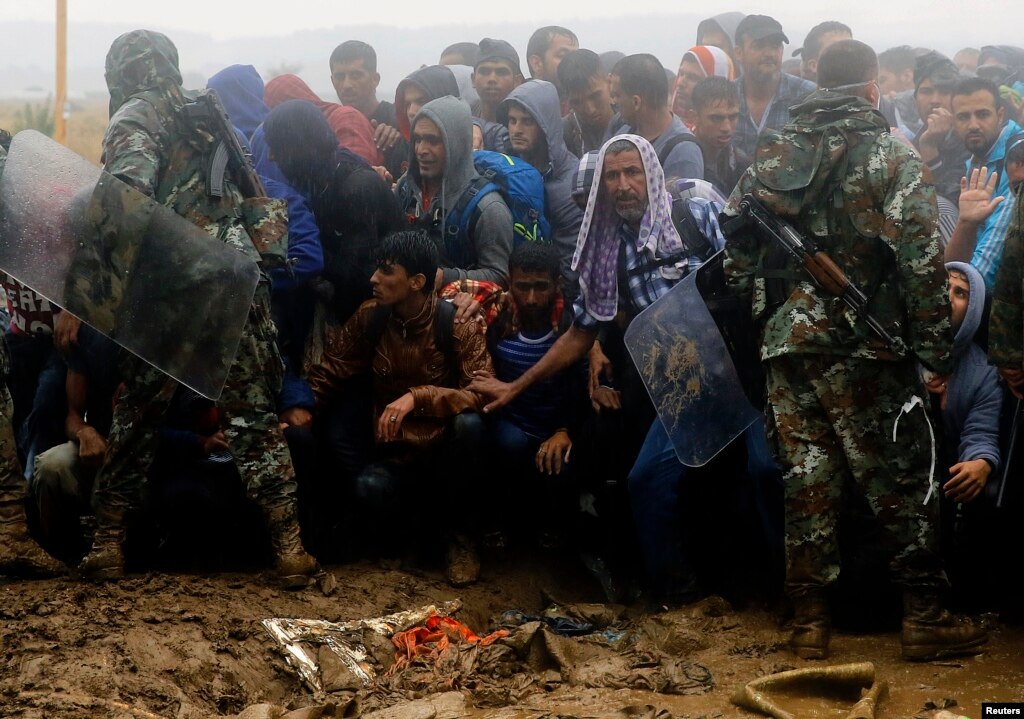
Macedonian policemen try to keep migrants and refugees under control before they cross the border line from Greece into Macedonia, near the Greek village of Idomeni, Sept. 10, 2015.

US Urged to Do More on Mideast Refugee Crisis

VOA

US Criticized On Refugee Crisis
Since the start of Syria's civil war more than four years ago, the U.S. has taken in just over 1,400 Syrian refugees — a barely detectable fraction of the four million who have fled the country. On Thursday, White House officials signaled they were ready to do more: they announced the U.S. would make preparations to take in at least 10,000 Syrian refugees in the upcoming fiscal year. "The president has directed our team to consider how we can further scale up our response," said White House spokesman Josh Earnest. "And one thing the United States can do is to begin to admit more Syrian refugees."

  Read More Here


 **************************************************************

O'Malley: U.S. should accept 65,000 Syrian refugees


Washington (CNN)
"I support the call from humanitarian and refugee organizations for the United States to accept at least 65,000 Syrian refugees next year," he said in a statement Friday. "If Germany -- a country with one-fourth our population -- can accept 800,000 refugees this year, certainly we -- the nation of immigrants and refugees -- can do more."
Syrian refugees are flooding Europe following the deaths of hundreds of thousands of Syrians due to ethnic violence in the Middle East. The migrant crisis has engulfed Europe, leading many to ask whether the U.S. would take refugees from the continued fighting in Syria.

Sunday, May 4, 2014

Ukraine : Pro-Russia insurgents shot down two Ukrainian helicopters Friday and Ukraine reported many militants killed or wounded as the interim government in Kiev launched its first major offensive

Yahoo News

Ukraine: Many insurgents killed in Slovyansk

Associated Press


.
Raw: Pro-Russians in Ukraine Prepare Defenses
...
Pro-Russia insurgents shot down two Ukrainian helicopters Friday and Ukraine reported many militants killed or wounded as the interim government in Kiev launched its first major offensive against an insurgency that has seized government buildings across the east.

The Kremlin said Kiev's military move against the insurgents "destroyed" the two-week-old Geneva agreement on cooling Ukraine's crisis. President Barack Obama said it was obvious to everyone now that the pro-Russia militants were not peaceful protesters and the U.N. Security Council held an emergency session in Ukraine at Russia's request.
Fighting broke out around dawn near Slovyansk, a city 160 kilometers (100 miles) from the Russian border that has become the focus of the armed insurgency. Two helicopter crew members were killed in the crashes, both sides said, and the insurgents reported one member killed.
Acting President Oleksandr Turchynov later said two Ukrainian soldiers were killed and seven wounded in Friday's clashes and the insurgents suffered significant losses, including many killed or injured. It was not clear if the two referred to the helicopter crew.
"Our security forces are fighting mercenaries of foreign states, terrorists and criminals," he said in a statement
By early evening, Turchynov said the army controlled all of the checkpoints around Slovyansk, a city of 125,000 people.
One of the helicopters was hit by a surface-to-air missile, the Ukrainian Security Service said, calling it a sophisticated weapon that undercut Russia's claims the city was simply under the control of armed locals. The agency said its forces were fighting "highly skilled foreign military men" in Slovyansk.
The Russian state television channel Rossia 24 showed one man they said was a wounded helicopter pilot reportedly being helped by pro-Russia forces.
Central Slovyansk still remained in the hands of pro-Russia gunmen, according to AP journalists in the city. Several foreign news crews trying to cover the fighting were detained for several hours Friday before being released.
A clash also broke out late Friday between pro-Russians and government supporters in Odessa, a Black Sea coast port some 550 kilometers (330 miles) from the turmoil in the east. Police said one person died from gunshot fire and other was wounded. Until now, Odessa had remained largely untroubled since the February toppling of pro-Russia President Viktor Yanukovych, which ignited tensions in the east.
Turchynov admitted earlier this week that the central government had lost control of the east, and said some government troops and police there were "either helping or cooperating with terrorist organizations." He said Ukrainian forces were working to prevent the unrest from spreading to central areas like Odessa.
In Moscow, Russian President Vladimir Putin's spokesman said the Ukrainian offensive "effectively destroyed the last hope for the implementation of the Geneva agreements" that aimed to defuse the crisis. But Dmitry Peskov said Russia "continues to undertake consistent efforts on de-escalation."
Putin had warned Ukraine not to move against the insurgents and said it should withdraw its military from the volatile eastern and southern regions.

Read More Here

Enhanced by Zemanta

Tuesday, April 8, 2014

A giant portrait of a young child has been produced to try and raise awareness of civilian casualties in the Pakistan region. Pointing out the fallacy of the Military's alleged "Bug Splats" attitude


‘Not bug splats’: Artists use poster-child in Pakistan drone protest

Published time: April 07, 2014 13:29
Image from notabugsplat.com
A poster of a young child has appeared in north-west Pakistan to raise awareness of the numerous drone attacks the region suffered. Artists who created the image hope military commanders will think twice about shooting after seeing the portrait.
More than 200 children are believed to have died in the heavily-bombed Khyber Pukhtoonkhwa according to the website notabugsplat.com. ‘Bug splat’ is the name given by the military to a person who has been killed by a drone. Viewing the body through a grainy computer image gives the impression that an insect has been crushed.
Now a giant portrait of a young child has been produced to try and raise awareness of civilian casualties in the region. The hope is now the drone operator will see a child’s face on his or her computer screen, rather than just a small white dot and may think twice before attacking indiscriminately.
The child featured in the poster is nameless, but according to the Foundation for Fundamental Rights, who helped to launch the project in collaboration with a number of artists, both parents were lost to a drone attack.
Drone raids in Pakistan started in 2004 under George W. Bush’s administration as part of the US War on Terror. The vast majority of strikes have focused on the Federally Administered Tribal Area’s and the Khyber Pukhtoonkhwa area due to their proximity to Afghanistan, which the country invaded following the September 11 terrorist attacks.

Read More Here


Enhanced by Zemanta