Showing posts with label Tyranny. Show all posts

Sunday, February 16, 2014

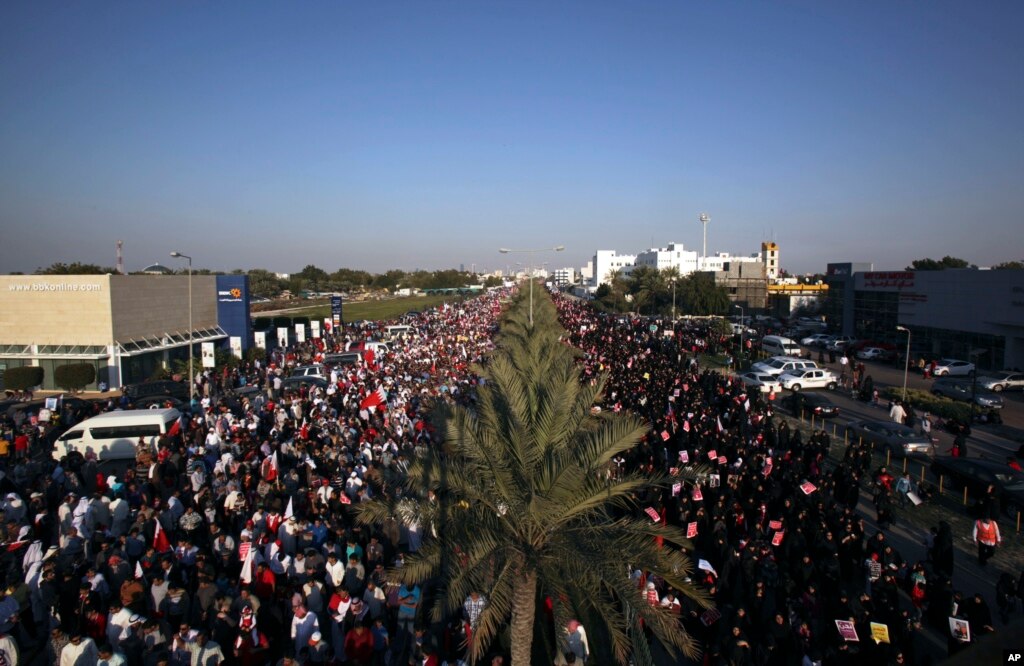
Bahrain Protest Attracts Tens of Thousands

VOA


Tens of thousands of Bahraini pro-democracy protesters wave signs and national flags during a march along a divided four-lane highway near Barbar, Bahrain, west of the capital of Manama, Feb. 15, 2014.

Reuters

The rally organized by the kingdom's main opposition al-Wefaq movement was one of the biggest staged since 2011.
Vast crowds of men, women and children took to the streets of the small Gulf Arab nation calling for democracy, political reform and the release of political prisoners, witnesses said.
"We will not stop until we achieve our demands," protesters shouted. "Shi'ites and Sunnis, we all love this country."
Police could not be seen at the rally on Budaiya Highway, which links Bahrain's southern Budaiya region with the capital Manama, witnesses said. No clashes were reported.
The Interior Ministry said a policeman had died after being wounded by a "terrorist" blast on Friday. Three other policemenwere wounded the same day, while 26 people had been arrested.
"Some villages saw rioting, vandalism and the targeting of policemen," the ministry said, referring to Friday's unrest.
Bahrain, with Saudi help, crushed the demonstrations that began on Feb. 14, 2011 inspired by Arab uprisings elsewhere, but has yet to resolve the conflict between majority Shi'ites and the Sunni-led monarchy they accuse of oppressing them.
The ruling family has launched a third round of dialogue with its opponents, but no political agreement is in sight.


Read More Here

Related Articles

.....
SFGate

Bahrainis protest, wounded police officer dies

Updated 11:41 am, Saturday, February 15, 2014
Police officers carry the body of fellow policeman Abdul Wahid Al Balouchi, who was killed in a bombing on Friday, during his funeral procession in Riffa, Bahrain, Saturday, Feb. 15, 2014. Thousands of Bahraini protesters clashed with security forces on Saturday, sending tear gas into a major shopping mall and bringing the capital's streets to a standstill on the same day that authorities said a police officer died of injuries sustained from an earlier bombing. Photo: Uncredited, AP / AP
Police officers carry the body of fellow policeman Abdul Wahid Al Balouchi, who was killed in a bombing on Friday, during his funeral procession in Riffa, Bahrain, Saturday, Feb. 15, 2014. Thousands of Bahraini protesters clashed with security forces on Saturday, sending tear gas into a major shopping mall and bringing the capital's streets to a standstill on the same day that authorities said a police officer died of injuries sustained from an earlier bombing. Photo: Uncredited, AP
MANAMA, Bahrain (AP) — Bahraini anti-government activists clashed with security forces as thousands of demonstrators took to the streets on Saturday, sending tear gas into a major shopping mall and bringing the capital's streets to a standstill on the same day that authorities said a police officer died of injuries sustained from an earlier bombing.
The Interior Ministry said that the officer was one of two injured in what it called a "terrorist blast" on Friday in the village of Dair, near the country's main airport. It did not identify the officer. In a second statement, the ministry characterized recent attacks against security forces as "urban guerrilla warfare."
Chaos in the small Gulf-island nation highlights deeper regional sectarian tensions that continue to roil Bahrain three years after the country's majority Shiites began an Arab Spring-inspired uprising to demand greater political rights from the Sunni-led monarchy.
Neighboring Sunni-ruled Gulf countries with smaller Shiite populations, led by Saudi Arabia, sent troops to Bahrain in an effort to stem the uprising in 2011. More than 65 people have died in the unrest, but rights groups and others put the death toll higher.


Read More Here
.....
Enhanced by Zemanta

Friday, January 31, 2014

We have ceased to be who we once were. Or at least who we claimed and hoped to be – The People : Golem XIV's Thoughts

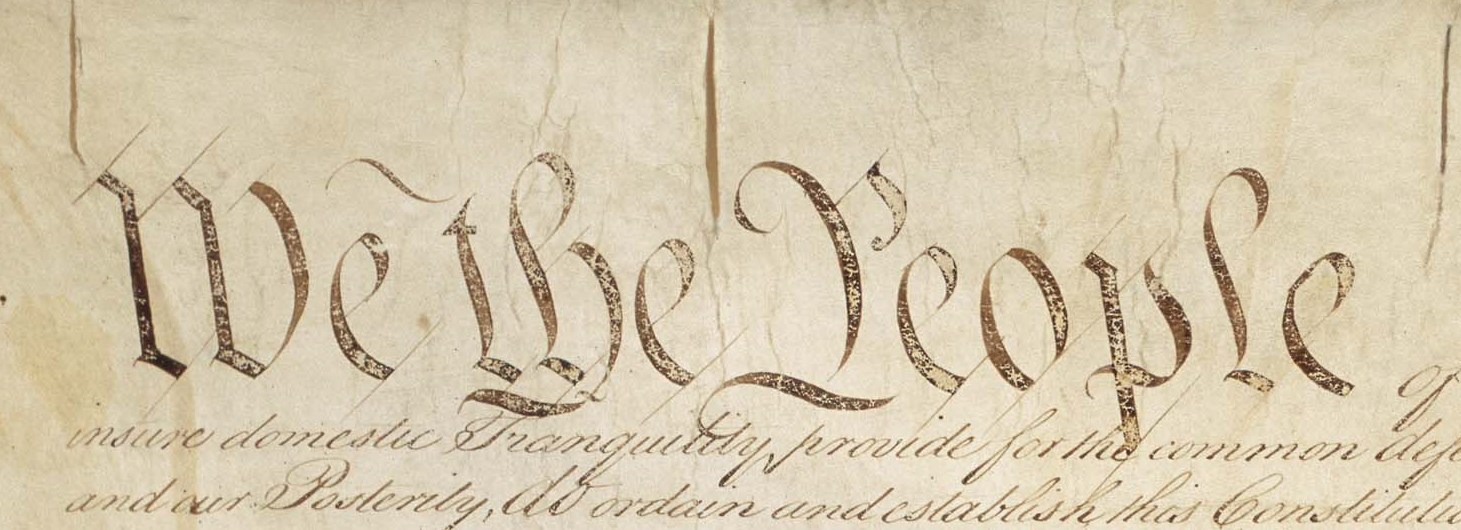
File:Constitution We the People.jpg

Image Source  :  Wikimedia. org  (Public Domain)
Detail of Preamble to Constitution of the United States

.....

ZeroHedge

We, The "Unwanted" People...


Submitted by Golem XIV via Golem XIV's Thoughts blog,
The fact that the phrase sounds antique should warn us of the scale of our folly. We have lost, given away, pawned the power we once claimed. We have ceased to be who we once were. Or at least who we claimed and hoped to be – The People. Now who are we? The Consumer?  The Unemployed. The Unwanted?  ”We, the Unwanted” does not have the same ring about it does it? And yet that is what we are fast becoming. It is time to chose. Sit in front of your television or computer screen and let it sooth you, until one day you too find you have have become one of the unheard, unlamented, Unwanted. Or reach out to others and grasp hold.
It is surely time that we re-assert what the phrase “We, The People” once meant. It is suybolic I know. But symbols are powerful. And the powerful fear them.
For too long now we have been supine, docile and cowed. There have been sputterings of resolve when a million people took to the streets to oppose the War in Iraq. But the rulers of the day ignored us and ‘the people’ simply went home vaguely disquieted, perhaps a little hurt at being ignored but mainly just confused as to what to do next – if anything.
For decades now we have let others have the initiative, let others define what was acceptable and legitimate. When it was never their position to do so. This must stop.
Once, a certain people declared, “No taxation without representation.” It was and still is a simple idea. You may not tax me unless you represent my interests. Only those with my interests in mind may ask me for taxes. Today that definitiion of democracy has withered and been quietly replaced by another similar sounding but actually radically different version – I would say perversion – of democracy. Today we are taxed by people who represent every interest but ours. They are still representatives but not of our interests. Democracy has now become a kind of opera – more and more lavish in direct proportion to its separation from ordinary people and their lives.  Every four or five years we get to chose between two teams who represent some interest which is not ours. They may represent the interests of bankers, or global corporations, or militarists and the industrial complex which gets rich from their adventures, or some other grouping within the machinery of the State, or the intersts of a powerful global 1% – whatever interest they serve it is never yours and mine. For those who will clamour and say the Democrats or Labour or La Gauche represent the interests of the labour unions, WAKE UP!  It’s been decades since that was even partially true. Labour under Blair and Brown was Thatcherism by another name and ignored a million people who said very clearly and en masse, that the Bush/Blair war was unjust, illegal and unwanted. The Democrats under Obama followed the same financial and economic ideology as Bush, even chosing the same people to run things, and was as warlike and arrogant as well. Change? Tell it to a moron. He might believe you.
Democracy is broken. No one represents us. We are allowed only to chose between different teams of The Entitled who, once chosen, ignore us completely. The whole idea of a mandate has mutated. Once that idea meant that a government could do what it had said it would do when it was trying to win our votes. Beyond those things, it had to consider ‘The People’.  Today all parties consider that being elected means to be handed absolute power to do whatever they feel like doing, whatever they can ram through the tattered remains of accountability and oversight.
Elected dictatorship in installments is what we have today.  And when each installment, no matter the different names and colours of the teams, is almost indistinguishable from the last, what is representative democracy if not a street parade of oversized cartoon characters and their pantomimed arguments. Are we not amused?
If we do not speak up soon we will find when we finally do, nothing is heard but grunting and bleating. We are, to borrow a phrase from the brilliant Roberto Callaso, already walking through a vast slaughter house. And those who run it have no good intent.
It is past time when we must revivify what We the People means. We must stop reacting like frightened animals and take the initiative.We cannot allow those who presume to rule over us to continue to tell us what ‘must’ be done and to over-rule all debate by  insisting ‘there is no alternative.’ We must state what We the People will accept and what we won’t, what we regard as legitimate and what is not. It is for us to decide these things not them. It may seem like just words and on one level of course it is. But it was only words when it was said the first time. What those words did the first time and can do again, is to stop our rulers’ proclamations always being against a blank and passive background. Simply by declaring what We will and won’t tolerate or accept we force their proclamations to appear as what they are – aggressive, partisan and debateable.

Read More Here

.....

Counterpunch


Does the Left Have a Future?

John Stauber on Wall Street’s Political Monopoly


by JOSLYN STEVENS

This week I spoke with John Stauber, an investigative journalist, author, founder of Center for Media and Democracy, and most recently a  self-professed outside agitator, on the benefits of voting two party.
In an article you wrote for CounterPunch back in March, you zeroed in on the “Progressive Movement” a democratic money and propaganda machine/echo chamber run by liberal elites like OFA, Mother Jones, Van Jones, The Nation, and largely MoveOn.org to name a few who sometimes fool progressives into supporting corporate causes and have co-opted messages from OWS to appear populist. Considering the far right has the left beat in the messaging game, how successful has the professional left been at advancing their neoliberal agenda on a larger scale? Are liberals really buying it?

A. These terms — progressives, liberals, left, populist, far right, neo-liberal — have different meanings for different people. I like to keep things simple and get back to basic principles and terms like democracy, individual rights and liberties, corporate power, concentrated wealth. The situation today is this: both the Democratic and Republican Parties represent the interests of the most powerful corporate elite in America. Neither party will ever represent the fundamental radical democratic changes we need to take wealth away from the small percentage who have concentrated it in their hands, and to empower people in a democracy. Let me repeat that: neither party will ever serve economic and political democracy.
The so-called “progressive movement” is made up of corporations run by paid staff and contractors who believe that the key to the future is to defeat the corporate Right, the Republicans, in elections. They believe that their own elite-funded propaganda campaigns on behalf of the environment, social justice, human rights, anti-monopoly politics, unions, can mobilize a public that can move the Democratic Party as a whole in this direction. That’s a farce and a fraud.
The crises facing us — poverty, ecological devastation, increasing concentration and power in the hands of the super rich and their economic institutions — are simply worsened by both corporate Parties, and those Parties run on elite wealth and massive propaganda. They are fully supported by all the established institutions of the society, including the corporate media.
But of course those of us who are radicals outside the corporate political parties are depicted as friends of fascism and the far right when we refuse to lend our support to electing Democrats. That will always be the case. And the extremely articulate and financially well rewarded pundits, flacks, and hacks of the professional “progressive movement” are dependent on the myth of two-party “democracy” to pay their bills, put their kids through school, buy houses, appear on TV, sell their books, and further their careers. They need deeply to believe this myth of American Democracy being advanced best through the Two Party system, because if they didn’t they’d be lousy at their jobs and would have a hard time living with themselves. It’s the cognitive dissonance of the salespeople; if you stop believing in the car or shoes or whatever you are peddling, you won’t be very good at selling it. So, they believe!
The problem we face is simple. It is the capitalist corporate economic system itself that is destroying the very ability of the planet to sustain life. Massive global poverty, super concentrated wealth and power, mindless consumerism, final destruction of the biosphere’s ability to sustain the industrial civilization — these are not issues that will be solved by the “professional progressives” with their clicktivism, talking points, game changing PR campaigns, and their support for reform via the existing political establishment. The evil shit is going to just continue to hit the fan, with no effective mobilized response because the professional reformers and their big NGOs suck all the air out of the room, and pose as a viable path to change. They are not.
Hillary Clinton is playing coy about her eventual presidential run in 2016 by saying,  “I will look carefully at what I think I can do and make that decision next year.” Like Obama, she talks the talk but doesn’t walk the walk and like Obama’s skin color, her gender is a driving force behind propelling her back into the White House. What can we expect from a female President Clinton?

A. Nothing will come from any Clinton but more of the same concentration of wealth and power in the hands of the corporate elite. Spying, war, destruction of the main street economy is what we can expect. But of course the billion-dollar sales pitch will be, “save our country from the Tea Party extremists, elect the first woman president!” It might work to get her elected, but don’t expect change.
Elizabeth Warren and Hillary Clinton appear to be polar opposites, 99% vs 1%. Can Warren’s passion for economic justice rebrand and revive the long-dead democrat party? She’s got the brains and influence but given her defense of Obama and the Clintons at last year’s DNC, I highly doubt it.
A. Nothing can “revive” the Democratic Party. Democratic “progressives” promote this myth that somehow “we” can “take back” the Party of the people and need saviors like Elizabeth Warren to do it.

Read More Here

.....


Enhanced by Zemanta

Thursday, September 5, 2013

Revolution: An Instruction Manual and The Power of Our ‘Global Political Awakening’

Revolution: An Instruction Manual

StormCloudsGathering StormCloudsGathering·


Published on Jul 5, 2013
How to take down a tyrant without firing a shot.
-------
Follow us on Facebook:     http://facebook.com/StormCloudsGathering
Follow us on Twitter: http://twitter.com/collapseupdates
Donate: http://StormCloudsGathering.com/donate
Visit our website: http://StormCloudsGathering.com
Get weekly email updates:  http://tinyurl.com/naturalrightsnewsl...
------
Recommended reading (these links are to free electronic versions, none of them are protected by copyright):
"The Psychology of Revolution" by Gustave Le Bon - http://www.amazon.com/The-Psychology-...
"From Dictatorship to Democracy" by Gene Sharp:
http://thepiratebay.sx/torrent/683367...


***************************************************

Brzezinski: ‘Global Political Awakening’ Making Syrian War Difficult

Mikael Thalen
by
August 29th, 2013
Updated 08/29/2013 at 2:47 pm

During a short interview with Germany’s DW News last Monday, former US National Security Adviser and Trilateral Commission co-founder Zbigniew Brzezinski commented on the growing inefficiency of war due to the increased political knowledge of the public.
Brzezinski-global-awakening-news“Given the contemporary reality of what I have called in my writings ‘Global Political Awakening,’ a policy of force based primarily on Western and in some cases former colonial powers does not seem to me a very promising avenue to an eventual solution to the regional problem,” said Brzezinski, referring to the situation in Syria.
Despite Brzezinski’s noted long-term relationship with Obama which included a top foreign policy adviser position, Brzezinski denied any specific knowledge of his plans regarding Syria, saying that if the administration has a strategy, it’s a “very well-kept secret.”
Obama’s Middle Eastern strategy has been a mere continuation of the policies seen under Bush, exemplified by former four star general and NATO commander Wesley Clark’s admission of the Bush-era Pentagon plan to overthrow several countries including Libya and Syria.
Although Brzezinski at times attempts to appear opposed to military interventionism, President Obama’s actions in Syria, which include the support of admitted Al Qaeda fighters, closely mirrors several of Brzezinski’s previous policies, most notably the opposition to the Soviet Union in 1979, where decisions made by Brzezinski led to the creation of Al Qaeda through the CIA funding of the Afghan Mujaheddin.


***************************************************
Enhanced by Zemanta

Friday, July 26, 2013

Mazar-e-Sharif Suicides: Poisonous Freedom for Afghan Women


By Nicola Abé in Mazar-e-Sharif, Afghanistan
Photo Gallery: Rash of Suicides Plagues Afghanistan
REUTERS
Women in Mazar-e-Sharif have straddled the worlds between Western freedoms and conservative traditions for a decade. As the Taliban gains strength and the West pulls out, Afghanistan's most liberal city is being plagued by a rash of suicides.
Fareba Gul decided to die in a burqa. She put on the traditional gown, which she usually didn't wear, and drove to the Blue Mosque. There, at the holiest place in the northern Afghan city of Mazar-e-Sharif, she swallowed malathion, an insecticide. She then ran over to the square, where hundreds of white doves were waiting to be fed by visitors. When she was surrounded by the birds, the cramps set in.

"Fareba was lying on the ground when I arrived, and people were standing all around her," says her uncle Faiz Mohammed, whom she had called before taking the poison. "She was screaming for help." He lifted up his niece, carried her to a taxi and took her to a hospital. Foam was pouring from her mouth, and she was slipping in and out of consciousness. One hour later, 21-year-old Fareba Gul was dead. She died on the same day, and in the same hospital, as her 16-year-old sister Nabila.
Behind the tragedy lay a harmless love affair, relatives say. The sisters had been fighting, and Nabila had taken things too far: She had fallen in love. Fareba, the relatives say, got angry, calling Nabila's behavior "indecent" and demanding that she end the affair. Both got very upset and were screaming at each other. Their mother entered the room and slapped Nabila. Then, Nabila reportedly took the poison from her father's cabinet and swallowed it in her room. A few hours later, Fareba took the same pills. "She felt guilty," says her uncle.
The sisters' double suicide hangs over the city like a dark shadow. Mazar-e-Sharif is widely viewed as one of the most peaceful and liberal cities in Afghanistan. But could this be an omen of what lies ahead for the country once Western troops start withdrawing in the near future?
Living in Mazar-e-Sharif means living in relative security. But now more and more women are starting to hurt themselves here, as well. It leaves one baffled, but it is still no coincidence.
More than anywhere else in Afghanistan, women in Mazar-e-Sharif are torn between tradition and their newly won freedom, between family expectations and their own sense of self. They are trapped in a society that is at once deeply conservative but also offers just enough freedom for women to discover a modern, Westernized lifestyle. Girls can go to school, women can work, and both can surf the Web and watch cable TV. But forced marriages, domestic violence and many limitations continue to exist for many of them -- and are all-the-more difficult to bear. Under these circumstances, choosing how and when to die can become a form of self-determination.
Zarghana, 28, has survived two suicide attempts. She enjoyed success working...
Farshad Usyan/ DER SPIEGEL
Zarghana, 28, has survived two suicide attempts. She enjoyed success working for a human rights organization as a teacher, but then her husband abandoned her with their seven children and she lost her job. Her father refuses to let her divorce her husband, a stepbrother whom she was forced to marry at a young age.
When asked about the women killing themselves, the city's police chief claims that such things "only happen in Heart province or in remote mountain villages." Women's rights organizations point to poverty and a lack of education as the main factors behind the suicides.
But the family home of the dead sisters is located in one of the best areas of town. It is spacious and in good condition, with a garden full of blooming roses. Marzia Gul, their mother, says "Please, come in," and sits down on the sofa in the living room, sinking into the red upholstery. "Fareba, my oldest daughter, studied law," she says. "She wanted to be a lawyer like her father" and was just a year away from her final exams. Nabila, the younger one, also did well in school, she continues. "She wanted to be a journalist."
Marzia gets up, walks over to the cupboard and takes a photo from a glass tray. The picture shows a smiling little girl with pigtails and freckles. "She was so kind and helpful," she says. Then her voice breaks.
A Place of Despair
The sisters' suicide is particularly unsettling because the girls led privileged lives in this long-suffering country. They watched Bollywood films, had mobile phones and Internet access. Along with jeans and makeup, they wore headscarves but no burqas. They didn't have to hide from the world.
And they lived in a city that does not force the well-off to barricade themselves behind concrete walls. A powerful governor controls life in this part of Afghanistan -- so effectively, in fact, that residents hardly have to fear death from a bomb attack. Foreign aid workers are permitted to move around freely. Visitors barely see any weapons in the streets. Instead, they can watch women in the bazaars trying on shoes, their eyelids shaded with the traditional cosmetic kajal and their hair lightly covered by a headscarf.
Indeed, in theory, Mazar-e-Sharif is a place of hope. But at least in the regional hospital's department of internal medicine, the city is a place of despair.
"Fridays are the worst," says Dr. Khaled Basharmal as he takes out a notebook. "Eight attempted suicides on a single day." He reads off the names of the most recent patients -- Raihana, Roya, Shukuria, Terena, Rahima. There are also the names of two young men.
"It's a disaster. Since late March, we've had more than 200 cases," Basharmal says. The sisters, Fareba and Nabila Gul, were among his patients as well.
Basharmal is sweating underneath his white coat, and he is exhausted. It's noon now, and he was forced to work another shift that lasted through the night.
No official statistics are kept, and no one can confirm his figures. Nevertheless, Afghanistan is believed to be one of the few countries in the world that has more women taking their lives than men. A recent study concluded that five out of every 100,000 women are committing suicide each year. But the real number is likely to be much higher, especially in rural areas far away from the big cities. More than 1.8 million women in Afghanistan, which has an estimated population of 31 million, are said to be suffering from depression.


More than anywhere else in Afghanistan, women in Mazar-e-Sharif are torn...
Getty Images
More than anywhere else in Afghanistan, women in Mazar-e-Sharif are torn between tradition and their newly won freedom, between family expectations and their own sense of self. They are trapped in a society that is at once deeply conservative but also offers just enough freedom for women to discover a modern, Westernized lifestyle. Girls can go to school, women can work, and both can surf the Web and watch cable TV.


 Read More  and See Additional Photos Here


Enhanced by Zemanta

Monday, July 1, 2013

Egypts Morsi receives 24 hour ultimatum from Opposition, 48 hour ultimatum from the Egyptian forces and Obama declines to intervene like he did during Mubarak.

logo

Egypt opposition gives Morsi a day to quit

Jul 1, 2013 12:58
Egyptian President Mohamed Morsi. Photo Credit: U.N. Photo/Marco Castro.
CAIRO (VOR/AFP) - Egypt's opposition Monday gave Islamist Mohamed Morsi a day to quit or face civil disobedience after deadly protests demanded the country's first democratically elected president step down after just a year in office.
"We give Mohamed Morsi until 5 p.m. on Tuesday, July 2 to leave power, allowing state institutions to prepare for early presidential elections," the Tamarod movement said in a statement on its website.
Otherwise, "Tuesday, 5 p.m. will be the beginning of a complete civil disobedience campaign."
Voice of Russia assistant producer Paige Anderson reports:
In Cairo, the seat of the powerful Muslim Brotherhood from which Morsi hails was set ablaze before people stormed and looted it, an AFP correspondent said.
People were seen leaving with petrol bombs, helmets, flak jackets, furniture, televisions and documents.
"This is a historic moment. The Brotherhood ruined the country, so stealing from them is justified," protester Mohammed told AFP.
Tamarod -- Arabic for Rebellion -- is a grassroots campaign which says it collected more than 22 million signatures declaring a lack of confidence in Morsi.
It was behind Sunday's protests that saw millions of people pour onto the streets demanding his departure on the first anniversary of his inauguration.
As Morsi stood firm and insisted the only way forward was dialogue, calls for army intervention increased.
Tamarod urged state institutions to support the protesters, calling on "the army, the police and the judiciary to clearly side with the popular will as represented by the crowds".
Opposition leader Hamdeen Sabbahi urged military intervention if Morsi refused to quit.
The army, which led a tumultuous transition after Mubarak, had already warned it would intervene if there was major unrest.
"The armed forces must act, because they have always been on the side of the people" which "has expressed its will", said Sabbahi, who was third in the 2012 presidential election.
The best outcome would be for Morsi to go willingly, he added.
But Morsi's spokesman Ehab Fahmy told reporters: "Dialogue is the only way through which we can reach an understanding... The presidency is open to a real and serious national dialogue."
Five people were killed in clashes late on Sunday and another person died overnight from injuries, a health ministry official said.
Television pictures showed the Muslim Brotherhood building in Cairo burning as people pelted it with petrol bombs.
Brotherhood supporters fired buckshot in a bid to repel the attackers, an AFP journalist said. Later, automatic weapons fire was heard.
In Tahrir Square, where hundreds of protesters spent the night, demonstrators blew whistles and chanted anti-Morsi slogans around tents.
Outside the presidential palace, hundreds of others staged a sit-in after the army estimated that millions had heeded the opposition call to protest.
Sunday's turnout -- on the first anniversary of Morsi's inauguration -- was described as the largest protest in Egyptian history.
"Long live the people," read Monday's headline in the independent daily al-Tahrir, while Al-Masry al-Youm called it the "June 30 revolution".
Anti-Morsi protests were held in the coastal city of Alexandria, the Nile Delta cities of Mansura, Menuf, Tanta and Mahalla, the canal cities of Suez and Port Said and the president's hometown Zagazig.
In Tahrir Square, protesters brandished red cards and Egyptian flags as patriotic songs played.
"The people want the ouster of the regime," they chanted, echoing the signature slogan of the 2011 revolt that ousted Hosni Mubarak and eventually brought Morsi to power.
His supporters have staged counter rallies to defend his legitimacy and there had been fears of major confrontations.
But Sunday's anti-government protests eclipsed the loyalists' gathering in Cairo's Nasr City neighbourhood, which the army estimated attracted some 25,000 people.
Police and troops had deployed at key buildings nationwide, including at vital Suez Canal installations.
Hospitals also went on high alert as banks and most offices closed on Sunday, a working day.
Last week, eight people including an American were killed and scores were injured as rival demonstrators clashed.
Morsi, previously a senior Brotherhood leader, is Egypt's first freely elected president, catapulted to power by the uprising that ended three decades of Mubarak rule.
His opponents accuse him of betraying the revolution by concentrating power in Islamist hands and of sending the economy into freefall.
Morsi supporters say he inherited many problems from a corrupt regime, and that he should be allowed to complete term which ends in 2016.
Any attempt to remove him would be a coup against democracy, they say.
Opponents insist calls for his resignation are aimed at restoring the revolution's cornerstones of democracy, freedom and social justice.

Anderson reported from Washington, D.C.

*********************************************************************************** ***********************************************************************************

Egyptian Army to Morsi: You Have 48 Hours to Solve This Mess

As protests supporting and opposing Morsi mounted, Egypt's army set an ultimatum for the President
AAFont Size
By David Lev
First Publish: 7/1/2013, 5:40 PM
Anti-Morsi protesters in Tahrir square in Cairo
Reuters
In a statement Monday afternoon, Egypt's top general, Abd al-Fatah a-Sisi, warned President Mohammed Morsi that he had 48 hours to resolve the crisis in Egypt. If he did not, the army would “intervene.” The army would expect Morsi to lay out a road map of steps he plans to take to “satisfy the will of the people,” and restore calm; otherwise, he said, the army would take control of the country. At a press conference, a-Sisi said that the Egyptian people “had made their will very clear.” He stressed that the army's sole interest was in restoring calm and ensuring that daily life did not descend into chaos, and that the army was not taking sides. Analysts said that with the statement, a-Sisi had basically sealed Morsi's fate. It was unlikely that protesters would be satisfied with anything less than his resignation, and if he did not resign, the army would make him do so. The announcement by a-Sisi followed the resignation of four of Morsi's ministers – those of the tourism, parliamentary affairs, communications and environmental ministries – on Monday afternoon. The resignations are expected to increase the pressure on Morsi to step down himself, or at least call new elections, a move he has absolutely refused to consider so far.

Read More Here

************************************************************************************ ************************************************************************************

Morsi Aide: Egyptian Army Can’t Oust President Without ‘American Approval’

John Glaser, July 01, 2013
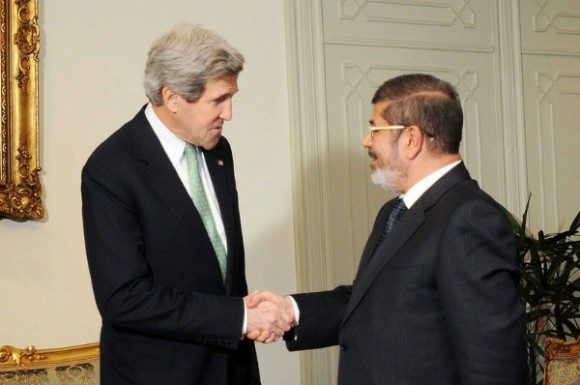
2013_0302_kerry_morsi_600_1

There is a bit of déjà vu happening in Egypt right now: as mass protests against the Morsi regime continue to grow, the Egyptian army gave the regime a 48-hour ultimatum, threatening direct military involvement in the political process “if the demands of the people are not realized.” In other words, if Morsi doesn’t either step down or call for early elections, the army will move to unseat him, just as happened when the protest movement prompted the ouster of Hosni Mubarak in 2011. But, as the Guardian is reporting, the Morsi regime believes that is impossible unless the Washington wants new leadership.
The head of Egypt’s armed forces, General Abdel Fattah Sisi, threatened direct military involvement in the political process “if the demands of the people are not realised”, in a statement implying that Morsi should either step down or at least call early elections. The presidency indicated that it viewed the statement as a coup d’etat, and implied that Morsi was safe as long as his administration still had US support. “Obviously we feel this is a military coup,” a presidential aide said. “But the conviction within the presidency is that [the coup] won’t be able to move forward without American approval.”
This should serve as a much-needed corrective to claims that the Obama administration relinquished America’s imperial holdings in Egypt and allowed the democratic process post-Mubarak to take hold unencumbered. As Egypt’s ruler’s see it, so long as the overlords in Washington want them to stay in power, then stay in power they will – regardless of what the public desires.

 Read More Here


************************************************************************************

The Hill

Obama declines to call for resignation of Egypt's president

By Julian Pecquet - 07/01/13 11:19 AM ET
President Obama on Monday declined to call for the resignation of embattled Egyptian President Mohammed Morsi despite the massive protests calling for his ouster. Obama said the White House is "concerned" about the outbreak of violence in Egypt and is monitoring the situation closely. But the president said Morsi's election was “legitimate” and called on all parties in Egypt to return to the negotiating table. “Our position has always been, it's not our job to choose who Egypt's leaders are,” Obama told reporters in Tanzania. “When I took a position that it was time for Egypt to transition [away from Hosni Mubarak in 2011], it was based on the fact that Egypt had not had democratic government for decades, if ever. And that's what the people were calling for.”
Hundreds of thousands, if not millions, of Egyptians took to the streets over the weekend to demand that Morsi step down. Egypt's military on Monday threatened to intervene if the uprising against the Muslim Brotherhood leader lasts another 48 hours. Obama said U.S. policy towards Egypt — including whether to continue providing $1.5 billion in annual aid — wouldn't change based on "counting the number of heads in a protest march.” “We're going to continue to work with all parties inside of Egypt to try to channel this through legal, legitimate processes,” Obama said, while calling on all parties to “step back from maximalist positions.”

Read More Here

************************************************************************************

‘Biggest protest in Egypt’s history’: LIVE UPDATES


Published time: June 30, 2013 21:38
Edited time: July 01, 2013 21:43
Protesters take part in a protest demanding that Egyptian President Mohamed Mursi resign at Tahrir Square in Cairo July 1, 2013.(Reuters / Mohamed Abd El Ghany)
Millions have taken to the streets across Egypt to demand the resignation of President Morsi on the first anniversary of his inauguration. But Morsi loyalists are staging counter-demonstrations, saying they will defend the leader with all means available.
21:34 GMT: Egyptian Armed Forces spokesman Ahmed Ali said that Egyptian military doctrine does not allow for “military coups” in a statement posted Monday to Facebook.
“Egyptian Armed Forces’ doctrines do not include military coups as a policy. The armed forces already deployed on Egypt's streets in 1977, 1987 and 2011 and this did not lead to a coup, but rather [led the army] to stand with the will of the great Egyptian people and their desire for reform and change,” the statement said.
19:38 GMT: Egypt's armed forces have banned the president and his entourage from leaving the country, ITAR-Tass reported.

19:20 GMT: Egypt's second largest Islamist party, the Nour Party, says it fears the army's return to public life in a "big way" after the military gave politicians 48 hours to resolve the country's crisis.
On its Facebook page, the party called for Morsi to take the "number and diversity" of the demonstrators into consideration and "realize the Egyptian people have legitimate demands that must be answered."
19:04 GMT: The Egyptian Brotherhood's Twitter says a statement will be issued "shortly."
18:57 GMT: The Muslim Brotherhood's Freedom and Justice Party has denied that Khairat al-Shater's bodyguards were arrested.
18:32 GMT: The headquarters of the moderate Egyptian Islamist Wasat party has been set on fire.
18:30 GMT: President Mohamed Mursi is meeting the head of Egypt's armed forces along with the prime minister, according to a statement on the president's official Facebook page. 
17:55 GMT: A Morsi aide has called the army's ultimatum a "military coup," the Guardian reported.
"Obviously we feel this is a military coup," the presidential aide said. "But the conviction within the presidency is that [the coup] won't be able to move forward without American approval." 
17:17 GMT: A house belonging to Shater has reportedly been attacked by "armed thugs."
16: 20 GMT: Fifteen bodyguards of Brotherhood leader Khairat al-Shater have been arrested by security forces, Reuters reported, citing "security sources." Shater's family reportedly phone Al Jazeera to report that his home was under police attack. The sources said security forces were involved in an exchange of fire with the guards after going to arrest them for unlawful possession of firearms.
14:36 GMT: Egypt's army will not be involved in politics or government, Egypt armed forces chief Abdul Fattah al-Sisi said in a statement. He wants politicians to agree on an inclusive road map for the country's future, but says the army will offer its own road map if politicians fail to come to a solution in 48 hours.
Sisi added that the "national security of the state is at risk, due to the developments taking place in the country."
14:33 GMT: Egypt's army gives politicians 48 hours to meet the demands of the people.
14:01 GMT: 

13:50 GMT: Egyptian Prime Minister Hesham Kandil has reportedly rejected the resignation requests from four members of the cabinet: the ministers for tourism, communication and information technology, minister of state for legal and parliamentary affairs and minister of state for environmental affairs.
12:00 GMT: The Muslim Brotherhood is considering action to defend itself, following ransacking of the party’s headquarters by protesters earlier on Monday.

"It's very dangerous for one entity in society to take up violence as a means of change because it may entice others to do so. The Muslim Brotherhood is a disciplined organization," said Gehad El-Haddad, spokesman of the Islamist movement, as cited by Reuters. He added the armed men who ransacked the party’s HQ had crossed a red line of violence. 

Looters carry furniture and other objects out of the Muslim Brotherhood's headquarters after it was burned down by protesters opposing Egyptian President Mohamed Mursi in Cairo's Moqattam district July 1, 2013. (Reuters / Amr Dalsh)
Haddad said self-defense units might be created to curb violence. Those units are going to be similar to the people's self-defense committees which were created during the 2011 uprising that overthrew former President Hosni Mubarak.

11:50 GMT: Four Egyptian ministers quit Morsi’s cabinet, according to a government official. The four are Tourism Minister Hisham Zaazou, Communication and Information Technology Minister Atef Helmi, Minister of State for Legal and Parliamentary Affairs Hatem Bagato and Minister of State for Environmental Affairs Khaled Abdel-Aal. According to the earlier report by the state news agency the ministers were considering resigning in sympathy with the protesters.

11:00 GMT: The Egyptian Health Ministry has announced that 16 people died in Sunday's anti-government protests in Egypt. Previous estimates put the number of deaths at seven.

08:50 GMT: Egyptian protesters again stormed the Muslim Brotherhood headquarters in Cairo after a night of massive protests. Witnesses reported ransacking of the HQ, including throwing things out of the windows and leaving with furniture and other items. There were no Brotherhood members inside the building, AFP reported. 


Egyptians opposed to President Mohamed Morsi set fire to the Muslim Brotherhood headquarters in Almoqatam district during clashes in Cairo on June 30, 2013. (AFP Photo)
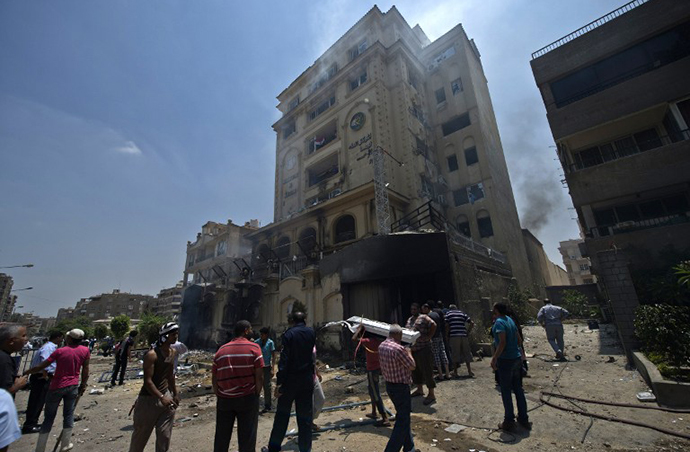

Egyptians gather outside the burnt headquarters of the Muslim Brotherhood in the Moqattam district of Cairo on July 1, 2013 after it was set ablaze by opposition demonstrators overnight. (AFP Photo / Khaled Desouki)
05:00 GMT: Early morning at the Tahrir Square is peaceful, though anti-Morsi protesters remain there as the rally described as the biggest in Egypt’s, and possibly world’s, history enters its second day. Dozens of tents are stationed at the Tahrir, with people obviously ready for long-term camping out.

03:00 GMT: An Egyptian military source told Reuters that as many as 14 million people in the nation of 84 million took part in Sunday's protests across the country. Despite no independent way to verify this estimate, some international media outlets have said that this could have been the largest demonstartion seen in the history of the world.

01:42 GMT: The latest video from RT's Ruptly video news agency shows crowds of anti-Morsi protesters in Cairo.

00:56 GMT:


00:33 GMT: The death toll in Sunday's clashes between supporters and opponents of President Morsi across Egypt has risen to seven. Two people have been killed during violence outside the Muslim Brotherhood's headquarters in Cairo, medical officials say. Five others were shot in a town around the south of Cairo, one in Beni Suef and another in Fayoum and three in Assiut. At least 600 were injued, medical and security sources told Reuters.
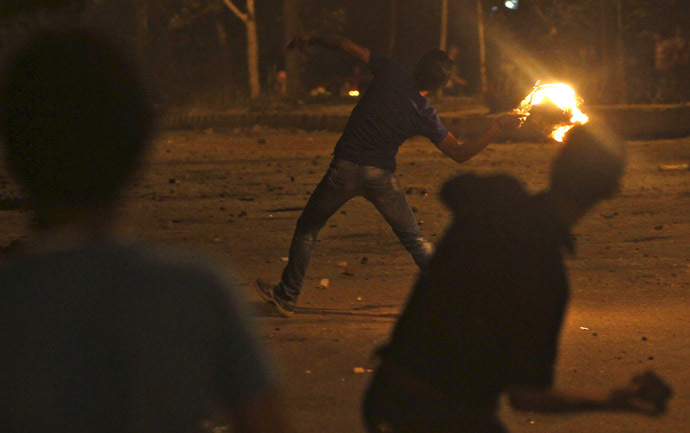

Protesters opposing Egyptian President Mohamed Mursi throw Molotov cocktails and stones at the national headquarters of the Muslim Brotherhood in Cairo's Moqattam district June 30, 2013. (Reuters)
00:20 GMT: “Tamarod” (Rebellion) movement - the backbone of Egypt’s resistance - has released a statement  demanding President Mohammed Morsi step down by Tuesday at 5pm. The movement also called on “police, army and judiciary” to support the people’s will. If Morsi fails to resign by Tuesday, civil disobedience will continue throughout the country.

Monday, July 1

23:39 GMT: Reports emerge that a number of people have been injured at the Muslim Brotherhood's headquarters in Mokattam, Cairo, Ahram Online reports. The location is seeing ongoing clashes between those inside the building and the attackers. Slingshots and possibly live ammunition are being used. Earlier protesters threw Molotov cocktails.

23:30 GMT: Tens of political parties and groups forming the “30 June Coordinating Committee” released a statement thanking the protesters and calling to end political repression.

Protesters opposing Egyptian President Mohamed Mursi shout slogans and set off fireworks during a protest in front of El-Thadiya presidential palace in Cairo June 30, 2013. (Reuters)
“We thank the Egyptian people who have revolted in their millions for a free Egypt, free of fascism, tyranny and injustice,” the statement read, while at the same time denouncing Morsi. “The presidency has released a statement belittling us and our legitimate demands and our million man marches all over Egypt’s squares.”
The committee promised to “stand behind the people and their just demands” and calls for further action by “all democratic means to demonstrate, hold sit-ins and strikes and besiege all state institutions and we demand the trial of all those responsible for torture, killing and announcing edicts inciting against the people and calls for terrorism which was called for by the Muslim Brotherhood.”

22:43 GMT:


22:05 GMT: The leader of Egypt's Islamist Nour party, Younis Makhyoun,  presented himself on Sunday as a mediator with protesters and urged Morsi to make concessions to avert bloodshed on the streets. "There must be concessions, even if they are difficult and bitter, to safeguard the blood of Egyptians," Makhyoun said. "We are worried about an escalation that will be hard to control, and that guns will have the loudest voice."
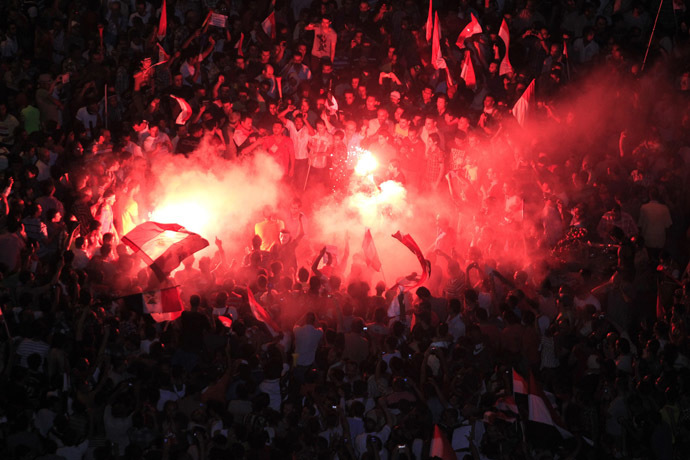

Protesters opposing Egyptian President Mohamed Morsi gather near a lit a flare during a protest at Tahrir Square in Cairo June 30, 2013. (Reuters)
21:50 GMT: Egyptian President Mohamed Morsi knows he has made mistakes and is working to fix them, his spokesman Omar Amer said on Sunday as massive anti-government demonstartions engulfed the coutnry.

************************************************************************************
Enhanced by Zemanta