Showing posts with label Women's Rights. Show all posts

Sunday, September 29, 2013

Driving affects ovary and pelvis, Saudi sheikh warns women. Hmm, Yes you read that right....


I suppose that  since they  can  no longer  claim that  Women  driving is  against  Sharia  Law  they  must  say  something.  The  excuse of damaged  ovaries  is as  good  as  any ,  especially  if  you are  counting  on   compliance  and  subservience.......Hmmmm.


How's that compliant and subservient thing  working  for  you ????


~Desert Rose~

***************************************************************


Al Arabiya News


Last Update: Saturday, 28 September 2013 KSA 07:27 - GMT 04:27


Saturday, 28 September 2013



 Saudi Sheikh Salah al-Luhaydan said driving “could have a reverse physiological impact" on women. (Al Arabiya)
Al Arabiya
Saudi women seeking to challenge a de facto ban on driving should realize that this could affect their ovaries and pelvises, Sheikh Salah al-Luhaydan, also a psychologist, told Saudi news website sabq.org.
Driving “could have a reverse physiological impact. Physiological science and functional medicine studied this side [and found] that it automatically affects ovaries and rolls up the pelvis. This is why we find for women who continuously drive cars their children are born with clinical disorders of varying degrees,” Sheikh al-Luhaydan said.
Saudi female activists have launched an online campaign urging women to drive on Oct. 26.
More than 11,000 women have signed the oct26driving.com declaration that says: “Since there are no clear justifications for the state to ban adult, capable women from driving. We call for enabling women to have driving tests and for issuing licenses for those who pass.”
Sheikh al-Luhaydan urged these women to consider “the mind before the heart and emotion and look at this issue with a realistic eye.”
“The result of this is bad and they should wait and consider the negativities,” he said.


Read More Here


************************************************************

Saudi women seek right to drive


A Saudi woman sits in a vehicle as a passenger in Riyadh (22 Sept 2013)

Stuck in the passenger seat: Women are not allowed to drive in Saudi Arabia

A new campaign asking for the right for women to drive in Saudi Arabia has attracted more than 11,000 signatures in support.
The campaign has set 26 October as a day for Saudi women to take to the roads - in defiance of the informal ban on women behind the wheel.
In a sign of how pervasive online social networks have become in Saudi Arabia, the campaign was started on Twitter.
It is the idea of the activist, Eman al-Nafjan, who set things in motion with a simple message saying that Saudi women would express their feelings about driving on 26 October.
"There is no justification for the Saudi government to prohibit adult women citizens who are capable of driving cars from doing so”

Petition for women's driving rights
The hope is that women will come out en masse to drive on that day, she told the BBC.
Ms Nafjan says the campaign is meant to be a grassroots movement open to all Saudis - men as well as women - to show their support.
Influential Saudis have given their public backing, while several videos of women driving have been posted on the campaign's website.
There is even a song linked to the campaign by the Saudi-born singer Shams, entitled It's Our Right to Drive.
Photos have also been sent in showing supporters' hands with parts of the online petition written across them.
The first point in the petition reads: "Since there is no justification for the Saudi government to prohibit adult women citizens who are capable of driving cars from doing so, we urge the state to provide appropriate means for women seeking the issuance of permits and licenses to apply and obtain them".
It goes on to say that the Saudi government must provide a valid and legal justification if it continues to deny women the right to drive.

Cars in Riyadh (22 Sept 2013)  
 
Many Saudi women are dependent on paid male drivers to get around
'Window dressing'

Women activists in Saudi Arabia say the issue of being allowed to drive is key to gaining other rights.
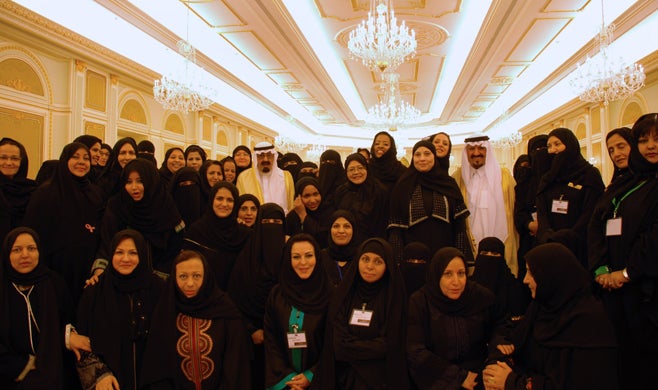
There have been moves in this direction recently with women allowed onto the influential Shura council for the first time, as well as having the right to vote in the next municipal elections.


Read More Here


Related Stories

************************************************************


Saudi Sheikh blasted on Twitter for saying women drivers ‘risk damaging ovaries’

Published time: September 29, 2013 17:43 
Reuters / Fahad Shadeed


Comments by a Saudi psychologist that driving affects women’s ovaries and can lead to their children having health problems have outraged many women in the conservative Muslim country, who are protesting a de facto ban on women driving.
In an interview Friday with the sabq.org website, Sheikh Saleh bin Saad al-Luhaydan said campaigners should put “the mind before the heart and emotion, and look at this issue with a realistic eye.”
“Physiological science and functional medicine [found that driving] automatically affects ovaries and rolls up the pelvis,” the judicial and psychological consultant to the Gulf Psychological Association said.
“This is why we find [that] for women who continuously drive cars, their children are born with clinical disorders of varying degrees.”
Many Saudis have expressed their anger in Twitter, mocking the Sheikh’s “great scientific discoveries.”
A special hashtag “Women_driving_affects_ovaries_and_pelvises” appeared on the social network, and is widely used.


Read More Here


************************************************************
Enhanced by Zemanta

Friday, July 26, 2013

Mazar-e-Sharif Suicides: Poisonous Freedom for Afghan Women


By Nicola Abé in Mazar-e-Sharif, Afghanistan
Photo Gallery: Rash of Suicides Plagues Afghanistan
REUTERS
Women in Mazar-e-Sharif have straddled the worlds between Western freedoms and conservative traditions for a decade. As the Taliban gains strength and the West pulls out, Afghanistan's most liberal city is being plagued by a rash of suicides.
Fareba Gul decided to die in a burqa. She put on the traditional gown, which she usually didn't wear, and drove to the Blue Mosque. There, at the holiest place in the northern Afghan city of Mazar-e-Sharif, she swallowed malathion, an insecticide. She then ran over to the square, where hundreds of white doves were waiting to be fed by visitors. When she was surrounded by the birds, the cramps set in.

"Fareba was lying on the ground when I arrived, and people were standing all around her," says her uncle Faiz Mohammed, whom she had called before taking the poison. "She was screaming for help." He lifted up his niece, carried her to a taxi and took her to a hospital. Foam was pouring from her mouth, and she was slipping in and out of consciousness. One hour later, 21-year-old Fareba Gul was dead. She died on the same day, and in the same hospital, as her 16-year-old sister Nabila.
Behind the tragedy lay a harmless love affair, relatives say. The sisters had been fighting, and Nabila had taken things too far: She had fallen in love. Fareba, the relatives say, got angry, calling Nabila's behavior "indecent" and demanding that she end the affair. Both got very upset and were screaming at each other. Their mother entered the room and slapped Nabila. Then, Nabila reportedly took the poison from her father's cabinet and swallowed it in her room. A few hours later, Fareba took the same pills. "She felt guilty," says her uncle.
The sisters' double suicide hangs over the city like a dark shadow. Mazar-e-Sharif is widely viewed as one of the most peaceful and liberal cities in Afghanistan. But could this be an omen of what lies ahead for the country once Western troops start withdrawing in the near future?
Living in Mazar-e-Sharif means living in relative security. But now more and more women are starting to hurt themselves here, as well. It leaves one baffled, but it is still no coincidence.
More than anywhere else in Afghanistan, women in Mazar-e-Sharif are torn between tradition and their newly won freedom, between family expectations and their own sense of self. They are trapped in a society that is at once deeply conservative but also offers just enough freedom for women to discover a modern, Westernized lifestyle. Girls can go to school, women can work, and both can surf the Web and watch cable TV. But forced marriages, domestic violence and many limitations continue to exist for many of them -- and are all-the-more difficult to bear. Under these circumstances, choosing how and when to die can become a form of self-determination.
Zarghana, 28, has survived two suicide attempts. She enjoyed success working...
Farshad Usyan/ DER SPIEGEL
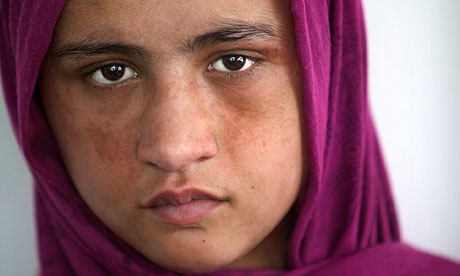
Zarghana, 28, has survived two suicide attempts. She enjoyed success working for a human rights organization as a teacher, but then her husband abandoned her with their seven children and she lost her job. Her father refuses to let her divorce her husband, a stepbrother whom she was forced to marry at a young age.
When asked about the women killing themselves, the city's police chief claims that such things "only happen in Heart province or in remote mountain villages." Women's rights organizations point to poverty and a lack of education as the main factors behind the suicides.
But the family home of the dead sisters is located in one of the best areas of town. It is spacious and in good condition, with a garden full of blooming roses. Marzia Gul, their mother, says "Please, come in," and sits down on the sofa in the living room, sinking into the red upholstery. "Fareba, my oldest daughter, studied law," she says. "She wanted to be a lawyer like her father" and was just a year away from her final exams. Nabila, the younger one, also did well in school, she continues. "She wanted to be a journalist."
Marzia gets up, walks over to the cupboard and takes a photo from a glass tray. The picture shows a smiling little girl with pigtails and freckles. "She was so kind and helpful," she says. Then her voice breaks.
A Place of Despair
The sisters' suicide is particularly unsettling because the girls led privileged lives in this long-suffering country. They watched Bollywood films, had mobile phones and Internet access. Along with jeans and makeup, they wore headscarves but no burqas. They didn't have to hide from the world.
And they lived in a city that does not force the well-off to barricade themselves behind concrete walls. A powerful governor controls life in this part of Afghanistan -- so effectively, in fact, that residents hardly have to fear death from a bomb attack. Foreign aid workers are permitted to move around freely. Visitors barely see any weapons in the streets. Instead, they can watch women in the bazaars trying on shoes, their eyelids shaded with the traditional cosmetic kajal and their hair lightly covered by a headscarf.
Indeed, in theory, Mazar-e-Sharif is a place of hope. But at least in the regional hospital's department of internal medicine, the city is a place of despair.
"Fridays are the worst," says Dr. Khaled Basharmal as he takes out a notebook. "Eight attempted suicides on a single day." He reads off the names of the most recent patients -- Raihana, Roya, Shukuria, Terena, Rahima. There are also the names of two young men.
"It's a disaster. Since late March, we've had more than 200 cases," Basharmal says. The sisters, Fareba and Nabila Gul, were among his patients as well.
Basharmal is sweating underneath his white coat, and he is exhausted. It's noon now, and he was forced to work another shift that lasted through the night.
No official statistics are kept, and no one can confirm his figures. Nevertheless, Afghanistan is believed to be one of the few countries in the world that has more women taking their lives than men. A recent study concluded that five out of every 100,000 women are committing suicide each year. But the real number is likely to be much higher, especially in rural areas far away from the big cities. More than 1.8 million women in Afghanistan, which has an estimated population of 31 million, are said to be suffering from depression.


More than anywhere else in Afghanistan, women in Mazar-e-Sharif are torn...
Getty Images
More than anywhere else in Afghanistan, women in Mazar-e-Sharif are torn between tradition and their newly won freedom, between family expectations and their own sense of self. They are trapped in a society that is at once deeply conservative but also offers just enough freedom for women to discover a modern, Westernized lifestyle. Girls can go to school, women can work, and both can surf the Web and watch cable TV.


 Read More  and See Additional Photos Here


Enhanced by Zemanta

Thursday, July 11, 2013

Afghan judges free three jailed for torture of child bride Sahar Gul


Campaigners warn of assault on women's rights after three freed despite imprisoning, starving and burning girl sold into marriage
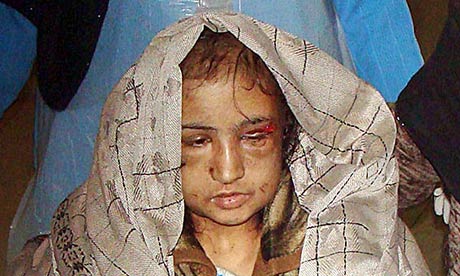
Afghan wife Sahar Gul being taken to hospital. Her in-laws tried her to force her into prostitution
Sahar Gul, then a 15-year-old Afghan wife, being carried to hospital in Baghlan. Her in-laws tortured her to force her into prostitution. Photograph: Jawed Basharat/AP
Human rights activists have warned of an new assault on women's rights in Afghanistan after judges and prosecutors allowed the early release of three people convicted for the brutal torture of a child bride, and conservative lawmakers made an aggressive bid to prevent relatives testifying against each other.
If successful, the small change – introduced covertly into the criminal prosecution code – would stop the vast majority of cases of violence against women from ever reaching court.
Together with the quashing of three convictions for the attempted murder of the teenager Sahar Gul, it marks an alarming two-pronged assault on women's rights by both those who make the laws and those tasked with upholding them.
"The last two months have really been a parade of horrible for women's rights in Afghanistan," said Heather Barr, Afghanistan researcher at Human Rights Watch, warning that the proposed change to the criminal code would leave most abused women with no legal protection against violence.
"Underage marriage, forced marriage, domestic violence, sale of women – these crimes are almost always committed against women by family members, whether through birth or through marriage."
The 10-year sentences handed down to Gul's tormentors last year was hailed as an important step forward, after her case horrified Afghanistan and prompted a bout of national soul-searching.
Sold as a wife when she was an illiterate 12-year-old, her in-laws wasted little time embarking on a campaign of almost unimaginable torture. They starved her, chained her in a basement bathroom, beat her, burned her with red-hot metal pipes and pulled her fingernails out.
By the end of her ordeal she could no longer walk, and was rescued from her makeshift prison in a wheelbarrow. But last week, according to her lawyer and women's activists, a court ordered the release of Gul's mother-in-law, father-in-law, and sister-in-law saying there was no proof of abuse.

No evidence

"This was based on the idea that there was no evidence, but the people who would have given evidence didn't know that the hearing was taking place," said Kimberley Motley, a Kabul-based US lawyer who took on Gul's case last week after learning of the release.
Judges ignored the fact that the courtroom was almost empty, with apparently no representation from government prosecutors or the victim, even though both should have been informed under Afghan law.
Sahar Gul, 14, at a women's shelter in Kabul. Sahar Gul at a women's shelter in Kabul, Afghanistan, last year. She was not told about the release of her three in-laws, her lawyer said. Photograph: Kuni Takahashi/New York Times/Redux/eyevine "Sahar Gul was not told about this," Motley said. "The prosecutor didn't show up or wasn't informed. I believe the only person in court was the defence lawyer for the accused."


Read More Here


Enhanced by Zemanta

Wednesday, June 19, 2013

Saudi Arabia: Activists Convicted For Answering Starving Mothers Call For Help


Saudi women activists get jail time for helping starving mother locked in home


Published time: June 19, 2013 01:56

AFP Photo / Fayez Nureldine

A Saudi court sentenced two women to ten months in prison, along with a two-year travel ban, after they tried to help a Canadian woman who, with her three children, was denied adequate food and water and was subjected to violence by her Saudi husband.
On June 6 2011, the two human rights workers Wajeha al-Huwaider and Fawzia al-Oyouni received a text message from Nathalie Morin, the Canadian woman, saying that her husband had locked the whole family in the house and left for a week-long visit to see relatives in another town while her supplies of food and water were running out, according to Human Rights Watch.
“I cannot help myself and I have no rights in Saudi Arabia. My children are hungry and I cannot do anything to feed them. I'm fighting to get freedom, justice and fairness for my family including myself,” Morin wrote on her blog.
The two bought food and came to Morin’s house, where police were already waiting for them. The women were brought to Damman station for questioning, where police told al-Huwaider and al-Oyouni they believed they were trying to smuggle Morin and her three children to Canada, Human Rights Center reports.
After the women signed a statement pledging to cease all involvement with the case, the police released them. However, more than a year later in July 2012, authorities called in al-Huwaider and al-Oyouni for questioning, after which the government launched a case against them.

The trial continued for another year, and last Saturday presiding judge Fahad al-Gda'a issued a ruling sentencing the two human rights workers to ten months in prison, imposing an additional two-year travel ban on top of the jail time. The charges were “inciting a woman to flee with her children” and “attempting to turn a woman against her husband.” The women were acquitted of charges that they had attempted to smuggle the wife and her three children to the Canadian Embassy in Riyadh.

Al-Huwaider and al-Oyouni plan to challenge the ruling in the Court of Appeals.

The same day the two women issued a statement that when the case was launched, they predicted that the government was trying to punish them for their women’s rights activism in recent years. 

Read More  Here


***************************************************************************


Saudi Arabia: Activists Convicted For Answering Call For Help, Says HRW

June 18, 2013

By

A Saudi court convicted two Saudi women’s rights activists on June 15, 2013, for trying to help a woman flee the country. Wajeha al-Huwaider and Fawzia al-Oyouni were each sentenced to 10 months in prison and two-year travel bans.
Al-Huwaider, a member of the Human Rights Watch Middle East advisory committee, told Human Rights Watch that she believes authorities pursued this case to punish her for unrelated women’s rights activism over the last 10 years. Al-Huwaider and al-Oyouni said they intend to appeal their convictions.
“Saudi authorities are using the courts to send a message that they won’t tolerate any attempt to alleviate the dismal status of women’s rights in the kingdom,” said Joe Stork, deputy Middle East director at Human Rights Watch. “Saudi authorities should immediately drop this case and stop harassing Saudi women who call for reform.”
Al-Huwaider told Human Rights Watch that her and al-Oyouni’s involvement with the Canadian woman began in 2009, when she received messages from Johanne Durocher, the woman’s mother, who is in Canada, pleading for activists to help her daughter, Natalie Morin. Morin is married to a Saudi citizen, Sa’eed al-Shahrani, and lives with him and their three children in the Eastern Province city of Dammam.
Durocher told them that al-Shahrani, a former police officer, was abusing Morin by locking her in their house and denying her adequate food and water. Durocher had helped draw international media attention to the case in 2009 by lobbying Canadian government officials to intervene and organizing protests over the case in Canada.
Al-Huwaider said that she and al-Oyouni organized several trips by other activists to deliver food and supplies to the woman, but that they did not attempt to visit Morin until the afternoon of June 6, 2011, when they received distressed messages from Morin herself. The messages said that Morin’s husband had left for a week-long visit to see relatives in another town and that her supplies of food and water were running out. When al-Huwaider and al-Oyouni approached the house to offer assistance they were confronted by police who were apparently waiting for them to arrive. The officers immediately arrested them and took them to a Damman police station for questioning.
The police told al-Huwaider and al-Oyouni that they believed they had gone to Morin’s home to help her and her three children, all Canadian citizens, to escape to Canada.
Police released al-Huwaider and al-Oyouni after midnight on June 7, after they signed a statement pledging to cease all involvement with the case and to allow the government-affiliated National Human Rights Commission and Canadian Embassy to investigate. The Damman branch of the National Commission on Human Rights declined to intervene, stating that there was insufficient evidence to conclude that al-Shahrani was mistreating Morin and their children. Canadian government officials have maintained since 2009 that this case is a private matter that must be resolved by Saudi authorities.

Read More   Here

****************************************************************************

HUMAN RIGHTS WATCH


Leading Rights Group Shuttered, Harsh Sentences on Politically-Motivated Charges

The Saudi authorities should immediately release al-Qatani and al-Hamid, drop the charges against them, and end political trials before the Specialized Criminal Court.
Eric Goldstein, Deputy Director of the Middle East and North Africa Division
(Beirut) – The harsh sentences against leading Saudi rights advocates and an order to shutter a civil and political rights group are major setbacks for rights in Saudi Arabia. Saudi authorities should release and drop charges against the two leading human rights activists sentenced to long prison terms after a Specialized Criminal Court convicted them on politically-motivated charges on Saturday.

The activists, Mohammed al-Qahtani and Abdulla al-Hamid, are co-founders of the Saudi Civil and Political Rights Association (ACPRA), a rights organization that has called for greater civil rights in the kingdom. They faced charges including “destabilizing security by calling for protests,” “spreading false information to outside sources,” “undermining national unity,” and “setting up an illegal human rights organization.” The two activists have been sentenced solely for their peaceful advocacy of reform and criticism of human rights violations.

“This is simply an outrageous case, which shows the extremes Saudi authorities are prepared to go to silence moderate advocates of reform and greater respect for human rights”, said Eric Goldstein, Deputy Director of the Middle East and North Africa Division at Human Rights Watch. “The Saudi authorities should immediately release al-Qatani and al-Hamid, drop the charges against them, and end political trials before the Specialized Criminal Court.”

The Specialized Criminal Court began trying the two activists in June 2012. At first, their trials were separate and they were conducted behind closed doors, like most other trials before the Specialized Criminal Court. The judge, however, decided to merge the two cases after their first sessions. The trial continued on camera until the fifth and last session, when the judge finally opened the proceedings and allowed the presence of media, lawyers, and rights activists, who attended in the presence of members of the security forces.

At the final session on Saturday, according to Sabq newspaper, the judge read through the charges at length and likened the activists’ beliefs to those of terrorists, claiming that “calling for a change of the name of the kingdom cannot possibly be reformist.” The newspaper also reported that presiding judge Hammad al-Omar told al-Hamid, after he remarked on the lack of independence of the court, not to question the validity of the sentences, warning him that “judges may add what crimes they deem necessary to the charge list.”


Read More   Here

****************************************************************************