Local and Global Community News – Activism / Protests - Animal Advocacy - Animal Rescue- Archaeology/Anthropology/Paleontology/Crypto-zoology , Corporate Assault on our Lives and Our Health, Environmental- Internet/IT - Signs of the Times – Wildlife : News Affiliate of Family Survival Protocol.com
Showing posts with label global Disaster Watch. Show all posts
Showing posts with label global Disaster Watch. Show all posts
Fukui
Gov Issei Nishikawa will soon give his consent for the restart of two
nuclear reactors in the prefecture on the Sea of Japan coast, sources
close to the matter said Sunday, as the central government seeks to
bring more reactors back online after the 2011 Fukushima nuclear crisis.
The
governor will visit the site of the Nos. 3 and 4 reactors at Kansai
Electric Power Co’s Takahama plant on Monday to check safety measures
before expressing his consent, they said. The governor’s consent is
necessary to restart the reactors.
Earlier in the day, industry
minister Motoo Hayashi, in charge of the country’s energy policy, met
with Nishikawa at the Fukui prefectural office and sought the Fukui
governor’s consent for the restart of the two nuclear reactors.
Algae Causing Sea Lion Brain Damage in California, Study Shows
byReuters
In
this September 11, 2013 file photo, a sea lion scratches himself on
Pier 39 at Fisherman's Wharf in San Francisco, California. DON EMMERT / AFP - Getty Images
WASHINGTON
— A toxin produced by marine algae is inflicting brain damage on sea
lions along California's coast, causing neurological and behavioral
changes that can impair their ability to navigate in the sea and survive
in the wild, scientists said on Monday.
Brain scans on 30
California sea lions detected damage in the hippocampus, a brain
structure associated with memory and spatial navigation, in animals
naturally exposed to the toxin known as domoic acid, the researchers
said.
Domoic acid mimics glutamate, a chemical that transmits
nerve impulses in the brain, and leads to over-activation of hippocampus
nerve cells and chronic epilepsy, according to Emory University
cognitive psychologist Peter Cook, who worked on the study while at the
University of California-Santa Cruz.
"The behavioral deficits
accompanying brain damage with domoic acid are severe, and may
negatively impact foraging and navigation in sea lions, driving
strandings and mortality," Cook said.
Hundreds of sea lions
annually are found stranded on California beaches with signs of domoic
acid poisoning such as disorientation and seizures. Thousands are
thought to be exposed to the toxin.
Monday, December 14, 2015 by: L.J. Devon, Staff Writer
(NaturalNews)
The Marine Mammal Center rescued over a hundred sea lions in a 10-day
period off the West Coast of California in the winter of 2015. The
influx of stranded sea lions is a sign that the health of the ocean is
deteriorating. From January 1 to February 12, 2015, National Geographic counted nearly 500 rescued sea lions, an amount that is alarming scientists. Something has gone awry in the West Coast waters.
The
sea lions are not finding food, they are losing strength, and many are
starting to wash ashore. The startling trend didn't start in 2015. The
number of stranded sea lions began rising in the winter of 2013, when
scientists started noticing waves of sea lion pups washing ashore.
Scientists believe the ocean's temperatures have shifted. Warmer
currents may be affecting food sources that the sea lions depend on.
Others see problems in ocean water acidity. The animals are being forced
to go on longer quests to find food. Many of the pups are being left
behind, stranded, while their parents search for food.
One-third of sea lions born last summer wiped out
The
death of this sentinel species is an indication of changes in ocean
climate and ecosystem. Sea lion prey, which include sardines and
crayfish, are reportedly disappearing in numbers as well, forcing the
starving sea lions to go on longer quests in search of food. Scientists
are concerned about ocean pH and rising acidity of the waters. According
to San Jose Mercury News, marine biologists warn that, if the trend continues, an entire generation of California sea lions could be wiped out.
When speaking to NBC News,
Sea World San Diego senior veterinarian Hendrick Nollens reported, "We
had rescued 19 California sea lions in January [2013]. This year we
already rescued 87 pups in that same month. So this event seems to be
much larger."
According to the Daily Breeze, the "unusual mortality event" wiped out two-thirds of the sea lion pup population off the West Coast in 2013.
Rehabilitation centers are taking several hundred pups in this year to save the species from total extinction.
NOAA
wildlife biologist Sharon Melin confirmed that most pups captured in
the wild in 2013 were only half their weight. After they are released
back into the wild, they are expected to maintain their weight. When
Melin went on a research trip in September 2013, she reported that the
weight of the pups was still low. She brought back the bad news: "We've told the centers to prepare for the worst."
The U-T San Diego
concurred, reporting that pups in the Channel Island rookeries
continued to struggle despite rehabilitation efforts. On average, pups
were 19% below their average weight, even after rehabilitation.
Jim
Milbury of NOAA Fisheries says that West Coast sea lions have a birth
rate of about 50,000 a year, and San Diego 6 reported on Jan. 28, 2015,
that nearly 1 of 3 pups born the previous summer have already died.
If 33% of pups born in 2014 have already died, then based on the average birth rate, over 15,000 have passed away in that short time frame.
Ocean water acidity on the rise, subjecting aquatic life to disease
According to Jennifer Palma of Global News,
ocean health is deteriorating, indicated by a die off of scallops and
oysters. "Getting pacific oysters and scallops is next to impossible;
the industry is in crisis. ... So what's killing the Pacific oysters and
scallops? A possible combination of factors including warmer oceans,
decreasing acidity levels and potentially disease," she said in a
report.
University of British Columbia marine microbiology professor Curtis Suttle is concerned about changes in the pH of ocean
waters. "The hypothesis -- there's a working hypothesis --w is that
these changes, these excursions in pH, are making the shellfish
vulnerable to infection by diseases that they would normally be
resistant to."
The
NaturalNews Network is a non-profit collection of public education
websites covering topics that empower individuals to make positive
changes in their health, environmental sensitivity, consumer choices and
informed skepticism. The NaturalNews Network is owned and operated by
Truth Publishing International, Ltd., a Taiwan corporation. It is not
recognized as a 501(c)3 non-profit in the United States, but it
operates without a profit incentive, and its key writer, Mike Adams,
receives absolutely no payment for his time, articles or books other
than reimbursement for items purchased in order to conduct product
reviews.
The vast majority of our content is freely given away at
no charge. We offer thousands of articles and dozens of downloadable
reports and guides (like the Honest Food Guide)
that are designed to educate and empower individuals, families and
communities so that they may experience improved health, awareness and
life fulfillment.
Scientists test seawater samples off the coast of Japan near the Fukushima Daiichi nuclear power station. (Photo: IAEA Imagebank/flickr/cc)
Radiation from the 2011 Fukushima
nuclear disaster in Japan has been detected at an increased number of
sites off U.S. shores, including the highest level in the area detected
to date, scientists announced Thursday.
While the levels are still
too low to be considered a threat to human or marine life by the
government's standards, tests of hundreds of samples of Pacific Ocean
water reveal that the Fukushima Daiichi plant has continued to leak
radioactive isotopes more than four years after the meltdown—and must
not be dismissed, according to Woods Hole Oceanographic Institution (WHOI) marine radiochemist Ken Buesseler.
"Despite
the fact that the levels of contamination off our shores remain well
below government-established safety limits for human health or to marine
life, the changing values underscore the need to more closely monitor
contamination levels across the Pacific," Buesseler said Thursday.
"[F]inding values that are still elevated off Fukushima confirms that
there is continued release from the plant."
Scientists from the WHOI and Buesseler's citizen-science project Our Radioactive Ocean discovered trace amounts of cesium-134, the "fingerprint" of Fukushima, in 110 new Pacific samples off U.S. shores in 2015 alone.
The
isotope is unique to Fukushima and has a relatively short two-year half
life, which means "the only source of this cesium-134 in the Pacific
today is from Fukushima," Buesseler said.
Map
shows the location of seawater samples taken by scientists and citizen
scientists that were analyzed at the Woods Hole Oceanographic
Institution for radioactive cesium as part of Our Radioactive Ocean.
Cesium-137 is found throughout the Pacific Ocean and was detectable in
all samples collected, while cesium-134 (yellow/orange dots), an
indicator of contamination from Fukushima, has been observed offshore
and in select coastal areas. (Figure by Jessica Drysdale, Woods Hole
Oceanographic Institution)
One sample collected
roughly 1,600 miles west of San Francisco revealed the highest radiation
level detected to date off the West Coast, the researchers said in a
post on the project's website. "[In] one cubic meter of seawater (about
264 gallons), 11 radioactive decay events per second can be attributed
to cesium atoms of both isotopes. That is 50 percent higher than we've
seen before."
"[T]hese long-lived radioisotopes will serve as
markers for years to come for scientists studying ocean currents and
mixing in coastal and offshore waters," Buesseler continued.
The
2011 accident, prompted by an earthquake and tsunami off Japan's east
coast, was the world's worst nuclear disaster since Chernobyl in 1986
and resulted in the near-total meltdown of three nuclear reactors at the Fukushima plant and a mass evacuation of the prefecture. Despite ongoing warnings
about long-term health and environmental impacts and widespread
opposition to nuclear power in the wake of the meltdown, Japan in August
restarted a reactor at the Sendai power plant, about 620 miles southwest of Tokyo.
Heavy
rains, flooding and a spike in new arrivals could threaten the lives of
over 110,000 Burundian refugees in overcrowded camps in Tanzania, six aid agencies said on Monday, amid warnings of rising political tension in Burundi.
Life-threatening
malaria and diarrhoea have been spreading in Nyarugusu, the world’s
third largest refugee camp, since the rainy season began, and damage
caused by a powerful El Nino has left aid agencies short of funds
throughout east Africa.
“Refugees
are arriving in the hundreds every day,” the agencies, which include
Oxfam, Save the Children and HelpAge International, said in a statement.
“Many
people are still living in overcrowded mass shelters months after their
arrival, where wet floors and cramped conditions mean that the risk of
respiratory infections and waterborne diseases is high.”
The agencies also fear a fresh outbreak of cholera, which killed 33 Burundian refugees in western Tanzania in May, as heavy rain sometimes makes toilets overflow and flood shelters.
California Drought Affects Winter Refuges for Migratory Birds
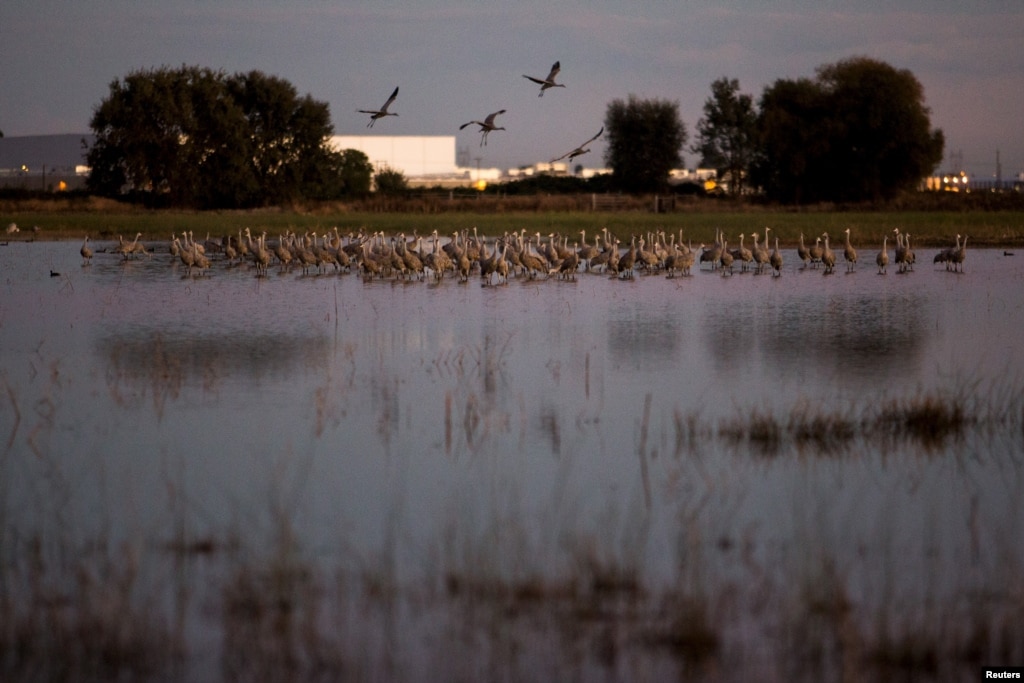
Sandhill
cranes land in flooded fields at the Sandhill Crane Reserve near
Thornton, California, Nov. 3, 2015. The state's ongoing drought has left
millions of waterfowl that migrate from northern climes to California
with fewer places to land, seek food.
Reuters
November 07, 2015 10:43 AM
LODI, CALIFORNIA—With
their red heads, 2.13-meter (7-foot) wingspan and a trilling call,
migrating Sandhill Cranes provide a dramatic sunset spectacle as they
land by the thousands in wetlands near Sacramento each night during the
fall and winter.
But the state's ongoing drought has left the
cranes, along with millions of other waterfowl that migrate from Canada
and other northern climes to spend the winter in California, with fewer
places to land, threatening their health as they crowd in on one another
to seek shelter and food.
"They're left with fewer and fewer
places to go, which will start to have impacts on their population,"
said Meghan Hertel, who works on habitat issues for the Audubon Society
in California. "They can die here from starvation or disease or be
weaker for their flight back north."
Beloved sight
The cranes are a beloved sight in California's Sacramento and San Joaquin Valleys when they arrive each fall.
Tourists
flock to see them as they take off en masse at dawn or land in a series
of swooping, trilling groups as the sun goes down.
Published: 09:25 EST, 24 November 2015 | Updated: 20:28 EST, 24 November 2015
Danger list: Endangered primates that are battling for survival
They
are our closest living relatives in the animal kingdom, yet more than
half of the world's primates are facing extinction due to our
destruction of the habitats where they live.
Burning
and clearing of large areas of tropical forest, combined with hunting
of primates for food and illegal wildlife trade, has placed many species
of apes, lemurs and monkeys at risk of dying out.
These
include iconic species such as the Sumatran orang-utan, Grauer's
gorilla, the Northern brown howler monkey and the Hainan gibbon.
More
than half of the world's primates are at risk of dying out due to the
threat posed by habitat loss and hunting. The Hainan gibbon (pictured)
is thought to be the world's most endangered primate, with just 25 of
the animals left living on an isolated island in China
Scientists
and conservation experts have now updated a report on the world's 25
most endangered primates based on the current knowledge of the animals
numbers and the risks facing them.
Dr
Christoph Schwitzer, a primatologist and director of conservation at
Bristol Zoological Society who helped compile the list, said: 'This
research highlights the extent of the danger facing many of the world's
primates.
Are you getting enough minerals? A new theory suggests most of Earth’s mass extinction events
could have been caused by a lack of essential trace elements in the
world’s oceans, causing fatal deficiencies in marine animals, from
plankton to reptiles.
“It’s a complex scenario,” says John Long
from Flinders University in Adelaide, Australia. He says there are
probably a lot of causes conspiring to drive these mass extinctions. But
his latest work suggests fluctuations in essential minerals in the
ocean could be an important, and so-far completely unexplored, cause.
Essential selenium
Earlier this year, researchers discovered that periods when the ocean had high levels of trace elements – like zinc, copper, manganese and selenium
– seemed to overlap with periods of high productivity, including the
Cambrian explosion, when most groups of living animals first appeared.
Monterey Bay anchovy numbers in decline, groups say
By Samantha Clark
Santa Cruz Sentinel
Posted: 10/30/2015 12:32:04 PM PDT4 Comments | Updated: 19 days ago
Anchovies
fill a hatch aboard the El Dorado as workers unload the fishing boat at
the Moss Landing Harbor on October 16, 2015. The boat is owned by Frank
Aliotti Senior. (David Royal - Monterey Herald) ( David Royal )
Frank Aliotti Jr. moves a vacuum hose while unloadin anchovies from the El... ( David Royal )
SANTA
CRUZ -- For at least the past three years, humpback whales have been
putting on a show in the Monterey Bay. Feasting and frisking, the
40-foot-long, 40-ton leviathans create in dizzying displays.
Locals have never seen anything like it. But things have changed.
"Since
late September, the whale numbers have decreased, their behavior has
changed and their food, anchovies, are less abundant," said Nancy Black,
marine biologist and owner of Monterey Bay Whale Watch. "We were seeing
carpets just thick of anchovies for almost a mile. Now all we're seeing
is spots."
Whale watching tour companies and conservationists
claim the anchovy population has "collapsed" due to environmental
reasons so fishing limits remain too high.
Plenty of anchovies in Monterey Bay, but maybe not elsewhere
Monterey
Fish Company worker Geronimo Hernandez feeds anchovies from a chute
into iced bins while unloading the El Dorado fishing boat at the Moss
Landing Harbor on October 16, 2015. The boat is owned by Frank Aliotti
Senior. (David Royal - Monterey Herald)
A fisherman moves anchovies toward a vacuum tube inside the hatch
aboard the El Dorado as workers unload the fishing boat at the Moss
Landing Harbor on Friday. The boat is owned by Frank Aliotti Sr. David Royal — Monterey Herald
Monterey >> Things are shifting for fishermen in Monterey Bay.
Market squid are disappearing, and in their place, fishing boats are reeling in piles of anchovies.
But while they appear abundant, conservation groups warn that the forage fish may be at their lowest levels since the 1950s.
“It’s
an anomalous year,” said Diane Pleschner-Steele, executive director of
the California Wetfish Producers Association. “Typically these are not
the kind of oceanographic conditions that anchovy like. But they are
here and they’re really close to shore, which is why we’re having a
spectacular year for whale watching.”
Anchovies aren’t just bringing whales into the bay — they’re also attracting fishing fleets.
“There
are thousands of tons,” said Sal Tringali, president of Monterey Fish
Company, whose fishermen in Moss Landing are landing about 120 tons of
anchovies each night and expect to do so for about another month. “There
are all the anchovies you want out here.”
POSTED: 11:24 AM PDT Oct 21, 2015 UPDATED: 01:13 PM PDT Oct 21, 2015
Anchovy shortage in Monterey bay
MOSS LANDING, Calif. - Several conservation groups and whale watching operators are very concerned about the anchovies in the Monterey Bay.
They're
worried they're being over-fished, and want something to be done about
it. Recently, fishermen have been hauling out 120 tons of anchovies
every night, but those anchovies are some of the last along California's
coast.
Still, the groups want to make it clear they’re not
against fishermen doing their job, they’re just concerned about a lack
of data on the anchovy population and health.
Oceana’s Geoff Shester said there hasn’t been an analysis on anchovies in more than 20 years.
"The
anchovy abundance out here, and off the entire state, has gotten to
some of the lowest we've seen since the 1950s," Shester said.
"Scientists are calling it an actual collapse."
Marine Biologist
and Whale Watching Operator Nancy Black said marine animals and
fishermen are both taking from the same source, driving down the anchovy
population.
Posted: Nov 03, 2015 5:15 PM CST Updated: Nov 03, 2015 5:39 PM CST
By JJ Bailey, Online News Producer
ST. PETERS, Mo. (KMOV.com) - Residents
in St. Charles County are familiar with seeing trains. Locomotives roll
through the county several times a day, but a topic under discussion involving the Westlake Landfill has some on edge.
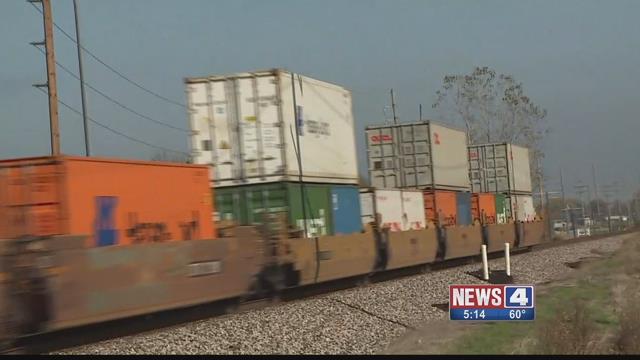
If
a decision is made to remove radioactive waste from Westlake, railways
could end up transporting it. A derailment is always a risk near any set
of tracks, but if train carrying radioactive waste is the one that
derails, it could be a catastrophe.
“Basically, what we want is to
have the trains run at a slower speed coming through the towns,” said
St. Peters Alderman Rock Reitmeyer. “We don't want to see any accidents
coming through our area and dropping all this waste. It could have a
hazardous effect.”
NRA to call for replacing Monju operator
Nuclear & Energy Nov. 3, 2015 - Updated 23:14 UTC-5
Japan's nuclear regulator is set to call on science minister Hirosi Hase to replace the operator of the country's prototype fast-breeder Monju reactor.
The Nuclear Regulation Authority made the decision at a meeting on Wednesday, based on its view that the current operator, the Japan Atomic Energy Agency, is unfit for the job. It says the operator of the Monju reactor in Fukui Prefecture has failed to improve its safety.
The NRA will also ask the minister to fundamentally review the reactor's status if a new operator cannot be found. It wants the minister to name an alternative operator within about 6 months.
The nuclear regulator ordered the Atomic Energy Agency 2 years ago not to conduct test-runs at Monju, after a large number of safety oversight problems surfaced.
New problems with its safety management were found even after the reactor went offline.
The NRA is authorized by law to offer unbinding recommendations to the heads of government ministries and agencies in order to ensure the safe use of nuclear power.
This is the first time the authority has decided to issue such a recommendation since it was established 3 years ago.
Tsuruga reactor to undergo screening for restart
Nuclear & EnergyNov. 4, 2015 - Updated 17:39 UTC-5
The operator of the Tsuruga nuclear power plant in central Japan is to apply for screening of one of its reactors to put it back online.
The Nuclear Regulation Authority concluded in its assessment in March that the No.2 reactor on the Sea of Japan Coast in Fukui Prefecture stands directly above a fault, and could move in the future.
The unit may be forced to shut down permanently.
Japan adopted tougher regulations that ban construction of reactor buildings and other key structures above such faults after the 2011 Fukushima Daiichi nuclear disaster.
The Japan Atomic Power Company says it challenges the assessment of the nuclear regulator, and will apply for a safety screening on Thursday.
The screening is a prerequisite in resuming operations of reactors that remain offline following the nuclear disaster. The operator compiled reports on its new findings after carrying out fresh drilling surveys and other on-site studies.
It argues it found that the fault that the nuclear regulator has concluded may shift in the future has not been active for many years, and said that the fault will remain inactive in the future.
Possible violation in radioactive waste storage
Nuclear & Energy Nov. 2, 2015 - Updated 06:15 UTC-5
Japan's Nuclear Regulation Authority secretariat has found the operator of a uranium enrichment plant in Aomori Prefecture stored radioactive waste in a location that violated safety regulations. The plant enriches uranium for nuclear power generation.
The Secretariat of the NRA is expected to ask Japan Nuclear Fuel Limited to remedy the situation.
The secretariat says the violation was discovered in August during an inspection of the plant in northeastern Japan.
It says the operator has been storing low-level radioactive waste temporarily in a room near equipment used to produce enriched uranium. The secretariat says the location is in violation of safety regulations.
The operator later moves the waste to a location that meets safety regulations.
But the secretariat says the temporary storage place is in violation of regulations. It is expected to ask the operator to correct the situation.
Officials at Japan Nuclear Fuel Limited say the plant made its own rules for temporary storage. They say there have been no leaks of radioactive substances.
The officials say they will store the waste in a proper way in the future.
East end given iodine pills as nuclear disaster precaution
JasonParis from Toronto, Canada - Frenchman's Bay (Pickering - Bay Ridges) Wikimedia.org
Residents
and businesses within 10 kms of the the Pickering and Darlington
Nuclear Generating Stations will receive potassium iodide pills, meant
to protect in case of the nuclear disaster.
By:Daniel OtisNews Reporter, Published on Tue Nov 10 2015
If
you live in Durham Region or Scarborough, you may have just been mailed
a package of pills in a calming sky blue box. Those pills are meant to
protect you in the event of a nuclear disaster — a disaster that you,
living within a sensitive 10km zone surrounding the Pickering and Darlington Nuclear Generating Stations, would be on the frontlines of.
“A serious nuclear accident is extremely unlikely,” says Ontario Power Generation (OPG) spokesperson Neal Kelly.
“(But) we worked with Toronto Health and Durham Health and we came up with a plan.”
200,000 homes and businesses have just received potassium iodide
(KI) pills in a $1.5 million OPG-funded project that is being run in
conjunction with Durham Region and the City of Toronto. Also known as
RadBlock, the pills prevent the thyroid gland from absorbing radioactive
iodine, thus reducing the risk of thyroid cancer in the aftermath of a
nuclear disaster. As a gas, radioactive iodine can travel quickly and is
easily inhaled.
“It’s
for one thing and one thing only — and that’s to reduce the risk of
thyroid cancer,” Ken Gorman, Durham Region’s director of environmental
health, says of the pills. The pills are not blanket anti-radiation
medication, Gorman adds, and they should only be taken as directed
immediately after a radioactive release.
“Radioactive iodine would only be one of the radioactive elements that could be released during an emergency-type situation.”
In
2014, the Canadian Nuclear Safety Commission (CNSC) ordered OPG to
distribute the pills for free to everyone living and working within the
nuclear plants’ 10 km “primary zones” by the end of 2015. In Toronto,
that means pretty much everyone who lives east of Morningside Ave.
Previously, the pills were available at local pharmacies, but few
residents bothered to pick them up.
A
shocking new report defies the chronically underestimated impacts of
the Fukushima's triple meltdown on the risk of cancer in exposed
populations, which does not just include Japan, but arguably the entire
world.
A new report from Fairewinds Energy Education (FEE), "Cancer on the Rise in Post-Fukushima Japan,"
reveals that the ongoing multi-core nuclear meltdown at the Fukushima
Daiichi plant that started in March 2011 has produced approximately 230
times higher than normal thyroid cancers in Fukushima Prefecture, and
could result in as many as one million more cancers in Japan's future as
a result of the meltdown.
According to the new report,
data provided by a group of esteemed Japanese medical professionals and
TEPCO, confirm a direct link of numerous cancers in Japan to the triple
meltdown. As transcribed by Enenews.com, Arnie Gundersen, chief engineer at Fairewinds stated, Nov. 4, 2015:
"It's
been almost 5 years from the Fukushima Daiichi meltdowns, and the news
from Japan is still not good. Two reports recently released in Japan,
one by Japanese medical professionals and the second from Tokyo Power
Corporation – TEPCO – acknowledged that there will be numerous cancers
in Japan, much greater than normal, due to the radioactive discharges
from the triple meltdown at Fukushima Daiichi... I believe, as do many
of my colleagues, that there will be at least 100,000 and as many as one
million more cancers in Japan's future as a result of this meltdown...
[T]he second report received from Japan proves that the incidence of
thyroid cancer is approximately 230 times higher than normal in
Fukushima Prefecture... So what's the bottom line? The cancers already
occurring in Japan are just the tip of the iceberg. I'm sorry to say
that the worst is yet to come."
Monday, November 02, 2015 by: L.J. Devon, Staff Writer
(NaturalNews)
A five-year fire is burning beneath a landfill in a St. Louis suburb,
and it's rapidly approaching an old cache of nuclear waste.
At
present, St. Louis County emergency officials are unsure whether or not
the fire will set off a reaction that releases a radioactive plume over
the city. An emergency plan was put together in October 2014 to "save
lives in the event of a catastrophic event at the West Lake Landfill."
St.
Louis County officials warn, "There is a potential for radioactive
fallout to be released in the smoke plume and spread throughout the
region."
Many residents are taking precautions; some are buying
gas masks, while others are considering moving away. Just recently, over
500 local residents discussed the precarious situation at a church
meeting which usually draws in less than 50 people.
EPA not worried about the fire or the nuclear waste
Nothing
stands in the way of the uncontrollable landfill fire, which is
smoldering hot underneath the trash of the West Lake Landfill of
Bridgeton County, St. Louis. This "smoldering event" is not uncommon.
Fires ignite and smolder under landfills because the trash becomes so
compact and hot. In this case, the fire is brewing less than a quarter
mile from an old deposit of nuclear waste that threatens to spread
cancer-causing radon gas.
EPA
officials admit that although the waste may eventually emit radon gas,
it won't affect anything outside the landfill property. This is the same
EPA that polluted the Colorado River with 3 million gallons of toxic
sludge full of lead, arsenic and other heavy metals. EPA
contractors breached a mine, sending the sludge flowing into the Animas
river, which quickly turned putrid and murky. That pollution has now
spread to New Mexico, Utah and Arizona, infiltrating the countryside
with toxic elements. Why should anyone in St. Louis County trust the EPA with radioactive waste?
To
make matters worse, the EPA isn't even worried about the fire reaching
the nuclear waste. "We just do not agree with the finding that the
subsurface smoldering event is approaching the radiologically impacted
material," said Mary Peterson, director of the Superfund division for
EPA Region 7.
There have been no plans to remove the radioactive
waste as of yet, leaving local residents baffled and worried. Most
residents were unaware of the existence of the radioactive waste, which
had been dumped there illegally four decades ago. If it weren't for
activists educating the public about the waste, no one would know.
Radioactive waste comes back to haunt St. Louis
The
radioactive waste includes 8,700 tons of leached barium sulfate
residue. It was illegally dumped in the West Lake Landfill by Cotter
Corporation sometime after World War II and wasn't discovered by
investigators until 1973. The radioactive waste was left behind due to
the mishandling of uranium by Mallinckrodt Chemical Works, a company
that started out working for the federal government's Manhattan Project.
Since 1990, the West Lake Landfill
has been managed by the EPA and deemed a Superfund site. The U.S.
Department of Health and Human Services Agency for Toxic Substances and
Disease Registry recently warned all agencies not to disturb the surface
of the landfill.
They warned that radium-226, radon-222 and radium-228 could be released
into the air, putting people near the landfill at risk.
The
agency reported that radon levels in the area are often measured above
regulations "by as much as 10 to 25 times at individual surface test
locations." Moreover, radium increases people's risk of developing bone,
liver and breast cancer.
The EPA is downplaying the potential for a Chernobyl or Fukushima-like disaster,
but residents have every reason not to trust the agency's guesswork,
given its decades-long refusal to safely remove the radioactive material
from the area.
The
NaturalNews Network is a non-profit collection of public education
websites covering topics that empower individuals to make positive
changes in their health, environmental sensitivity, consumer choices and
informed skepticism. The NaturalNews Network is owned and operated by
Truth Publishing International, Ltd., a Taiwan corporation. It is not
recognized as a 501(c)3 non-profit in the United States, but it
operates without a profit incentive, and its key writer, Mike Adams,
receives absolutely no payment for his time, articles or books other
than reimbursement for items purchased in order to conduct product
reviews.
The vast majority of our content is freely given away at
no charge. We offer thousands of articles and dozens of downloadable
reports and guides (like the Honest Food Guide)
that are designed to educate and empower individuals, families and
communities so that they may experience improved health, awareness and
life fulfillment.
Tonya
Mason, who works just feet away from the fence line of Republic
Services' landfill in Bridgeton, expresses anger that the air from
burning underground material has never been tested for contaminants on
Thursday, Oct. 15, 2015 at a meeting by Just Moms at John Calvin
Presbyterian Church. Hundreds of people gathered to hear about the
ongoing problems at the site. Photo by Christian Gooden,
cgooden@post-dispatch.com
More
than 40 years ago, radioactive waste was dumped at the West Lake
Landfill in Bridgeton. The decades since have been filled with legal and
political moves that have not gotten the site cleaned up.
Now
a growing number of residents want to know how dangerous it is to live
and work in the area as a fire burns underground in the adjoining
Bridgeton Landfill. More than 500 people showed up at a Bridgeton church
on Thursday for a meeting organized by residents. The monthly meetings
held for the last two years typically attract no more than 50.
The
surge in public interest comes after state reports showed the fire is
moving toward the nuclear waste, and radioactive materials can be found
in soil, groundwater and trees outside the perimeter of the landfill.
At
least six school districts have sent letters home in the last week
outlining their plans for a potential nuclear emergency. St. Louis
County recently released its own emergency evacuation plan that was
written last year.
Underground fires are common in
landfills as buried garbage can get hot, much like the bottom of a
compost pile. Typically they are monitored and allowed to burn out. But
none of the fires have gotten so close to nuclear waste, which was
created during the World War II era for St. Louis’ part in the
production of the atomic bomb.
Published: 17:18 EST, 2 November 2015 | Updated: 23:50 EST, 2 November 2015
A
large ship found in deep water off the Bahamas is the lost freighter El
Faro that sank with 33 crew members in a hurricane last month, U.S.
authorities said on Monday.
The
wreckage, in an upright position and intact on the ocean floor, was
initially detected by a U.S. Navy salvage team over the weekend at a
depth of nearly three miles.
It was
found in the vicinity of El Faro's last known location off Crooked
Island in the southeastern Bahamas, the U.S. National Transportation
Safety Board (NTSB) said.
A
large ship found in deep water off the Bahamas is the lost freighter El
Faro (pictured in a file photo at sea) that sank with 33 crew members
in a hurricane last month, U.S. authorities said on Monday
The
790-ft cargo ship, disappeared on October 1 during a regular weekly run
between Florida and Puerto Rico after the captain reported losing
propulsion and taking on water
The
Navy salvage tug Apache subsequently deployed a deep ocean remotely
operated submersible, CURV-21, equipped with a camera to confirm the
identity of the ship, officials said.
A
salvage team will now seek to retrieve the ship's voyage data recorder -
similar to an airplane's black box - which could contain vital clues
for the NTSB-led investigation into what sank the El Faro.