Showing posts with label Wildlife. Show all posts

Wednesday, December 23, 2015

For the second time in two months, a rare deadly yellow bellied sea snake has washed ashore at one of southern California's most popular beaches.


Pelamis platurus, related to the cobra family (Elapidae)
Yellowbelly Sea Snake      Carpenter0     Wikipedia.org


................................................................................................................................


El Nino washes a SECOND posionous sea snake onto popular California beach which has not seen any for THIRTY YEARS

For the second time in two months, a rare deadly sea snake has washed ashore at one of southern California's most popular beaches.

A dead 27-inch-long male yellow bellied sea snake was discovered last week during a coastal cleanup campaign by volunteers for the Surfrider Foundation in Huntington Beach, the Los Angeles Times reported.

In October, a two-foot-long yellow bellied sea snake was discovered slithering onto Silver Strand State Beach in Ventura County, but it died shortly after being taken to a US Fish and Wildlife Service office nearby.

The venomous sea serpent, known to scientists as Pelamis platura, was first spotted in 1972 during an El Niño in San Clemente.


Deadly: A dead 27-inch-long male yellow bellied sea snake (above) was discovered last week during a coastal cleanup campaign by the Surfrider Foundation


Deadly: A dead 27-inch-long male yellow bellied sea snake (above) was discovered last week during a coastal cleanup campaign by the Surfrider Foundation


The latest yellow bellied sea snake discovered was found at the popular Huntington Beach in California (file photo above)


The latest yellow bellied sea snake discovered was found at the popular Huntington Beach in California (file photo above)

A descendant of Australian tiger snakes, experts believe the arrival of the sea snake is a harbinger of El Niño because the last time it appeared in California was during the weather system in the '80s.


120 “cold-stunned” sea turtles wash up on the shores of Cape Cod Bay


The Boston Globe

Scores of rare turtles found stranded on Cape

Rescuers placed cold-stunned turtles in fruit boxes.
Wellfleet Bay Wildlife Sanctuary
Rescuers placed cold-stunned turtles in fruit boxes.
Massachusetts Audubon Society volunteers recovered about 120 “cold-stunned” sea turtles during the weekend after strong winds caused them to wash up on the shores of Cape Cod Bay.

The majority of the reptiles found on the beaches of Wellfleet, Truro, Eastham, and Brewster were Kemp’s ridley sea turtles, a critically endangered species and the rarest type of sea turtle.

It was an unusually large late-season stranding for the turtles, who most often get stuck on Cape Cod shores around Thanksgiving as they try to make their way south to warmer waters for the winter.

Young sea turtles often feed in Cape Cod Bay during the summer but can get trapped in the “hook” of the Cape and become hypothermic as temperatures drop, according to Mass Audubon.

Despite their rarity, Kemp’s ridleys are the type of turtle most often found stranded on Massachusetts beaches.


Read More Here

African lions are to be placed under the protection of the Endangered Species Act, five months after a famous lion named Cecil was killed in Zimbabwe by an American dentist.


African lions to join the endangered species list: Five months after Cecil was slain, the animals are to be given special protection

  • Lions in central and west Africa will be listed as endangered
  • While lions found across south and east Africa will be listed as threatened
  • It is hoped the move will make it harder for hunters to bring 'trophies' to US
  • Fish and Wildlife Service said its move is not the result of Cecil outcry 
African lions are to be placed under the protection of the Endangered Species Act, just five months after a famous lion named Cecil was killed in Zimbabwe by an American dentist.

It is hoped the move will better regulate hunting and make it trickier for hunters to bring lion trophies into the US.

Lions in central and west Africa will be listed as endangered, according to the Fish and Wildlife Service, while a second subspecies found across southern and eastern Africa will be listed as threatened.

African lions are to be placed under the protection of the Endangered Species Act, five months after a famous lion named Cecil (pictured) was killed in Zimbabwe by an American dentist. Lions in central and west Africa will be listed as endangered while a second subspecies in southern and eastern Africa will be listed as threatened

African lions are to be placed under the protection of the Endangered Species Act, five months after a famous lion named Cecil (pictured) was killed in Zimbabwe by an American dentist. Lions in central and west Africa will be listed as endangered while a second subspecies in southern and eastern Africa will be listed as threatened

Both changes will make it harder for hunters to import lion parts.

In particular, importing skins and trophies from countries where the animals are endangered will be 'generally prohibited,' the agency told The New York Times.

The order states the Fish and Wildlife Service will deny a permit to import a sport-hunted lion to anyone who has been convicted or pleaded guilty to violating federal or state wildlife laws.
If this rule had been implemented sooner, it could have potentially prevented the death of Cecil.
In 2008, Walter Palmer, the Minnesota dentist who shot the lion with a bow and arrow earlier this year, pleaded guilty to making false statements to the Fish and Wildlife Service about a black bear fatally shot in western Wisconsin outside an authorised hunting zone.

Under the changes, this would have prevented him getting a permit to travel to Africa and hunt Cecil.

The order states the Fish and Wildlife Service will deny a permit to import a sport-hunted lion to anyone who has been convicted or pleaded guilty to violating federal or state wildlife laws. The move has been made in response to a large decline in the numbers of lions in Africa, rather than in direct response to Cecil's demise

The order states the Fish and Wildlife Service will deny a permit to import a sport-hunted lion to anyone who has been convicted or pleaded guilty to violating federal or state wildlife laws. The move has been made in response to a large decline in the numbers of lions in Africa, rather than in direct response to Cecil's demise

The move has been made in response to a large decline in the numbers of lions in Africa over the past two decades, rather than in direct response to Cecil's demise.

But some claim the creature's very public death was the driving force for many such changes.


Read More Here

Sunday, December 20, 2015

Fukui Gov Issei Nishikawa will soon give his consent for the restart of two nuclear reactors at Kansai Electric Power Co’s Takahama plant


To deliver electricity in a stable and safe. Each employee will continue to support it with a passion and mission of each as a company take charge of an important lifeline.
THE KANSAI ELECTRIC POWER CO., INC.
..........

JAPAN TODAY


Fukui governor to give consent for nuclear plant restart

 
FUKUI —

Fukui Gov Issei Nishikawa will soon give his consent for the restart of two nuclear reactors in the prefecture on the Sea of Japan coast, sources close to the matter said Sunday, as the central government seeks to bring more reactors back online after the 2011 Fukushima nuclear crisis.

The governor will visit the site of the Nos. 3 and 4 reactors at Kansai Electric Power Co’s Takahama plant on Monday to check safety measures before expressing his consent, they said. The governor’s consent is necessary to restart the reactors.

Earlier in the day, industry minister Motoo Hayashi, in charge of the country’s energy policy, met with Nishikawa at the Fukui prefectural office and sought the Fukui governor’s consent for the restart of the two nuclear reactors.


Read More Here

Monday, December 14, 2015

A toxin produced by marine algae is inflicting brain damage on sea lions along California's coast. It may negatively impact foraging and navigation in sea lions, driving strandings and mortality,


NBC NEWS
 
News
Dec 14 2015, 4:51 pm ET

Algae Causing Sea Lion Brain Damage in California, Study Shows

 
Image: ENVIRONMENT-US-RESEARCH-BIOLOGY-NATURE-ANIMAL-FILES
In this September 11, 2013 file photo, a sea lion scratches himself on Pier 39 at Fisherman's Wharf in San Francisco, California. DON EMMERT / AFP - Getty Images
 
 
WASHINGTON — A toxin produced by marine algae is inflicting brain damage on sea lions along California's coast, causing neurological and behavioral changes that can impair their ability to navigate in the sea and survive in the wild, scientists said on Monday.

Brain scans on 30 California sea lions detected damage in the hippocampus, a brain structure associated with memory and spatial navigation, in animals naturally exposed to the toxin known as domoic acid, the researchers said.

Domoic acid mimics glutamate, a chemical that transmits nerve impulses in the brain, and leads to over-activation of hippocampus nerve cells and chronic epilepsy, according to Emory University cognitive psychologist Peter Cook, who worked on the study while at the University of California-Santa Cruz.

"The behavioral deficits accompanying brain damage with domoic acid are severe, and may negatively impact foraging and navigation in sea lions, driving strandings and mortality," Cook said.
Hundreds of sea lions annually are found stranded on California beaches with signs of domoic acid poisoning such as disorientation and seizures. Thousands are thought to be exposed to the toxin.


Read More Here

Over 15,000 baby sea lions estimated dead as Pacific sea life dies off


NaturalNews's profile photo
NaturalNews


Sea lions


(NaturalNews) The Marine Mammal Center rescued over a hundred sea lions in a 10-day period off the West Coast of California in the winter of 2015. The influx of stranded sea lions is a sign that the health of the ocean is deteriorating. From January 1 to February 12, 2015, National Geographic counted nearly 500 rescued sea lions, an amount that is alarming scientists. Something has gone awry in the West Coast waters.

The sea lions are not finding food, they are losing strength, and many are starting to wash ashore. The startling trend didn't start in 2015. The number of stranded sea lions began rising in the winter of 2013, when scientists started noticing waves of sea lion pups washing ashore. Scientists believe the ocean's temperatures have shifted. Warmer currents may be affecting food sources that the sea lions depend on. Others see problems in ocean water acidity. The animals are being forced to go on longer quests to find food. Many of the pups are being left behind, stranded, while their parents search for food.

One-third of sea lions born last summer wiped out


The death of this sentinel species is an indication of changes in ocean climate and ecosystem. Sea lion prey, which include sardines and crayfish, are reportedly disappearing in numbers as well, forcing the starving sea lions to go on longer quests in search of food. Scientists are concerned about ocean pH and rising acidity of the waters. According to San Jose Mercury News, marine biologists warn that, if the trend continues, an entire generation of California sea lions could be wiped out.
When speaking to NBC News, Sea World San Diego senior veterinarian Hendrick Nollens reported, "We had rescued 19 California sea lions in January [2013]. This year we already rescued 87 pups in that same month. So this event seems to be much larger."

According to the Daily Breeze, the "unusual mortality event" wiped out two-thirds of the sea lion pup population off the West Coast in 2013.

Rehabilitation centers are taking several hundred pups in this year to save the species from total extinction.

NOAA wildlife biologist Sharon Melin confirmed that most pups captured in the wild in 2013 were only half their weight. After they are released back into the wild, they are expected to maintain their weight. When Melin went on a research trip in September 2013, she reported that the weight of the pups was still low. She brought back the bad news: "We've told the centers to prepare for the worst."
The U-T San Diego concurred, reporting that pups in the Channel Island rookeries continued to struggle despite rehabilitation efforts. On average, pups were 19% below their average weight, even after rehabilitation.

Jim Milbury of NOAA Fisheries says that West Coast sea lions have a birth rate of about 50,000 a year, and San Diego 6 reported on Jan. 28, 2015, that nearly 1 of 3 pups born the previous summer have already died.

If 33% of pups born in 2014 have already died, then based on the average birth rate, over 15,000 have passed away in that short time frame. 

Ocean water acidity on the rise, subjecting aquatic life to disease


According to Jennifer Palma of Global News, ocean health is deteriorating, indicated by a die off of scallops and oysters. "Getting pacific oysters and scallops is next to impossible; the industry is in crisis. ... So what's killing the Pacific oysters and scallops? A possible combination of factors including warmer oceans, decreasing acidity levels and potentially disease," she said in a report.
University of British Columbia marine microbiology professor Curtis Suttle is concerned about changes in the pH of ocean waters. "The hypothesis -- there's a working hypothesis --w is that these changes, these excursions in pH, are making the shellfish vulnerable to infection by diseases that they would normally be resistant to."


Sources for this article include:


http://enenews.com
http://enenews.com
http://enenews.com
http://www.dailybreeze.com

.................................................................................................

About NaturalNews

The NaturalNews Network is a non-profit collection of public education websites covering topics that empower individuals to make positive changes in their health, environmental sensitivity, consumer choices and informed skepticism. The NaturalNews Network is owned and operated by Truth Publishing International, Ltd., a Taiwan corporation. It is not recognized as a 501(c)3 non-profit in the United States, but it operates without a profit incentive, and its key writer, Mike Adams, receives absolutely no payment for his time, articles or books other than reimbursement for items purchased in order to conduct product reviews.
The vast majority of our content is freely given away at no charge. We offer thousands of articles and dozens of downloadable reports and guides (like the Honest Food Guide) that are designed to educate and empower individuals, families and communities so that they may experience improved health, awareness and life fulfillment.
Learn More About Natural News Here//


Friday, December 11, 2015

Radiation from the 2011 Fukushima nuclear disaster in Japan has been detected at an increased number of sites off U.S. shores, including the highest level in the area detected to date, scientists announced Thursday.


Home
Published on
by

'Fukushima Fingerprint': Highest-Yet Radiation Levels Found Off US Coast

'The changing values underscore the need to more closely monitor contamination levels across the Pacific.'


Scientists test seawater samples off the coast of Japan near the Fukushima Daiichi nuclear power station. (Photo: IAEA Imagebank/flickr/cc)
Radiation from the 2011 Fukushima nuclear disaster in Japan has been detected at an increased number of sites off U.S. shores, including the highest level in the area detected to date, scientists announced Thursday.

While the levels are still too low to be considered a threat to human or marine life by the government's standards, tests of hundreds of samples of Pacific Ocean water reveal that the Fukushima Daiichi plant has continued to leak radioactive isotopes more than four years after the meltdown—and must not be dismissed, according to Woods Hole Oceanographic Institution (WHOI) marine radiochemist Ken Buesseler.

"Despite the fact that the levels of contamination off our shores remain well below government-established safety limits for human health or to marine life, the changing values underscore the need to more closely monitor contamination levels across the Pacific," Buesseler said Thursday. "[F]inding values that are still elevated off Fukushima confirms that there is continued release from the plant."
Scientists from the WHOI and Buesseler's citizen-science project Our Radioactive Ocean discovered trace amounts of cesium-134, the "fingerprint" of Fukushima, in 110 new Pacific samples off U.S. shores in 2015 alone.

The isotope is unique to Fukushima and has a relatively short two-year half life, which means "the only source of this cesium-134 in the Pacific today is from Fukushima," Buesseler said.


Map shows the location of seawater samples taken by scientists and citizen scientists that were analyzed at the Woods Hole Oceanographic Institution for radioactive cesium as part of Our Radioactive Ocean. Cesium-137 is found throughout the Pacific Ocean and was detectable in all samples collected, while cesium-134 (yellow/orange dots), an indicator of contamination from Fukushima, has been observed offshore and in select coastal areas. (Figure by Jessica Drysdale, Woods Hole Oceanographic Institution)Map shows the location of seawater samples taken by scientists and citizen scientists that were analyzed at the Woods Hole Oceanographic Institution for radioactive cesium as part of Our Radioactive Ocean. Cesium-137 is found throughout the Pacific Ocean and was detectable in all samples collected, while cesium-134 (yellow/orange dots), an indicator of contamination from Fukushima, has been observed offshore and in select coastal areas. (Figure by Jessica Drysdale, Woods Hole Oceanographic Institution)

One sample collected roughly 1,600 miles west of San Francisco revealed the highest radiation level detected to date off the West Coast, the researchers said in a post on the project's website. "[In] one cubic meter of seawater (about 264 gallons), 11 radioactive decay events per second can be attributed to cesium atoms of both isotopes. That is 50 percent higher than we've seen before."

"[T]hese long-lived radioisotopes will serve as markers for years to come for scientists studying ocean currents and mixing in coastal and offshore waters," Buesseler continued.

The 2011 accident, prompted by an earthquake and tsunami off Japan's east coast, was the world's worst nuclear disaster since Chernobyl in 1986 and resulted in the near-total meltdown of three nuclear reactors at the Fukushima plant and a mass evacuation of the prefecture. Despite ongoing warnings about long-term health and environmental impacts and widespread opposition to nuclear power in the wake of the meltdown, Japan in August restarted a reactor at the Sendai power plant, about 620 miles southwest of Tokyo.


...............................................................

...................................

Monday, December 7, 2015

'Taningia Danae' or 'whiplash squid' rarely seen alive caught on video footage.


Hawaii marine biologists celebrate extremely rare footage of the giant Whiplash squid as it glides through the darkest depths of the Pacific

  • The majestic squid is called 'Taningia Danae' or 'whiplash squid' 
  • Experts say that the whiplash squid has rarely been seen alive 
  • The squid can travel between two and two-and-a-half miles per hour 
  • It attached itself onto a remotely operated underwater vehicle
  • Scientists will study the footage to learn more about the squid
This is the magical moment that National Oceanic and Atmospheric Administration scientists captured footage of a rare deep sea squid.

The majestic sea creature, which is around one to two meters long, is called 'Taningia Danae' or 'whiplash squid.'

As it descended to the sea floor of the Pacific Ocean in Hawaii on September 19, 2015 a remotely operated underwater vehicle caught it on camera.
 

This is the magical moment that NOAA scientists captured footage of a rare deep sea squid


Read More Here

Sunday, December 6, 2015

Botswana's government recently sold the rights to Drill for Shale Gas, in a National Park, to the British Karoo Energy company


the guardian

Botswana sells fracking rights in national park

Licences for more than half of the Kgalagadi transfrontier park, one of Africa’s largest conservation areas, have been granted to drill for shale gas

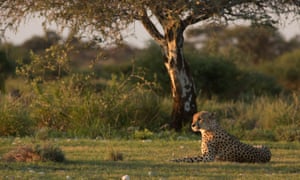
The Kgalagadi transfrontier park straddles Botswana and South Africa and is home to the cheetah and black-maned Kalahari lion.
The Kgalagadi transfrontier park straddles Botswana and South Africa and is home to the cheetah and black-maned Kalahari lion. Photograph: Jeffrey Barbee/Alliance Earth.org

The Botswana government has quietly sold the rights to frack for shale gas in one of Africa’s largest protected conservation areas, it has emerged.

The Kgalagadi transfrontier park, which spans the border with South Africa, is an immense 3 6,000 sq km wilderness, home to gemsbok desert antelope, black-maned Kalahari lions and pygmy falcons. But conservationists and top park officials – who were not informed of the fracking rights sale – are now worried about the impact of drilling on wildlife.

Prospecting licences for more than half of the park were granted to a UK-listed company called Nodding Donkey in September 2014, although the sale has not been reported previously. That company changed its name earlier this month to Karoo Energy.

Park officials said that no drilling has yet taken place, but the Guardian found oil sediment on the ground near a popular camp site. There was an overwhelming smell of tar and a drill stem protruded from an apparently recently drilled hole. It is not known who had carried out the drilling or when.
Scientist Gus Mills worked and lived in Kgalagadi for 18 years studying cheetahs and hyenas. He said he is worried about the impact on wildlife and environment.

“The development that is going to have to go on there, with infrastructure that has to be moved in, seems to be yet another nail in the coffin of wild areas in the world.”

Dr Peter Apps, who studies large predators for the Botswana Predator Conservation Trust , said drilling could have a range of impacts, notably on water sources in the park.


Read More Here

Tuesday, December 1, 2015

Wolves have returned to a large national park on the outskirts of Warsaw, decades after they were wiped out there.


File:Wolves in Kolmården.jpg
Vargar    Wikimedia.org
............................................................................................................

the guardian

Wolves return to Poland more than 50 years after being wiped out

National park outside Warsaw says several of the animals seem to have settled there again after government cull in the 1960s
Wolves have returned to a large national park on the outskirts of Warsaw, decades after they were wiped out there under a hunt launched by the communist authorities.

“We’re really happy,” said Magdalena Kamińska, spokeswoman for the 150sq mile (385sq km) Kampinos national park, Poland’s second largest. “The fact that wolves have returned to our park, from which they completely disappeared in the 1960s, means that nature is in good health and is renewing itself.”

Park employees spotted a first wolf in 2013, but the animal was just passing through. Now there are several and they appear to have settled in for the long haul, Kamińska said.


Read More Here

Wednesday, November 25, 2015

Plastics in the world's oceans, whether floating or resting at the bottom, is a problem that's on the rise, and is said to have "reached crisis proportion."


Published on
by

Biodegradable is Bunk: World's 'Ocean Waste Baskets' Still Filled With Plastic Trash

Such products 'will not bring about a significant decrease either in the quantity of plastic entering the ocean or the risk of physical and chemical impacts on the marine environment,' UN report states.
 
 
Pieces of plastic litter a black rock beach on the island of Hawaii in 2008.  (Photo: LCDR Eric Johnson, NOAA Corps./via flickr/cc)

Plastics in the world's oceans, whether floating or resting at the bottom, is a problem that's on the rise, and is said to have "reached crisis proportion."

And while they may be assumed to be more eco-friendly, plastics labeled "biodegradable" still pose a threat to marine environments, a new United Nations study has found.

The report from the UN Environment Programme (UNEP), Biodegradable Plastics and Marine Litter. Misconceptions, Concerns and Impacts on Marine Environments (pdf), explains how these products still fail to tackle the growing problem.

The agency's executive director, Achim Steiner, underscored the magnitude of the problem. "Recent estimates from UNEP have shown as much as 20 million tonnes of plastic end up in the world's oceans each year. Once in the ocean, plastic does not go away, but breaks down into microplastic particles."

The report notes that just what proportion of this plastic is biodegradable versus non-biodegradable has yet to be analyzed.

One of the problems, the report states, is that in order for some of the plastic debris to be completely broken down, conditions found in industrial compositing units that can achieve prolonged temperatures of above 50°C are needed. Yet those conditions "are rarely if ever met in the marine environment."

And while some have the inclusion of a pro-oxidant, which would induce degradation, "[t]he fate of these fragments (microplastics) is unclear, but it should be assumed that oxo-degradable polymers will add to the quantity of microplastics in the oceans, until overwhelming independent evidence suggests otherwise."

Contributing to the problem, the report says, is evidence suggesting the biodegradable label could make the public more likely to litter.

The report concludes that "the adoption of plastic products labelled as 'biodegradable' will not bring about a significant decrease either in the quantity of plastic entering the ocean or the risk of physical and chemical impacts on the marine environment, on the balance of current scientific evidence."
Peter Kershaw, one of the authors of the study, put the problem in blunt terms.

"Essentially the ocean is being used as a waste basket and the waste basket is getting fuller and fuller, and so the impacts of that plastic litter are just going to keep on increasing," he toldCBC News.


..........................................................................................................

California's ongoing drought has left millions of waterfowl that migrate from northern climes with fewer places to land, seek food.


VOA Voice of America

California Drought Affects Winter Refuges for Migratory Birds

 
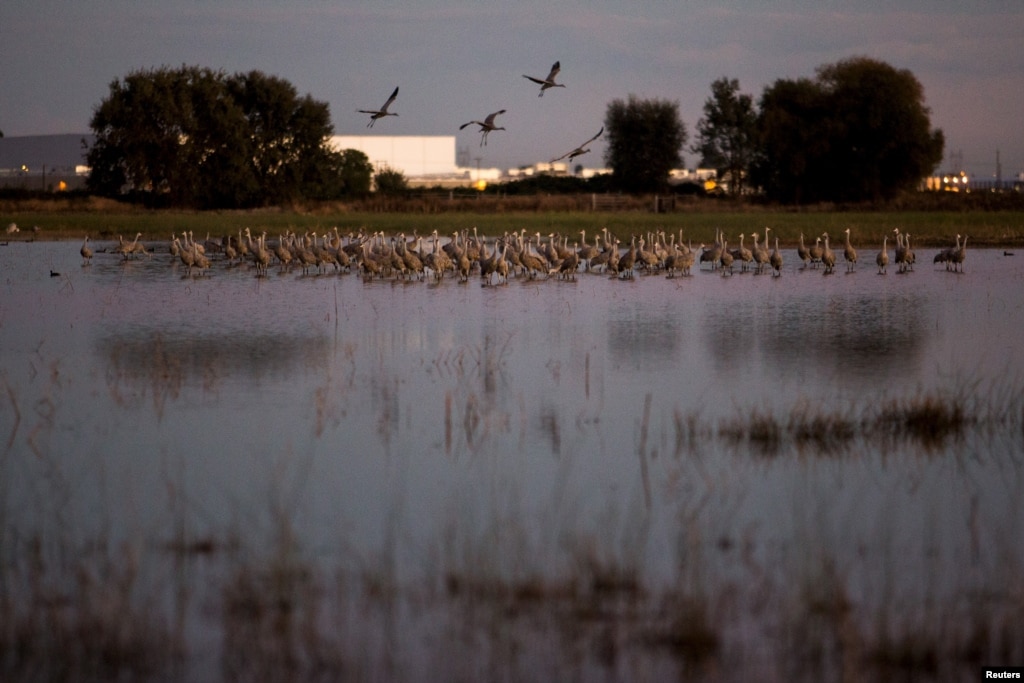
Sandhill cranes land in flooded fields at the Sandhill Crane Reserve near Thornton, California, Nov. 3, 2015. The state's ongoing drought has left millions of waterfowl that migrate from northern climes to California with fewer places to land, seek food.
 
 
Reuters
 
With their red heads, 2.13-meter (7-foot) wingspan and a trilling call, migrating Sandhill Cranes provide a dramatic sunset spectacle as they land by the thousands in wetlands near Sacramento each night during the fall and winter.

But the state's ongoing drought has left the cranes, along with millions of other waterfowl that migrate from Canada and other northern climes to spend the winter in California, with fewer places to land, threatening their health as they crowd in on one another to seek shelter and food.

"They're left with fewer and fewer places to go, which will start to have impacts on their population," said Meghan Hertel, who works on habitat issues for the Audubon Society in California. "They can die here from starvation or disease or be weaker for their flight back north."


Beloved sight


The cranes are a beloved sight in California's Sacramento and San Joaquin Valleys when they arrive each fall.

Tourists flock to see them as they take off en masse at dawn or land in a series of swooping, trilling groups as the sun goes down.


Read More Here


Related Articles

They are our closest living relatives in the animal kingdom, yet more than half of the world's primates are facing extinction due to our destruction of the habitats where they live.


Primates in peril: HALF of our closest living relatives are on the brink of extinction around the world

  • Scientists released a new report on the world's most endangered primates
  • The Hainan gibbon in China has just 25 individuals remaining in the wild
  • There are just 50 Northern sportive lemur left living in Madagascar
  • Scientists warn new efforts are needed to save many of these species
Danger list: Endangered primates that are battling for survival
They are our closest living relatives in the animal kingdom, yet more than half of the world's primates are facing extinction due to our destruction of the habitats where they live.
Burning and clearing of large areas of tropical forest, combined with hunting of primates for food and illegal wildlife trade, has placed many species of apes, lemurs and monkeys at risk of dying out.
These include iconic species such as the Sumatran orang-utan, Grauer's gorilla, the Northern brown howler monkey and the Hainan gibbon.
More than half of the world's primates are at risk of dying out due to the threat posed by habitat loss and hunting. The Hainan gibbon (pictured) is thought to be the world's most endangered primate, with just 25 of the animals left living on an isolated island in China
Scientists and conservation experts have now updated a report on the world's 25 most endangered primates based on the current knowledge of the animals numbers and the risks facing them.
Dr Christoph Schwitzer, a primatologist and director of conservation at Bristol Zoological Society who helped compile the list, said: 'This research highlights the extent of the danger facing many of the world's primates.

Read More Here

Tuesday, November 24, 2015

New reports indicate that Monarch Butterfly populations are actually beginning to grow again.


Monarch Butterfly Populations Are Rising Again After Years In Decline


New reports indicate that Monarch Butterfly populations are actually beginning to grow again.


Credit: Wikipedia
Credit: Wikipedia
.............................................................................................................


This year, we have published several stories about the dwindling monarch butterfly populations and some of the efforts that have been made to save the species. New reports last week have indicated that these efforts may actually be paying off, because Monarch populations are actually beginning to grow again. In Mexico, one of the main breeding areas for these butterflies, scientists believe that this year there will be at least three times as many of them this year than there was last year.
During a recent conference at the Piedra Herrada research reserve, U.S. Interior Secretary Sally Jewell said that Mexico and the US will be working together to create pesticide-free zones for the butterflies to flourish.

“Mexico, the U.S., and Canada have many species that don’t know our political borders, that cross the borders freely,” she said during a conference at the Piedra Herrada research reserve, adding that the three countries will be working together to rebuild the populations.

She told the audience that they hope to see “225 million monarch butterflies returning right here to Mexico every year. We believe we can get there by working together and it sounds like we may be on our way, we hope.”

“We are very glad to report that calculations done before the landfall of Hurricane Patricia showed the monarch presence could cover up to four hectares, a clear indication that the efforts mentioned by Secretary Jewell are having a positive effect,” Environment Secretary Rafael Pacchiano said.

“We estimate that the butterfly population that arrives at the reserve is as much as three and could reach four times the surface area it occupied last season,” he added.
For years, environmental experts have been warning about the steady decline of monarch butterfly populations. The causes of this decline have been largely speculation until recently, but a new report suggests that Monsanto’s herbicide Roundup Ready could be responsible.
 
The report was recently released by US environment watchdog Center for Food Safety and sheds new light on what has been happening with monarch butterfly populations.
According to the report, Monsanto’s herbicide has wiped out 99 percent of milkweed in corn and soybean fields in the US Midwest since 1999.
This has resulted in a decline of nearly 90 percent in monarch butterfly populations in the past 20 years.

Without the milkweed, the butterfly’s food supply is entirely cut out because caterpillars eat only milkweed plants, and then milkweed is needed again when it is time for the butterfly to lay their eggs.
Although this is a very serious problem, it is something that the average person can help to solve. Anyone with some space in their lawn or garden can plant milkweed to help reverse the trend that Monsanto started.
Below are some PDF guides which give you step by step instructions on how to plant milkweed and create habitats for monarch butterflies:
  1. Planting Native Milkweed Species
  2. Avoiding Non-Native Species
  3. Create Habitat for Monarchs
  4. Gardening for Monarchs
 

John Vibes is an author and researcher who organizes a number of large events including the Free Your Mind Conference. He also has a publishing company where he offers a censorship free platform for both fiction and non-fiction writers. You can contact him and stay connected to his work at his Facebook page. You can purchase his books, or get your own book published at his website www.JohnVibes.com. This article (Monarch Butterfly Populations Are Rising Again After Years In Decline) was made available via

True Activist

True Activist Exposing the truth one lie at a time

Saturday, November 21, 2015

Researchers have observed a chimpanzee looking after its ‘severely disabled’ daughter in Tanzania


The Telegraph


Wild chimpanzee observed caring for disabled infant in ‘first case of its kind’

Wild chimpanzee observed caring for disabled infant in ‘first case of its kind’
 
A wild chimp has been observed caring for its disabled daughter  Photo: AFP / Getty / Michio Nakamura
 
For the first time in the wild scientists claim to have observed a female chimpanzee caring for an infant with severe disabilities.
A team of researchers from Japan’s Kyoto University studied a mother providing care for her daughter living in the Mahale Mountains National Park in Tanzania over a two-year period.
The infant, known as XT11, was born at the park in 2011 and displayed symptoms resembling Down's syndrome seen in other chimps in captivity.
She lived for 23 months and researchers doubt she would have stayed alive for so long without the help and care of her mother and sister.
Michio Nakamura, an associate professor at the university, told the Japan Times: "She had a fish look and kept her mouth half-open, so we assumed she had some kind of mental handicap."
 
Scientists observed the chimps for nearly two years

"The observed infant exhibited symptoms resembling Down syndrome, similar to those reported previously for a captive chimpanzee," researchers found in the study detailed in the international journal, Primates.


Read More Here

Wednesday, November 18, 2015

Fukushima News 11/4/15: “Deadly” Radiation Levels Detected Outside Fukushima Reactor 2 Vessel


Thursday, October 1, 2015

Monsanto’s Cancer Causing Herbicide Doesn’t Even Work, Actually Makes Weeds Stronger


...............................................

 
grass-76069_640


As we have covered extensively in recent months, Monsanto’s herbicide Glysophate, the primary ingredient in their top-selling product “RoundUp” has been proven to cause cancer. Now, according to new reports, the chemical doesn’t even work and is creating a new resistance in weeds that make them more resiliant and more difficult to get rid of.

Nebraska farmer Mike Pietzyk recently discussed how the weeds are becoming resistant to RoundUp in a recent interview with Chemicals And Engineers News.

“The days of going out and spraying RoundUp twice a year—those are long gone,” he said, adding that he was forced to use a cocktail of different chemicals, some of which are even more dangerous than RoundUp. Pietzyk and other farmers are now seeking new solutions to avoid the harsh pesticides used in conventional farming.
 
“People in urban areas and towns need to understand—we live here, we drink the water under the ground out here,” he says. “We want to be good stewards of what we’ve been entrusted with,” he said.

According to U.S. weed scientist Dallas Peterson, one type of weed, in particular, called Palmer amaranth, has become especially resistant to pesticides and is overgrowing farms across the country.
Complaints of herbicide-resistant weeds have become so common that the House Agriculture Committee has scheduled a meeting on December 4th to specifically address the situation.

Roundup, formulated to be used on GMO or “Roundup Ready” crops engineered to be resistant to it, is the most widely used herbicide in the world. It was originally introduced in the 1970s to control weeds and then took off when the planting of GMO crops skyrocketed in the past 15 years.

According to a U.S. Geological Survey (USGS), glyphosate use in the U.S. increased from about 20 million pounds in 1992 to 110 million pounds in 2002 to more than 280 million pounds in 2012.
In a statement released earlier this year, the World Health Organization’s International Agency for Research on Cancer (IARC) announced that glyphosate, the main ingredient in RoundUp, is “probably carcinogenic.”


John Vibes writes for True Activist and is an author, researcher and investigative journalist who takes a special interest in the counter culture and the drug war.

Wednesday, September 23, 2015


SF Gate

The silence of the birds: When nature gets quiet, be very afraid


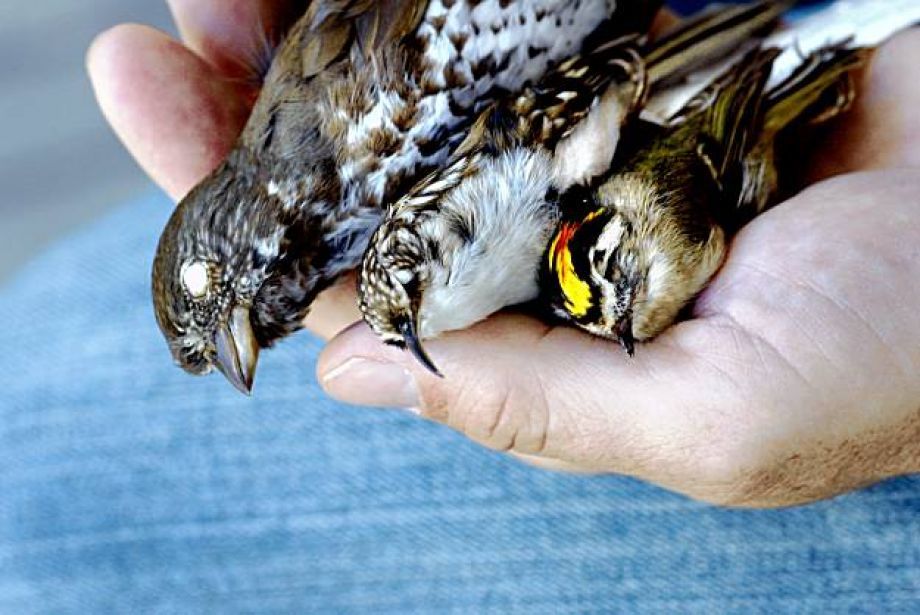
three_dead.jpg
Image 2 of 9 | The silence of the birds: Be afraid
Researchers say "the [destructive] changes in bird habitats and behavior between now and 2070 will equal the evolutionary and adaptive shifts that normally occur over tens of thousands of years." Yay humans!
Brutal wildfire images too much to bear? Fatigued by non-stop news of extreme weather, record-low snowpack, emaciated polar bears, unprecedented this and fast-receding that, a natural world that appears to be going more or less insane?
Maybe you need some quiet. Get outside, sit yourself down and let nature’s innate healing powers soothe your aching heart.
Sounds good, right? Sounds refreshing. Sounds… well, not quite right at all. Not anymore.
Have you heard? Or more accurately, not heard? Vicious fires and vanishing ice floes aside, there’s yet another ominous sign that all is not well with the natural world: it’s getting quiet out there. Too quiet.
Behold, this bit over in Outside magazine, profiling the sweet, touching life and times of 77-year-old bioacoustician and soundscape artist Bernie Kraus, author of “The Great Animal Orchestra” (2012), TED talker, ballet scorer, and a “pioneer in the field of soundscape ecology.”
Krause, last written about on SFGate back in 2007, is a man whose passion and profession has been making field recordings of the world’s “biophony” for going on 45 years, setting up his sensitive equipment in roughly the same places around the world to record nature’s (normally) stunningly diverse aural symphony – all the birds, bees, beavers, wolves, babbling streams, fluttering wings, the brush of trees and the rush of rivers – truly, the very pulse and thrum of life itself.

Read More Here